PCA Exam Questions & Answers Accurate 100%
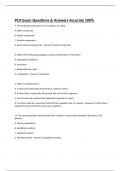
7. The nonliving components of an ecosystem are called: A. Biotic compounds B. Abiotic compounds C. Mineral components D. Environmental components - Answer B. Abiotic compounds 8. Which of the following ecological concepts is illustrated in a food web? A. Population equilibrium B. mutualism C. Biogeochemical cycles D. Competition - Answer B. mutualism 9. What is a limiting factor? A. A biotic factor that stops the growth of a plant of animal B. A factor that is required for the growth and survival of an organism C. One of many soil nutrients that regulates the growth of a plant D. An action made by a consumer that limits the population size of a species - Answer B. A factor that is required for the growth and survival of an organism 10. The mean population level around which a species' characteristic abundance fluctuates is the species? A. Density dependence B. Equilibrium position C. Population density D. Abundance level - Answer B. Equilibrium position 11. Many agricultural pest species such as foliar pathogens, aphids, mites and small seeded weeds are considered: A. S strategists B. K strategists C. R strategists D. C strategists - Answer C. R strategists 12. In general, how does the amount of biodiversity in an agroecosystem compare to that of a natural, more mature ecosystem? Biodiversity level is: A. Equal among most ecosystems B. Lower in an agroecosystem than a natural system C. Higher in an agroecosystem than a natural system D. Not measureable in agroecosystems - Answer B. Lower in an agroecosystem than a natural system 13. The goal of pest eradication is generally: A. To eliminate newly invading pests B. Aimed a eliminating exotic pests from a given county C. To reduce existing pest populations D. To discourage damaging pest populations form occurring in a given area - Answer A. To eliminate newly invading pests 14. Secondary pests are pests that: A. Damage crop plants but do not kill them B. Become prevalent after control actions have been taken to control key pests C. Damage the crop plant but do not damage the harvested part D. Harm crop plants but never cause enough damage to be economically important - Answer B. Become prevalent after control actions have been taken to control key pests 15. What is the relationship between a treatment threshold and an economic injury level? A. A treatment threshold is always higher than the economic injury level B. An economic injury level is always higher than the treatment threshold C. Economic injury levels are equal to treatment thresholds D. Economic injury levels have been determined for all classes of pests buy treatment thresholds have not. - Answer B. An economic injury level is always higher than the treatment threshold 16. What is the "aesthetic injury level"? A. The population level of a pest at which foliar damage will occur B. The level at which pest damage of pest populations on a ornamental plant become intolerable to the general public C. The time at which damage caused by populations of pests on an ornamental plant will exceed the cost of controlling them D. The lowest acceptable level of damage that the general public will tolerate on harvest fruit - Answer B. The level at which pest damage of pest populations on a ornamental plant become intolerable to the general public 17. Populations of some pests in most ecosystems are under partial biological control: IPM programs take advantage of this fact by. A. Using inundative and inoculative release of NE B. Increasing control tactics that reduce habitat diversity so biocontrol agents can find their hosts C. Reducing the use of broad-spec pesticides to conserve naturally occurring populations of predators and parasites D. Using resistant host plants to prevent damage - Answer C. Reducing the use of broad-spec pesticides to conserve naturally occurring populations of predators and parasites 18. Water holding capacity, texture, pH and CEC are all characteristics of ______ that influence pest development. A. Fertilizers B. Pesticides C. Foliage D. Soil - Answer D. Soil 19. Some soil-applied herbicides become tightly bound and cease to function in which type of soil? A. Wet, sandy soil B. Soil with high organic matter content C. Coarse textured soil with low organic matter content D. Dry clay soil - Answer B. Soil with high organic matter content 20. Reliance on multiple tactics for pest control: A. Is not recommended as it requires a very high level of knowledge of plant and pest biology B. Works of all cropping systems and any set of control measures C. Increase the complexity of the agroecosystem D. Increase the effectiveness of pest management - Answer D. Increase the effectiveness of pest management 21. Identification of pests to scientific name is important for all of the following reasons except: A. To refer to the list of organisms controlled by a pesticide on a pesticide label B. To standardize the naming of organisms on a world-wide basis C. To determine if the pest in question is the same genus as a pest in another area of the state D. In order to discern how closely organisms are related to one another - Answer C. To determine if the pest in question is the same genus as a pest in another area of the state 22. When sending samples to a lab for testing identification samples should be: A. Stored in cool water, but not frozen B. Kept frozen C. Packed in clean plastic bags and kept cool D. Dried and packed in clean plastic bags - Answer C. Packed in clean plastic bags and kept cool 23. Arthropoda is a phylum of invertebrates which includes A. Insects, spiders, nematodes and snails B. Insects, symphylans, termites, slugs and snails C. Insects, centipedes, millipedes and mollusks D. Insects, spiders, mites and crustaceans - Answer D. Insects, spiders, mites and crustaceans 24. Which of the following organs is unique to spiders A. Idiosomas B. Spinnerets C. Chelicerae D. Cuneus - Answer C. Chelicerae 25. Which of these insects damages plants primarily by feeding on foliage? A. Lacewings B. Katydids C. Caddisflies D. Springtails - Answer B. Katydids 26. The brown garden snail, helix aspersa, belongs to which phylum? A. Gastropoda B. Arthropoda C. Nemata D. Mollusca - Answer D. Mollusca 27. Which of the following are typical aboveground symptoms of plant parasitic nematodes? A. Defoliation and wig dieback B. Plant death C. Foliar and stem wilting, stunting and chlorosis D. All of the above - Answer C. Foliar and stem wilting, stunting and chlorosis
Written for
- Institution
- Pca
- Course
- Pca
Document information
- Uploaded on
- October 7, 2023
- Number of pages
- 18
- Written in
- 2023/2024
- Type
- Exam (elaborations)
- Contains
- Questions & answers
Subjects
- pca exam stuvia
-
pca exam questions answers accurate 100
-
7 the nonliving components of an ecosystem are ca
-
8 which of the following ecological concepts is i

Document also available in package deal