

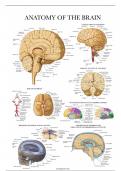
, Overview Neuropsychology sorted by location
Forebrain
Major structure: left & right hemisphere. Responsible for most higher order functions (C11).
Cortex: Cerebral Cortex / Neocortex
Cerebral cortex = gray matter, the outer most layer of tissue.
The cerebral cortex is a thin sheet composed of 6 layers of nerve cells folded many times to
fit inside the skull responsible for regulation various mental activities.
Stimulated with electrical signals by Penfield during neurosurgery.
Has a part in components of emotion: cognitions (thought about experience).
One of the brain principles: “Sensory and motor division exist throughout the nervous
system at all kind of different levels, for example in the spinal cord and the neocortex.
Sensory and motor divisions in the Somatic and Central Nervous System.”
Sensory coding & representation: The neocortex represents the sensory field of each
modality – vision, hearing, touch, smell or taste – as a spatially organized neural
representation of the external world.
CC gives input to basal ganglia.
Allocortex
Evolutionary older part of cortex (also present in simpler brains) consiting of 3 or 4 layers of
nerve cells present in structures of the limbic system (in cingulate cortex, hippocampus,
amygdale) as well as structures related to the olfactory system.
Cingulate cortex: controlling motivational states, attention, self monitoring.
- Anterior cingulate cortex: both regulates and is regulated by the
amygdala – higher level cognitive interpretation of emotional situations
Cortex in the limbic system is referred to as allocortex.
Lobes (of the cerebral cortex)
Both hemispheres got four lobes: frontal, parietal, temporal, occipital.
Frontal lobe/cortex
Speech, initiates muscle movement, planning, decision making, EF.
Unique aspects of frontal lobe development
- Frontal lobe is among the last brain regions to mature
- Maturation extends far beyond age 20
Adolescents have a disbalance between frontal and subcortical
reward regions. So the real issue with the risk taking in
adolescents is the disbalance.
,- Frontal cortex develops very late, and striatum develops very early.
- Striatum = knowing where to get the rewards and know what turns them on.
- PFC= is brake on our behavior, know when to stop / planning.
- Drive is matured, brake is not matured. = risk taking behaviour.
Neural basis of addiction: control over substance use → frontal cortex (but not so simple).
Critical in emotional and motivational behavior / neuroanatomy of emotion and
motivation
- Part of components of emotion: subjective feelings (fear) – frontal lobes & amygdala.
- Involved in non-regulatory motivated behavior (sexual, parental, aggression, food
preference, curiosity, reading).
- Ventral prefrontal cortex & orbitofrontal cortex: anticipation of emotional events / low
level cognitive interpretation
Factors involved in controlling hypothalamic hormone related activity:
- Neural regulation: other brain regions (limbic system & frontal lobes) influence hormone
release (milk production is easier when they look at the baby , crying of the baby can
stimulate milk production/preparation)(stress/anxiety → milk production is reduced
Frontal lobes get projections from amygdala.
Part of neural circuit for explicit memory.
Episodic amnesia: associated with frontal lobe injuries or reduced blood flow to frontal
lobes.
Association cortices: The frontal cortex coordinates information coming from the parietal
and temporal regions, making judgements, plans, strategies, solving motivated problems
Deficits in attention
- Frontal association cortex: damage can lead to focusing excessively on external stimuli
and difficulty shifting attention (highest part of brain, higher order function)
, Prefrontal cortex (director of the brain)
Emotion regulation by the prefrontal cortex: Reappraisal,
reinterpretation, self-monitoring, inhibitory control,
distraction, attentional biases, denial or suppression of
information.
Receives connections from the amygdala, the dorsomedial
thalamus, the posterior parietal (sensory association)
cortex, and the dopaminergic cells of the ventral tegmental
area
➔ Dopaminergic input influences how prefrontal
neurons react to stimuli, especially emotionally
arousing stimuli
Prefrontal emotional functions
- Act much like a composer, selecting our actions
- Frontal lobes are sometimes described as housing the
brain’s executive functions
• Plays a role in specifying goals and developing plans to achieve them
• Appraises emotional significance / expectations → emotion regulation
• Supports the selection of action plans that are appropriate for the particular situation
• Controls the processes by which we select movements that are appropriate for the
particular time an context
◼ May be cued by internal information (such as memory and emotion) or it may be
made in response to context (environmental information)
Executive function of frontal lobes
Prefrontal cortex and emotional behavior
- Damage to the prefrontal cortex was severe effects on social
and emotional behavior
- For example:
• Inability to experience/express/recognise
emotions
• Loss of inhibitory control
• Apathy and loss of initiative or drive
Forebrain
Major structure: left & right hemisphere. Responsible for most higher order functions (C11).
Cortex: Cerebral Cortex / Neocortex
Cerebral cortex = gray matter, the outer most layer of tissue.
The cerebral cortex is a thin sheet composed of 6 layers of nerve cells folded many times to
fit inside the skull responsible for regulation various mental activities.
Stimulated with electrical signals by Penfield during neurosurgery.
Has a part in components of emotion: cognitions (thought about experience).
One of the brain principles: “Sensory and motor division exist throughout the nervous
system at all kind of different levels, for example in the spinal cord and the neocortex.
Sensory and motor divisions in the Somatic and Central Nervous System.”
Sensory coding & representation: The neocortex represents the sensory field of each
modality – vision, hearing, touch, smell or taste – as a spatially organized neural
representation of the external world.
CC gives input to basal ganglia.
Allocortex
Evolutionary older part of cortex (also present in simpler brains) consiting of 3 or 4 layers of
nerve cells present in structures of the limbic system (in cingulate cortex, hippocampus,
amygdale) as well as structures related to the olfactory system.
Cingulate cortex: controlling motivational states, attention, self monitoring.
- Anterior cingulate cortex: both regulates and is regulated by the
amygdala – higher level cognitive interpretation of emotional situations
Cortex in the limbic system is referred to as allocortex.
Lobes (of the cerebral cortex)
Both hemispheres got four lobes: frontal, parietal, temporal, occipital.
Frontal lobe/cortex
Speech, initiates muscle movement, planning, decision making, EF.
Unique aspects of frontal lobe development
- Frontal lobe is among the last brain regions to mature
- Maturation extends far beyond age 20
Adolescents have a disbalance between frontal and subcortical
reward regions. So the real issue with the risk taking in
adolescents is the disbalance.
,- Frontal cortex develops very late, and striatum develops very early.
- Striatum = knowing where to get the rewards and know what turns them on.
- PFC= is brake on our behavior, know when to stop / planning.
- Drive is matured, brake is not matured. = risk taking behaviour.
Neural basis of addiction: control over substance use → frontal cortex (but not so simple).
Critical in emotional and motivational behavior / neuroanatomy of emotion and
motivation
- Part of components of emotion: subjective feelings (fear) – frontal lobes & amygdala.
- Involved in non-regulatory motivated behavior (sexual, parental, aggression, food
preference, curiosity, reading).
- Ventral prefrontal cortex & orbitofrontal cortex: anticipation of emotional events / low
level cognitive interpretation
Factors involved in controlling hypothalamic hormone related activity:
- Neural regulation: other brain regions (limbic system & frontal lobes) influence hormone
release (milk production is easier when they look at the baby , crying of the baby can
stimulate milk production/preparation)(stress/anxiety → milk production is reduced
Frontal lobes get projections from amygdala.
Part of neural circuit for explicit memory.
Episodic amnesia: associated with frontal lobe injuries or reduced blood flow to frontal
lobes.
Association cortices: The frontal cortex coordinates information coming from the parietal
and temporal regions, making judgements, plans, strategies, solving motivated problems
Deficits in attention
- Frontal association cortex: damage can lead to focusing excessively on external stimuli
and difficulty shifting attention (highest part of brain, higher order function)
, Prefrontal cortex (director of the brain)
Emotion regulation by the prefrontal cortex: Reappraisal,
reinterpretation, self-monitoring, inhibitory control,
distraction, attentional biases, denial or suppression of
information.
Receives connections from the amygdala, the dorsomedial
thalamus, the posterior parietal (sensory association)
cortex, and the dopaminergic cells of the ventral tegmental
area
➔ Dopaminergic input influences how prefrontal
neurons react to stimuli, especially emotionally
arousing stimuli
Prefrontal emotional functions
- Act much like a composer, selecting our actions
- Frontal lobes are sometimes described as housing the
brain’s executive functions
• Plays a role in specifying goals and developing plans to achieve them
• Appraises emotional significance / expectations → emotion regulation
• Supports the selection of action plans that are appropriate for the particular situation
• Controls the processes by which we select movements that are appropriate for the
particular time an context
◼ May be cued by internal information (such as memory and emotion) or it may be
made in response to context (environmental information)
Executive function of frontal lobes
Prefrontal cortex and emotional behavior
- Damage to the prefrontal cortex was severe effects on social
and emotional behavior
- For example:
• Inability to experience/express/recognise
emotions
• Loss of inhibitory control
• Apathy and loss of initiative or drive


