NREMT CRASH COURSE QUESTIONS WITH CORRECT ANSWERS GRADED TO PASS
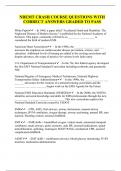
White Paper - In 1966, a paper titled "Accidental Death and Disability: The Neglected Disease of Modern Society" is published by the National Academy of Sciences. This paper, commonly referred to as ________ __________ is considered the birth of modern EMS American Heart Association - In the 1980s, the ______ ______ ________ increases the emphasis on cardiovascular disease prevention, science, and education. Additional levels of training are added to the existing curriculum and despite advances, the scope of practice for various levels lacks unity. U.S. Department of Transportation - In the 70s, this federal agency developed the first EMT National Standard Curriculum including textbooks and paramedic NSC National Registry of Emergency Medical Technicians; National Highway Transportation Safety Administration - In the 1990s, the _____ ____ ___ ___ ___ ___ advocates for the creation of a national training curriculum and the _______ ___ ____ ___ ___ begins work on the EMS Agenda for the Future National EMS Education Standards (NEMSES) - In the 2000s, the NHTSA identifies universal knowledge and skills for EMS professionals through the new _________ ________ ______ __________. This new curriculum replaces the National Standard Curricula created by USDOT. EMR - CPR, AED, Oral airways, airway obstruction, manual airway techniques, BVM ventilation, oxygen therapy, airway suctioning, manual BP, auto injector, bleeding control, assisted childbirth EMT - EMR skills + humidified oxygen, venturi mask, automated transport ventilators, nasal airways, pulse oximetry, auto BP, assisted medications, spinal immobilization, splinting, tourniquet, MAST/PASG, mechanical CPR, assisted complicated childbirth AEMT - EMT skills + multilumen airways, blood glucose monitoring, IV/IO insertion, medication administration Paramedic - AEMT skills + BiPap/CPAP, needle decompression, percutaneous cricothyrotomy, ETCO2/capnography, NG/OG tube, intubation, direct laryngoscopy, PEEP, ECG interpretation, manual defibrillation/cardioversion, transcutaneous external pacing, extensive medication administration, thrombolytic therapy Scene safety - What is an EMT's first priority ALWAYS? Acute stress - an immediate physiological and psychological reaction to a specific event. The event triggers the body's fight or flight response Delayed stress - a stress reaction that develops after the stressful event. It does not interfere with the EMT's ability to perform during the stressful event. Posttraumatic stress disorder (PTSD) is an example of ________ _______ Cumulative stress - the result of exposure to stressful situations over a prolonged period of time. This leads to burnout for many EMTs. Critical Incident Stress Management (CISM) - is a formalized process to help emergency workers deal with stress - diffusing sessions are held within 4 hours of the incident - debriefing sessions are held 24 to 72 hours after the incident Occupational Safety and Health Administration - oversees regulations concerning workplace safety, including infectious disease precautions Minimum PPE - Gloves and eye protection should be used during any patient contact situation and are examples of... Expanded PPE - The use of disposable gown and mask for significant contact with body fluids. Use a high-efficiency particulate air (HEPA) mask or a N-95 respirator for suspected airborne disease exposure, such as tuberculosis not enter; emergency care - Unless cleared by a hazmat specialist, an EMT is expected to _____ ______ and not begin _______ ______ until patients have been decontaminated or otherwise cleared by hazmat crews not enter; safe distance - When it comes to crime scenes, EMS providers should ____ ______ a crime scene unless law enforcement has determined it is safe. EMS providers may be advised to respond to the call but maintain a _____ _______ away until cleared by law enforcement. This is sometimes called "staging for PD" highly reflective traffic safety vest - In extrication situations, federal law requires EMS workers wear approved _______ ______ ____ ____ ______ when working on roadways, around traffic, or at an accident scene Power lift - A method of lifting where one keeps the object close to the body, using the legs to lift and not the back (legs bent, back straight). Use a power grip with palms UP and all fingers wrapped around the object. Urgent move - the patient has a potentially life-threatening injury or illness and must be moved quickly for evaluation and transport includes rapid extrication Rapid extrication - an urgent move used for patients in a motor vehicle; it requires multiple rescuers and a long backboard. The patient is rotated onto a backboard with manual cervical spine precautions and removed from the vehicle Non-urgent moves - used when there are no hazards and no life-threatening conditions apparent. includes direct ground lift, extremity lift, direct carry method, and draw sheet method Log roll technique - commonly used to place a patient on a backboard or assess the posterior, can be done while maintaining manual cervical spine precautions should have at least 3 trained personnel Stair-chair - excellent for staircases, small elevators, etc. Does not allow for manual cervical spine protection, CPR, or artificial ventilation Backboard - used primarily for cervical spine immobilization, allows for CPR and artificial ventilation. requires 4 people scoop stretcher - allows for easy positioning with minimal patient movement. good for reducing patient discomfort during movement rear - when approaching a helicopter, never approach from the left - if the patient is pregnant and needs to be on a backboard, they should be placed on the ___ side
Written for
- Institution
- NREMT
- Course
- NREMT
Document information
- Uploaded on
- October 4, 2023
- Number of pages
- 55
- Written in
- 2023/2024
- Type
- Exam (elaborations)
- Contains
- Questions & answers
Subjects
- nremt crash course
- nremt
-
nremt crash course questions

Also available in package deal