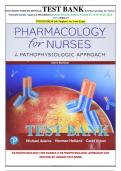
SOLUTIONS WITH RATIONALE TEST BANK for Pharmacology for Nurses
Pathophysiologic Approach 6th Edition byAdams Michael, Holland Norman & Caroll Urban (April
2019), ISBN-13
978-0135218334/ All Chapters/ Ace Your Exam
k for
Pharmacology for Nurses A PathophysiologicApproach 6th Edition by Adams
PATHOPHYSIOLOGY FOR NURSES A PATHOPHYSIOLOGIC APPROACH 6TH
EDITION BY ADAMS TEST BANK
TopRankProf©Files PLC
,Pharmacology for Nurses: A Pathophysiological Approach 6 th Edition
Adams, Pharmacology for Nurses: A Pathophysiologic
Approach,6/E
Chapter 1: Introduction to Pharmacology
1) A nurse is reviewing key events in the history of
pharmacology with a student nurse.
Whichstudent comment indicates an understanding?
1. "Early researchers used themselves as test subjects."
2. "A primary goal of pharmacology is to prevent disease."
3. "Penicillin is one of the initial drugs isolated from a natural source."
4. "Pharmacologists began synthesizing drugs in the laboratory in the nineteenth century."
Answer: 1 Explanation:
1. Some early researchers, like Friedrich Serturner, used themselves as test subjects.
2. An early goal of pharmacology was to relieve human suffering.
3. Initial drugs isolated from complex mixtures included morphine, colchicine, curare, and
cocaine, but not penicillin.
4. By the twentieth century, pharmacologists could synthesize drugs in the laboratory.
Page Ref: 3
Cognitive Level: Applying
Client Need/Sub: Physiological Integrity: Pharmacological and Parenteral Therapies Standards:
QSEN Competencies: I.A.1 Integrate understanding of multiple dimensions of patient-centered
care: patient/family/community preferences, values; coordination and integration of care;
information, communication, and education; physical comfort and emotional support;
involvement of family and friends; and transition and continuity. | AACN Essential
Competencies: I.7 Integrate the knowledge and methods of a variety of disciplines to inform
decision making. | NLN Competencies: Knowledge and Science: Integration of knowledge
fromnursing and other disciplines. | Nursing/Integrated Concepts: Nursing Process:
Evaluation
Learning Outcome: 1-1 Identify key events in the history of pharmacology.
MNL Learning Outcome: 1.1 Examine the relationship between medicine and pharmacology.
2) A student nurse asks a nursing instructor why anatomy and physiology as well as
microbiology are required courses when the student only wants to learn about
pharmacology. What is the best response by the instructor? 1. "Because
pharmacology is an outgrowth of those subjects."
2. "You must learn all, since all of those subjects are part of the curriculum."
3. "Knowledge of all those subjects will prepare you to administer medication."
4. "An understanding of those subjects is essential to understand pharmacology."
Answer: 4
1
Trinity Test banks
,Pharmacology for Nurses: A Pathophysiological Approach 6 th Edition
Explanation:
1. Pharmacology is an outgrowth of anatomy, physiology, and microbiology, but this is not
the most essential reason for the nurse to learn them.
2. The nurse must learn anatomy, physiology, and microbiology to understand
pharmacology, not because they are part of the curriculum.
3. Knowledge of anatomy, physiology, and microbiology prepares the nurse to understand
pharmacology, not to provide care such as administration of medications.
4. It is essential for the nurse to have a broad knowledge base of many sciences in order to
learn pharmacology.
Page Ref: 3
Cognitive Level: Applying
Client Need/Sub: Physiological Integrity: Pharmacological and Parenteral Therapies Standards:
QSEN Competencies: I.A.1 Integrate understanding of multiple dimensions of patient-centered
care: patient/family/community preferences, values; coordination and integration of care;
information, communication, and education; physical comfort and emotional support;
involvement of family and friends; and transition and continuity. | AACN Essential
Competencies: I.7 Integrate the knowledge and methods of a variety of disciplines to inform
decision making. | NLN Competencies: Knowledge and Science: Integration of knowledge
fromnursing and other disciplines. | Nursing/Integrated Concepts: Nursing Process:
Implementation
Learning Outcome: 1-2 Explain the interdisciplinary nature of pharmacology, giving an example
of how knowledge from different sciences impacts the nurse's role in drug administration. MNL
Learning Outcome: 1.1 Examine the relationship between medicine and pharmacology.
3) A nurse is teaching a group of nurses about the differences between pharmacology and
therapeutics. The nurse determines that learning has occurred when which statements are
made?
Note: Credit will be given only if all correct choices and no incorrect choices are selected. Select
all that apply.
1. "Pharmacology is the development of medicines."
2. "Pharmacology is the study of medicines."
3. "Therapeutics relates to drug use to treat suffering."
4. "Therapeutics is the study of drug interactions."
5. "Pharmacology is the study of drugs to prevent disease." Answer: 2, 3, 5
Explanation:
1. Pharmacology is not the development of medicines.
2. Pharmacology is the study of medicines.
3. Therapeutics is the use of drugs in the treatment of suffering.
4. Therapeutics is not related to study of drug interactions.
5. Pharmacotherapy is the application of drugs for the purpose of disease prevention.
2
Trinity Test banks
, Pharmacology for Nurses: A Pathophysiological Approach 6 th Edition
Page Ref: 4
Cognitive Level: Applying
Client Need/Sub: Physiological Integrity: Pharmacological and Parenteral Therapies Standards:
QSEN Competencies: I.A.1 Integrate understanding of multiple dimensions of patient-centered
care: patient/family/community preferences, values; coordination and integration of care;
information, communication, and education; physical comfort and emotional support;
involvement of family and friends; and transition and continuity. | AACN Essential
Competencies: I.7 Integrate the knowledge and methods of a variety of disciplines to inform
decision making. | NLN Competencies: Knowledge and Science: Integration of knowledge
fromnursing and other disciplines. | Nursing/Integrated Concepts: Nursing Process:
Evaluation
Learning Outcome: 1-3 Compare and contrast therapeutics and pharmacology.
MNL Learning Outcome: 1.1 Examine the relationship between medicine and pharmacology.
4) A nurse administers a vaccine to a client. What is the nurse's best understanding as it relates to
the manufacture of a vaccine?
1. The vaccine is produced by natural plant extracts in the laboratory.
2. The vaccine is naturally produced in animal cells or microorganisms.
3. The vaccine is produced by a combination of animal and plant products.
4. The vaccine is most commonly synthesized in a laboratory. Answer: 2
Explanation:
1. Vaccines are not produced by natural plant extracts.
2. Vaccines are naturally produced in animal cells, microorganisms, or by the body itself.
3. Vaccines are not produced by a combination of animal and plant products.
4. Vaccines are not synthesized in a laboratory.
Page Ref: 4
Cognitive Level: Applying
Client Need/Sub: Physiological Integrity: Pharmacological and Parenteral Therapies
Standards: QSEN Competencies: III.A.1 Demonstrate knowledge of basic scientific methods
and processes. | AACN Essential Competencies: IX.3 Implement holistic, patient-centered care
that reflects an understanding of human growth and development, pathophysiology,
pharmacology, medical management, and nursing management across the health-illness
continuum, across lifespan, and in all healthcare settings. | NLN Competencies: Knowledge and
Science: Integration of knowledge from nursing and other disciplines. | Nursing/Integrated
Concepts: Nursing Process: Evaluation
Learning Outcome: 1-4 Compare and contrast traditional drugs, biologics, and complementary
and alternative medicine therapies.
MNL Learning Outcome: 1.1 Examine the relationship between medicine and pharmacology.
3
Trinity Test banks
Pathophysiologic Approach 6th Edition byAdams Michael, Holland Norman & Caroll Urban (April
2019), ISBN-13
978-0135218334/ All Chapters/ Ace Your Exam
k for
Pharmacology for Nurses A PathophysiologicApproach 6th Edition by Adams
PATHOPHYSIOLOGY FOR NURSES A PATHOPHYSIOLOGIC APPROACH 6TH
EDITION BY ADAMS TEST BANK
TopRankProf©Files PLC
,Pharmacology for Nurses: A Pathophysiological Approach 6 th Edition
Adams, Pharmacology for Nurses: A Pathophysiologic
Approach,6/E
Chapter 1: Introduction to Pharmacology
1) A nurse is reviewing key events in the history of
pharmacology with a student nurse.
Whichstudent comment indicates an understanding?
1. "Early researchers used themselves as test subjects."
2. "A primary goal of pharmacology is to prevent disease."
3. "Penicillin is one of the initial drugs isolated from a natural source."
4. "Pharmacologists began synthesizing drugs in the laboratory in the nineteenth century."
Answer: 1 Explanation:
1. Some early researchers, like Friedrich Serturner, used themselves as test subjects.
2. An early goal of pharmacology was to relieve human suffering.
3. Initial drugs isolated from complex mixtures included morphine, colchicine, curare, and
cocaine, but not penicillin.
4. By the twentieth century, pharmacologists could synthesize drugs in the laboratory.
Page Ref: 3
Cognitive Level: Applying
Client Need/Sub: Physiological Integrity: Pharmacological and Parenteral Therapies Standards:
QSEN Competencies: I.A.1 Integrate understanding of multiple dimensions of patient-centered
care: patient/family/community preferences, values; coordination and integration of care;
information, communication, and education; physical comfort and emotional support;
involvement of family and friends; and transition and continuity. | AACN Essential
Competencies: I.7 Integrate the knowledge and methods of a variety of disciplines to inform
decision making. | NLN Competencies: Knowledge and Science: Integration of knowledge
fromnursing and other disciplines. | Nursing/Integrated Concepts: Nursing Process:
Evaluation
Learning Outcome: 1-1 Identify key events in the history of pharmacology.
MNL Learning Outcome: 1.1 Examine the relationship between medicine and pharmacology.
2) A student nurse asks a nursing instructor why anatomy and physiology as well as
microbiology are required courses when the student only wants to learn about
pharmacology. What is the best response by the instructor? 1. "Because
pharmacology is an outgrowth of those subjects."
2. "You must learn all, since all of those subjects are part of the curriculum."
3. "Knowledge of all those subjects will prepare you to administer medication."
4. "An understanding of those subjects is essential to understand pharmacology."
Answer: 4
1
Trinity Test banks
,Pharmacology for Nurses: A Pathophysiological Approach 6 th Edition
Explanation:
1. Pharmacology is an outgrowth of anatomy, physiology, and microbiology, but this is not
the most essential reason for the nurse to learn them.
2. The nurse must learn anatomy, physiology, and microbiology to understand
pharmacology, not because they are part of the curriculum.
3. Knowledge of anatomy, physiology, and microbiology prepares the nurse to understand
pharmacology, not to provide care such as administration of medications.
4. It is essential for the nurse to have a broad knowledge base of many sciences in order to
learn pharmacology.
Page Ref: 3
Cognitive Level: Applying
Client Need/Sub: Physiological Integrity: Pharmacological and Parenteral Therapies Standards:
QSEN Competencies: I.A.1 Integrate understanding of multiple dimensions of patient-centered
care: patient/family/community preferences, values; coordination and integration of care;
information, communication, and education; physical comfort and emotional support;
involvement of family and friends; and transition and continuity. | AACN Essential
Competencies: I.7 Integrate the knowledge and methods of a variety of disciplines to inform
decision making. | NLN Competencies: Knowledge and Science: Integration of knowledge
fromnursing and other disciplines. | Nursing/Integrated Concepts: Nursing Process:
Implementation
Learning Outcome: 1-2 Explain the interdisciplinary nature of pharmacology, giving an example
of how knowledge from different sciences impacts the nurse's role in drug administration. MNL
Learning Outcome: 1.1 Examine the relationship between medicine and pharmacology.
3) A nurse is teaching a group of nurses about the differences between pharmacology and
therapeutics. The nurse determines that learning has occurred when which statements are
made?
Note: Credit will be given only if all correct choices and no incorrect choices are selected. Select
all that apply.
1. "Pharmacology is the development of medicines."
2. "Pharmacology is the study of medicines."
3. "Therapeutics relates to drug use to treat suffering."
4. "Therapeutics is the study of drug interactions."
5. "Pharmacology is the study of drugs to prevent disease." Answer: 2, 3, 5
Explanation:
1. Pharmacology is not the development of medicines.
2. Pharmacology is the study of medicines.
3. Therapeutics is the use of drugs in the treatment of suffering.
4. Therapeutics is not related to study of drug interactions.
5. Pharmacotherapy is the application of drugs for the purpose of disease prevention.
2
Trinity Test banks
, Pharmacology for Nurses: A Pathophysiological Approach 6 th Edition
Page Ref: 4
Cognitive Level: Applying
Client Need/Sub: Physiological Integrity: Pharmacological and Parenteral Therapies Standards:
QSEN Competencies: I.A.1 Integrate understanding of multiple dimensions of patient-centered
care: patient/family/community preferences, values; coordination and integration of care;
information, communication, and education; physical comfort and emotional support;
involvement of family and friends; and transition and continuity. | AACN Essential
Competencies: I.7 Integrate the knowledge and methods of a variety of disciplines to inform
decision making. | NLN Competencies: Knowledge and Science: Integration of knowledge
fromnursing and other disciplines. | Nursing/Integrated Concepts: Nursing Process:
Evaluation
Learning Outcome: 1-3 Compare and contrast therapeutics and pharmacology.
MNL Learning Outcome: 1.1 Examine the relationship between medicine and pharmacology.
4) A nurse administers a vaccine to a client. What is the nurse's best understanding as it relates to
the manufacture of a vaccine?
1. The vaccine is produced by natural plant extracts in the laboratory.
2. The vaccine is naturally produced in animal cells or microorganisms.
3. The vaccine is produced by a combination of animal and plant products.
4. The vaccine is most commonly synthesized in a laboratory. Answer: 2
Explanation:
1. Vaccines are not produced by natural plant extracts.
2. Vaccines are naturally produced in animal cells, microorganisms, or by the body itself.
3. Vaccines are not produced by a combination of animal and plant products.
4. Vaccines are not synthesized in a laboratory.
Page Ref: 4
Cognitive Level: Applying
Client Need/Sub: Physiological Integrity: Pharmacological and Parenteral Therapies
Standards: QSEN Competencies: III.A.1 Demonstrate knowledge of basic scientific methods
and processes. | AACN Essential Competencies: IX.3 Implement holistic, patient-centered care
that reflects an understanding of human growth and development, pathophysiology,
pharmacology, medical management, and nursing management across the health-illness
continuum, across lifespan, and in all healthcare settings. | NLN Competencies: Knowledge and
Science: Integration of knowledge from nursing and other disciplines. | Nursing/Integrated
Concepts: Nursing Process: Evaluation
Learning Outcome: 1-4 Compare and contrast traditional drugs, biologics, and complementary
and alternative medicine therapies.
MNL Learning Outcome: 1.1 Examine the relationship between medicine and pharmacology.
3
Trinity Test banks