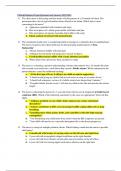
UWorld Pediatrics Exam Questions and Answers 2023/2024
1. The clinic nurse is discussing nutrition needs with the parents of a 10-month-old client. The parent provides a list of typical breakfast items offered to the infant. Which item is most concerning to the nurse? a. Applesauce sprinkled with cinnamon and sugar b. Bite-sized pieces of a whole-grain muffin with butter and jam c. Bite-sized pieces of organic chocolate chip waffles with syrup d. Infant oatmeal sweetened with natural honey 2. The community health nurse is conducting health screenings in a culturally diverse neighborhood. The nurse recognizes that which child may be demonstrating manifestations of betathalassemia? a. African American toddler with joint pain b. Ashkenazi Jewish infant with progressive muscle weakness c. Greek/mediterranean toddler with a large abdomen and pallor d. White infant with a persistent, thick, productive cough 3. The nurse is evaluating a parent's understanding of home interventions for a 24-month-old client who recently recovered from a viral illness that caused a febrile seizure. Which statement by the parent indicates a need for additional teaching? a. "At the first sign of fever, I will give my child an aspirin suppository. b. "I should avoid giving my child a bath in cool water or using ice to reduce fevers." c. "I should call emergency services if a febrile seizure lasts longer than 5 minutes." d. "If another febrile seizure occurs, I will turn my child on the side and measure the seizure length." 4. The nurse is educating the parent of a 7-year-old client who has newly diagnosed irritable bowel syndrome (IBS). Which of the following statements by the nurse are appropriate? Select all that apply. a. "Adding a probiotic to your child's daily regimen may reduce abdominal discomfort." b. "Anxiety contributes to IBS, so it encourages healthy coping skills such as deep breathing. c. "Including more whole grains, fruits, and vegetables in the diet helps manage constipation." d. "You should keep your child home from school when the IBS symptoms are present. e. "Your child will need to see a specialist throughout life as the disease progresses.' 5. The nurse is caring for multiple pediatric clients. Which finding would alert the nurse to possible child abuse? a. 5-month-old with bruises of varying colors on the left arm and right knee b. 2-year-old with an irregularly shaped scald burn on the right shoulder c. 4-year-old with brown bruises on both shins and a laceration on the left elbow d. 6-year-old with two missing upper teeth and an abrasion on the right knee 6. The pediatric nurse is caring for a hospitalized 18-month-old child. Which of the following nursing actions would be helpful in reducing stress for this client? Select all that apply. a. Allow parents to hold the child during procedures. b. Encourage parents to invite the child's friends to visit c. Permit the child to make simple choices when possible d. Thoroughly explain all of the treatments and procedures e. Use prescribed PRN topical aesthetics prior to needlesticks 7. The pediatric nurse reinforces education about home administration of a liquid medication with the parents of an 8-year-old client. Which statement by a parent indicates a correct understanding? a. "I can pour the medicine into a glass of my child's favorite beverage." b. "I will let my child gather supplies and mark doses on a daily calendar.' c. "I will measure the dose with the teaspoon from my kitchen tableware." d. "If my child vomits after taking the medicine, I will give another dose." 8. The nurse is obtaining client histories during a pediatric developmental screening event. The nurse recognizes that which of the following parent statements describe behaviors consistent with autism spectrum disorder? Select all that apply. a. "After placing new curtains in my child's bedroom my child became anxious and began hitting his head.' b. "If family members do not sit in the same place at the dinner table each night my child becomes distressed.' c. "My child gets in trouble at school for talking and not following directions during individual quiet activities." ( this if for ADHD) d. "My child shows no interest in visitors to our home and does not make eye contact with them." e. "When there is excessive noise in our home, my child sits on a chair and rocks back and forth." 9. The nurse provides teaching to the parent of a 7-year-old client diagnosed with nocturnal enuresis. Which statement by the parent indicates a need for further education? a. "I will awaken my child at midnight every night to use the bathroom." b. "I will restrict my child's fluid intake after the evening meal. c. "My child will sit in time-out for a few minutes on mornings when the bed is wet." d. "My child will wear regular, cotton underpants to bed.' 10. The nurse reviews measures to prevent obesity with the parent of an overweight 12-year-old client. Which of the following statements by the parent indicate a correct understanding? Select all that apply. a. "I allow my child second portions at dinner because we do not eat breakfast." b. "I have replaced the cookies in my child's lunch with apples and grapes. c. "My child's birthday gift was a skateboard and related safety gear." d. "We have removed the television from our child's room." e. "We stopped buying cola beverages and instead keep a pitcher of water available." 11. The nurse reinforces discharge teaching with the parent of a child who had a tonsillectomy. Which of the following statements by the parent indicate that teaching was effective? Select all that apply a. "Citrus juices and spicy foods may irritate my child's throat.” b. "Drinking from a straw will reduce the pain of swallowing.” c. "I will give my child aspirin for discomfort or fever over 101 F (38.3 C)." d. "Mild ear pain is common, but I will report a persistent earache.” e. "My child can return to gymnastics practice after 4 days.” 12. The clinic nurse reinforces education on measures to decrease asthma exacerbations with a client's parents. Which of the following statements indicate that teaching has been effective? Select all that apply. a. "We can prevent indoor mold growth by using dehumidifiers. b. "We should avoid outdoor play when the pollen count is high." c. "We should stop using the wood-burning fireplace in our home.' d. "We will not allow anyone to smoke tobacco around our child." e. "We will wash plush toys often and allow them to dry thoroughly.” 13. The nurse supervises a graduate nurse (GN) who is planning care for a child admitted with measles. Which statement by the GN would cause the nurse preceptor to intervene? a. "I will administer the prescribed supplemental vitamin A and encourage intake of foods that are rich in vitamin A.' b. "I will advise the parents to encourage other unvaccinated family members to receive the measles vaccine." c. "I will place droplet precaution signs at the client's door and ensure that other staff use surgical masks.' (measles is airborne) d. "I will promote a quiet environment and request that the parents avoid bringing additional visitors." 14. The nurse is preparing an enteral feeding for a 1-week-old client with low birth weight who is in the neonatal intensive care unit. The nurse notes that the client appears lethargic and has a 1-cm increase in abdominal girth with blood in the stool. After notifying the health care provider, which of the following actions should the nurse implement? Select all that apply. a. Hold scheduled enteral feeding b. Monitor for decreased or absent bowel sounds c. Place the client in a supported prone position d. Prepare the client for an abdominal x-ray e. Take a rectal temperature reading to check for fever 15. The nurse is providing education to a high school student with infectious mononucleosis. Which statement by the student indicates a need for further teaching? a. "I can go to football practice tonight if I'm not too tired.' b. "I may be fatigued and have a fever for several weeks." c. "I may develop a skin rash, which is normal." d. "I won't share cups or utensils with anyone." 16. The graduate nurse (GN) is providing discharge instructions to the parent of a child treated for Kawasaki disease. Which statement by the GN requires the nurse preceptor to intervene? a. "Do not be concerned if the skin on your child's hands and feet begins to peel. This is expected and is not painful.' b. "Do not worry if your child has intermittent fevers for a few weeks. You can give acetaminophen if the fevers cause discomfort." c. "Kawasaki disease is known to cause irritability. Although this change in behavior is not permanent, it can last up to 2 months." d. "Your child may not feel like moving due to joint pain, but you should continue range-ofmotion exercises to ease joint stiffness." 17. The graduate nurse (GN) is caring for a 4-year-old client with pancytopenia who is being evaluated for possible aplastic anemia. Which action by the GN would cause the supervising nurse to intervene? Click the exhibit button for additional information. a. Educates the client's parents about chemotherapy b. Obtains a parent's signature for bone marrow biopsy consent c. Prepares to administer the prescribed varicella vaccine (aplastic anemia = deficiency in all three cellular components (red/white blood cells, platelets) which means likely for infection. d. Requests a prescription for packed RBCs 18. The school nurse is caring for several students in the clinic. It is most important for the nurse to contact the parent or guardian of which student to discuss sending the child home? a. Child whose left eye has inflamed sclera and purulent discharge b. Child whose temperature is 99.4 F (37.4 C) and reports abdominal cramps after gym class c. Child with asthma who is mildly wheezing after recess and has an albuterol inhaler d. Child with attention deficit hyperactivity disorder who is excitable and yelling angrily 19. The student nurse is providing education to the parent of a child with cystic fibrosis who was newly prescribed pancreatic enzymes (pancrelipase). Which statement by the student nurse requires the registered nurse to intervene? a. "Crush the contents of the capsule and mix with juice if your child cannot swallow the whole capsule.' b. "Give the medication right before your child eats a meal or a snack. c. "The health care provider may adjust the dosage if your child experiences bloating, gas, or diarrhea.' d. "This medication should decrease the frequency of your child's bowel movements.
Document information
- Uploaded on
- September 29, 2023
- Number of pages
- 20
- Written in
- 2023/2024
- Type
- Exam (elaborations)
- Contains
- Questions & answers