Intro to Statistics Module 5 (A+ Graded 100% Verified)
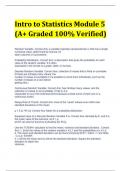
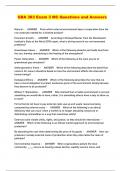
Intro to Statistics Module 5 (A+ Graded 100% Verified) Random Variable Correct Ans: a variable (typically represented by x) that has a single numerical value, determined by chance, for each outcome of a procedure. Probability Distribution Correct Ans: a description that gives the probability for each value of the random variable. It is often expressed in the format of a graph, table, or formula. Discrete Random Variable Correct Ans: collection of values that is finite or countable. (If there are infinitely many values, the number of values is countable if it is possible to count them individually, such as the number of tosses of a coin before getting tails.) Continuous Random Variable Correct Ans: has infinitely many values, and the collection of values is not countable. (That is, it is impossible to count the individual items because at least some of them are on a continuous scale.) Range Rule of Thumb Correct Ans: most of the "usual" values occur within two standard deviations of the mean. μ = Σ [x ×P( x)] Correct Ans: Mean for a probability distribution Expected value of a Discrete Random Variable X is Correct Ans: denoted by E, and it is the mean value of the outcome, so E = μ and E can also be found by evaluating Σ[x⋅P(x)], Use the TI 83/84+ calculator to find the mean, variance and standard deviation. Correct Ans: 1. Enter the values of the random variable x in L1 and the probabilities of x in L2. 2. The mean and standard deviation can be found choosing STAT / CALC / 1-Var Stats / L1,L2 / ENTER 3. x will be the mean and σx will be the standard deviation. Square the standard deviation to obtain the variance. Expected value of a discrete random variable Correct Ans: Dentoed by E, and it represents the average value of the outcomes it is obtained by finding the value of: Σ x × P(x) Binomial Probability Distribution Correct Ans: 1. The procedure has a fixed number of trials. 2. The trials must be independent. (The outcome of any individual trial doesn't affect the probabilities in the other trials.) 3. Each trial must have all outcomes classified into two categories (commonly referred to as success and failure). 4. The probability of a success remains the same in all trials. Finding the probability formula Correct Ans: Access the DISTR menu with 2nd VARS. Choose binompdf( You will have to arrow down the DISTR menu. Be careful - the distribution directly after binompdf is binomcdf. It is the cumulative probability function. The syntax is: binompdf( n, p [,x] ) The value of x is optional; binompdf(n, p) lists all the probabilities for x = 0 to n. =binompdf(6, 0.8, 5)
Written for
- Institution
- Intro to Statistics Module 5
- Course
- Intro to Statistics Module 5
Document information
- Uploaded on
- September 27, 2023
- Number of pages
- 2
- Written in
- 2023/2024
- Type
- Exam (elaborations)
- Contains
- Questions & answers
Subjects
-
intro to statistics module 5 a graded 100 verif

Document also available in package deal