
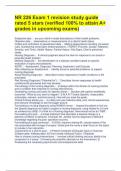
NR 226 Exam 1 revision study guide rated 5 stars (verified 100% to attain A+ grades in upcoming exams)
NR 226 Exam 1 revision study guide rated 5 stars (verified 100% to attain A+ grades in upcoming exams) Subjective data - are your client's verbal descriptions of their health problems. Objective data - observations or measurements of a client's heath status. Collect and verification of assessment data - Making observations including nonverbal cues, Questioning using Open ended questions + PQRST (Provoke, Quality, Radiation, Severity, and Time), Health History, Family History, Vital Signs, Client's perceived needs Nursing Diagnosis - A clinical judgment about the client in response to an actual or potential health problem Medical Diagnosis - the identification of a disease condition based on specific evaluation of signs and symptoms. ADPIE - Assessment, Diagnosis, Planning, Implement, and Evaluate After collecting an Assessment - identify actual or potential problems, to support nursing diagnosis. Actual Nursing Diagnosis - describes human responses to health conditions or life processes Risk Nursing Diagnosis ("Potential for") - Describes human responses to health conditions/life processes that may develop. The etiology of the nursing diagnosis - is always within the domain of nursing practice and a condition that responds to nursing interventions. Developing nursing care plans for specific clients - Set plan with patient andIdentify outcomes: "What do you want to happen", S.M.A.R.T Goals (Specific, measurable, achievable, relevant, and time bound), How will you meet the goals. Critical thinking allows you - to utilize and use collective data, prior clinical experiences and relevant knowledge to see the bigger picture. Formulating a nursing diagnosis using NANDA format - Assess the patient to find out the Specify diagnosis and data to support a nursing diagnosis, using related to (r/t) and as evidence by (AEB). If a Risk for a Nursing diagnosis, there would not be an "AEB" Formulating pt's goal - a broad statement that describes a desired change in a patient's condition or behavior. Example: Mr. Jacobs has the diagnosis of deficient knowledge regarding his post- operative recovery Formulating pt's goal continued - A GOAL requires making Mr. Jacobs aware of the risk associated with his type of surgery. Goals give the nurse a clear focus on the topics to include in her instruction. Components of a client's goal - 1)Patient-Centered; 2)Singular Goal or Outcome; 3)Observable; 4)Measurable; 5)Time-Limited; 6)Mutual Factor; 7)Realistic How to choose nursing interventions - involves critical thinking and your ability to be component in 3 areas: 1) Knowing the scientific rationale for the intervention; 2) Possessing the necessary psychomotor and interpersonal skills How to choose nursing interventions continued - 3) Being able to function within a particular setting to use the available health care resources effectively. What is Consultation? - a process by which you seek the expertise of a specialist such as your nursing instructor, physician, or a clinical nurse educator to identify ways to handle problems in patient management or the planning and implementation of therapies What is Consultation? Continued - The process is important so all health care providers are focused on common patient goals. It focuses on problems in providing nursing care How to consult with other healthcare professionals? - 1st: Identify general problem area. 2nd: direct the consultation to the right professional. 3rd: Provide the consultant with relevant information about the problem area. 4th: Don't be prejudice or influence consultants
Document information
- Uploaded on
- September 26, 2023
- Number of pages
- 9
- Written in
- 2023/2024
- Type
- Other
- Person
- Unknown


