
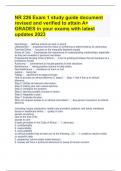
NR 226 Exam 1 study guide document revised and verified to attain A+ GRADES in your exams with latest updates 2023
NR 226 Exam 1 study guide document revised and verified to attain A+ GRADES in your exams with latest updates 2023 Deontology - defines actions as right or wrong Utilitarianism - proposes that the value of something is determined by its usefulness Feminist Ethics - focuses on the inequality between people Ethics of Care - Emphasizes the importance of understanding relationships, especially as they are revealed in personal narratives Professional Nursing Code of Ethics - A set of guiding principles that all members of a profession accept Autonomy - commitment to include patients in their decisions Beneficence - taking positive actions to help others Nonmaleficence - avoidance of harm or hurt Justice - being fair Fidelity - agreement to keep promises How to process an ethical dilemma (7 steps) - Step 1: Ask if this is an ethical dilemma. Step 2: Gather all relevant information. Step 3: Clarify your own values/opinons. Step 4: Verbalize the problem. Step 5: Identify possible courses of action. Step 6: Negotiate a plan. Step 7: Evaluate the plan. Who can request access to an ethical committee? - Any person involved in an ethical dilemma (including nurses, physicians, health care providers, patients, and family members) Issues in healthcare ethics - quality of care genetic screening care at the end of life access to care 4 basic principles in the Code of Ethics - 1. advocacy 2. confidentiality 3. responsibility 4. accountability an ethical problem has at least one of the following.. (3) - 1. unable to resolve solely on scientific data 2. perplexing- cannot easily make decision 3. answer will have a profound relevance for areas of human concern purposes of the ethical committee - provide education, recommendations, and case consultation issue: quality of life - measures the values/benefits of certain medical interventions (ex. DNR, cancer therapy) issue: genetic screening - can alert patient to a condition that is not yet apparent, but will eventually develop issue: futile care - medical interventions that are unlikely to produce benefit to the patient (ex. tx to a patient that has no hope/incurable) moral distress - describes the anguish experienced when a person feels unable to act according to closely held core values ethics - The study of conduct and character. It is concerned with determining what is good or valuable for individuals and society at large values - Personal beliefs about the worth of something, that influences their behavior accountability - answering for your own actions magnet recognition - the hospital has clinical promotion systems and research and evidence-based practice programs; nurses have professional autonomy over their practice team nursing - interdisciplinary team approach developed in response to severe shortage of nursing after World War II- team effort, team leader, care is provided collaboratively total patient care - -original care delive
Document information
- Uploaded on
- September 26, 2023
- Number of pages
- 10
- Written in
- 2023/2024
- Type
- Exam (elaborations)
- Contains
- Questions & answers


