Clinical Psychology Exam 1 Questions And Answers A+ Review
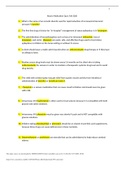
Clinical Psychology Exam 1 Questions And Answers A+ Review "Clinical psychology" first used - ANS-•1907 by Lightner Witmer •Originally defined as similar to medicine, education, and sociology Witmer was the first - ANS-operate a psychological clinic. a. the first clients were - children with behavioral or educational problems. B. According to Witmer's definition, a clinical psychologist was a person - whose work with others involved aspects of 1. treatment: method 2. education: Psych. education ( educate that person about diagnosis). 3. interpersonal issues: The relationship between the psychologist and person is very important. It is critical for the relationship. Miller and wonpo suggest that - ANS-the relationship between patient and psychologist is the single best indicator if patient will get better. Recent definitions More Recent Definitions of Clinical psychology - ANS-- Tremendous growth has resulted in a very broad, hard-to-define field A.Brief definitions emphasize the study, assessment, and treatment of people with psychological problems B. More detailed definitions (e.g., Division 12 of APA) are more inclusive and descriptive Concise definitions fall short of capturing the field in its entirety. Contemporary clinical psychologists do many different things, with many different goals, for many different people. APA Division 12 Definition of Clinical Psychology - ANS-"The field of Clinical Psychology integrates science, theory, and practice to understand, predict, and alleviate maladjustment, disability, and discomfort as well as to promote human adaptation, adjustment, and personal development. Clinical Psychology focuses on the intellectual, emotional, biological, psychological, social, and behavioral aspects of human functioning across the life span, in varying cultures, and at all socioeconomic levels." (APA, 2012) - An accurate, comprehensive, contemporary definition of clinical psychology needs to be more inclusive and descriptive, such as that provided by the APA. - The field and practitioners of clinical psychology continue to outgrow classical definitions. Comparison of PsyD and PhD - ANS-A. PhD - Emphasize practice and research - Smaller classes - Lower acceptance rate -Typically in university departments -Offer more funding to students - Greater success in placing students in APA-accredited internships B. PsyD - Emphasize practice over research -Larger classes -Greater acceptance rate -Often in free-standing professional schools -Offer less funding to students -Less success in placing students in APA-accredited internships Education and Training in Clinical Psychology - ANS-Commonalities among most training programs oDoctoral degree- going into a program with a bachelor's degree. oMost enter with bachelor's, some with master's degree oRequired coursework oThesis/dissertation oPredoctoral internship (more information in later slides) - WV: Licensed master's in psychology. - About 3,000 doctoral degrees in clinical psychology are awarded each year. Education and Training: Specialty Tracks - ANS-In recent decades, specialty tracks have emerged, including: oChild oHealth oForensic oFamily oNeuropsychology - More than half of APA-accredited doctoral programs offer (but may not require) training within a specialty track. * Get a degree that allows you to get a license (go broad and then specialize). Three Models of Training - ANS-1. Scientist-practitioner model (or Boulder model):Created in 1949 in boulder Colorado at a conference.Emphasized both practice and research.Balances Clinical practice with scientific research. a. Graduate students would need to receive training and display competence in the application of clinical methods (assessment, psychotherapy, etc.) and the research methods necessary to scientifically study and evaluate the field. - These graduate programs would continue to be housed in departments of psychology at universities, and graduates would be awarded the PhD degree. 2. Practitioner-scholar model (or Vail model): Created in 1973 at a conference in Vail, CO. This Spends more time doing clinical work with patients rather than clinical work and research. Leans towards clinical practice. Higher acceptance rates and larger classes. Proliferated in recent years- Come with a PsyD rather than a PHD. a. PsyD - Clinical focused internships doesn't care about APA- accredited internships. They are not research focused. * In the 1988 to 2001 time period alone, the number of PsyD degrees awarded increased by more than 160%. 3. Clinical scientist model:- Emerged in the 1990's. Reaction to Vail Model. Leans towards research. Trains researchers rather than practitioners A. Richard McFall's 1991 "Manifesto for a Science of Clinical Psychology" sparked this movement: The Academy of Psychological Clinical Science was founded at a conference at Indiana University. Graduate programs who are members of the Academy endorse McFall's views. For examples of graduate programs that adhere to each of the three training models. Examples are also provided in subsequent slides. - A subset of PhD institutions who strongly endorse empiricism and science Three Models of Training Example - ANS-R T P - Theory drives both research and practice. Research to test theories. - Theories inform our practice. - Research influences theory and practice. - As we research, we revise theories. - Research also informs practice. - Practice influences theory and research. - Practice informs theory and research Will lean to one part of the triangle, all three are important. Emerging Trends in Training - ANS-A. Technology •Use of webcams for supervision •Computer-based assessment (MMPI) B.Competencies (outcome-based skills) •Skills that a student must demonstrate •E.g., Intervention, assessment, research, etc. (Multicultural, Group theory competencies). *Emphasizing competencies ensures that the students who graduate from clinical psychology programs will not only have earned good grades on exams, papers, and other academic tasks, but will be able to apply what they have learned as well. Continues...
Written for
- Institution
- Clinical Psychology Exa 1 Q&A
- Course
- Clinical Psychology Exa 1 Q&A
Document information
- Uploaded on
- September 25, 2023
- Number of pages
- 22
- Written in
- 2023/2024
- Type
- Exam (elaborations)
- Contains
- Questions & answers
Subjects
- clinical psychology
- exam 1
- questions and answers
- a review
-
clinical psychology exam 1