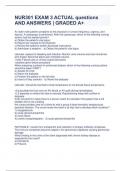
NUR301 EXAM 3 ACTUAL questions AND ANSWERS | GRADED A+
NUR301 EXAM 3 ACTUAL questions AND ANSWERS | GRADED A+ An older male patient complains to the physician of urinary frequency, urgency, and dysuria. A cystoscopy is performed. After the cystoscopy, which of the following nursing actions has the highest priority? a) Obtain the patient's vital signs: b) Report any nausea to the physician c) Review the patient's written discharge instructions d) Administer a sedative - a) Obtain the patient's vital signs rationale: assess for bleeding and infection. Monitor urine volume and color should be pink tinged. Abnormal pelvic pain indicates trauma. -notify if blood clots or urinary output decreases -sedative given before procedure When preparing a patient for peritoneal dialysis, which of the following nursing actions should be taken FIRST? a) Assess for bruit: b) Warm the dialysate c) Position the patient on the left side d) Insert a Foley catheter - b) Warm the dialysate rationale:: should be warmed to body temperature to not disrupt tissue temperature. -A:auscultate the bruit over an AV fistula or AV graft during hemodialysis -C:it depends on where the tube is inserted. Repositioning helps with outflow of dialysate D:do not perform unless there is a proven need; for example if the patient has a full bladder and is not urinating the nurse provides care for a client dx with a group A beta-hemolytic streptococcal bacterial infection. The nurse knows the client is at high risk to develop which condition? 1) myoglobinuria 2) acute glomerulonephritis 3) renal calculi 4) uremic encephalopathy - 2) acute glomerulonephritis RATIONALE:: results from entrapment and collection of antigen antibody complexes. The immune complexes become lodged in the glomerular capillaries causing glomerular damage Which finding in the urine of the client diagnosed with chronic kidney disease is expected by the nurse? a) Hematuria b) Polyuria c) Dysuria d) Oliguria - d) Oliguria RATIONALE: urine production less than 400 ml a day is a sign of kidney failure A: caused by glomerulonephritis C: : this would be s/s of uti The client is admitted to the hospital with a diagnosis of acute kidney injury. The nurse understands which explanation is the MOST accurate description of the client's condition? a) A sudden loss of kidney function due to failure of the renal system circulation or to glomerular or tubular damage b) A progressive deterioration in kidney function that ends fatally when uremia develops c) An inflammation of the kidney pelvis, tubules, and interstitial tissues of one or both kidneys d) An inflammation process precipitated by chemical changes in the glomeruli of both kidneys - a) A sudden loss of kidney function due to failure of the renal system circulation or to glomerular or tubular damage RATIONALE:acute kidney injury is sudden cessation of kidney function caused by renal failure or by glomerular or tubular damage Which of the following urine outputs BEST indicates to the nurse that a patient's kidneys are functioning normally? a) 555 mL in 2 hr b) 30 mL in one hr c) 1,500 mL in 24 hr d) 800 mL in 24 hr - c) 1,500 mL in 24 hr RATIONALE: normal urine output is 800-2000 ml in a 24 hour period with an intake of about 2 liters a) 555 mL in 2 hr: polyuria is an indication of infection, diabetes, kidney failure or kidney stones b) 30 mL in one hr: this may indicate kidney failure or an obstruction d) 800 mL in 24 hr: this would be minimum urine output unless there is an obstruction or kidney failure The nurse cares for a client after a traditional cholecystectomy. The nurse contacts the health care provider if which observation is made? a. 800 mL bloody drainage the first day postop b. The client frequently reports abdominal pain during the first 24 hours. c. Nasogastric tube connected to intermittent suction the first day postop d. Temperature elevation to 100F (37.8C) the evening of surgery - a. 800 mL bloody drainage the first day postop RATIONALE: 50 ml is an appropriate amount of drainage. Too much drainage indicates hemorrhage b. The client frequently reports abdominal pain during the first 24 hours. : incisional pain is common and treated with morphine using a patient controlled pump c. Nasogastric tube connected to intermittent suction the first day postop: decompress stomach, tube removed when peristalsis returns d. Temperature elevation to 100F (37.8C) the evening of surgery: not unusual to have a slightly elevated temperature evening of surgery The nurse cares for a client diagnosed with cholelithiasis. It is MOST important to instruct the client to avoid which of the following foods? SELECT ALL a. Apples B. Brocoli C lettuce d. Cheese e. Bacon f carrots - b. Brocoli: avoid vegetables that cause gas including cabbage, beans and onions d. Cheese: high in cholesterol and fat. Cream, butter, whole milk and icecream should be avoided. Avoid fried foods with high amounts of calories too e. Bacon: bacon and other meats high in fat and cholesterol should be avoided The nurse provides care for a pt with acute pancreatitis. The nurse administers morphine IV for pain. Which behavior indicates the medication is effective? a. Pt sleeps for one hour B: pt frequently changes position in bed C: pt states there is less nausea D: pt does not report thirst - a. Pt sleeps for one hour: pt sleeping indicates morphine is effective. Nurse can evaluate the pain on a scale before and after administration The day after an appendectomy, the pt has severe abd pain, a temperature of 101, and a rigid abdomen. The nurse suspects which complication a. A: anesthesia intolerance. B: atelectasis and pneumonia C: infection of peritoneal sac D: bladder distention - C: infection of peritoneal sac : can be caused by ruptured appendix or gross contamination of peritoneum. s/s of peritonitis include severe abd pain, abd rigidity, decreased bowel sounds, n/v, elevated temperature and shock the nurse obtains a history from a client suspected of having a duodenal ulcer. the nurse expects the client to make which statement i have been vomiting bright red blood a. "I have abdominal pain and tenderness." b. "I have been vomiting bright red blood." c. "I have frequent loose stools every day." d. "I have increased pain after eating."a - a, "I have abdominal pain and tenderness.": epigastric pain occurs 2-3 hours after eating is most common symptom and food relieves the pain "I have been vomiting bright red blood.": melena is more common with duodenal ulcer and hematemesis is common with gastric ulcer "I have frequent loose stools every day.": diarrhea is a symptom of ulcerative colitis and not associated with ulcers "I have increased pain after eating.": increased pain is gastric ulcer and the pain is relieved by vomiting The nurse gives discharge instructions to the family of a patient diagnosed with hepatic encephalopathy. The nurse determines further teaching is necessary if the family makes which of the following statements? a. Our parents should eat meat at every meal b. We should contact doctor if parent is restless at night c. Our parent may have some tremors in hands d. Lactulose may cause bloating and cramps - aOur parents should eat meat at every meal: the pt will be on a low meat diet and high plant protein diet. We should contact doctor if parent is restless at night: client may experience sleep disturbances to lethargy to a deep coma Our parent may have some tremors in hands: asterixis is a sign of hepatic encephalopathy Lactulose may cause bloating and cramps: this is a laxative that promotes excretion of ammonia in the stool the clinic nurse monitors a client recovering from hepatitis a. the nurse knows that this is transmitted through which route? a. fecal oral b. droplet c. airborne d. contact - a. Fecal oral: this is true. Due to consumption of contaminated food or water Droplet: this is for influenza Airborne: this is for chickenpox Contact: this is conjunctivitis the nurse cares for the client with crohn's disease. Which finding describes a common complication of crohn's disease? a. Reflux esophagitis b. Chronic const
Document information
- Uploaded on
- September 25, 2023
- Number of pages
- 41
- Written in
- 2023/2024
- Type
- Exam (elaborations)
- Contains
- Questions & answers