

Maryville NURS 611 Exam 1 ;
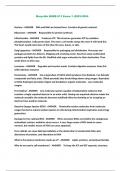
Nucleus - ANSWER DNA and RNA are housed here. Contains all genetic material. Ribosomes - ANSWER Responsible for protein synthesis Mitochondria - ANSWER Produces ATP. This structure generates ATP by oxidative phosphorylation. Cells power plant. The more a cell needs energy the more it will need this. The heart would need more of this than the eyes, bones, or skin. Golgi apparatus - ANSWER Responsible for packaging and distribution. Processes and packages proteins for delivery. Shipping and receiving center. Receives newly synthesized proteins and lipids from the ER. Modified with sugar molecules for their destination. Then sends them on their way. Lysosome - ANSWER Degrades and recycles waste. Contains digestive enzymes. Does this with hydrolase enzymes Peroxisome - ANSWER Has a byproduct of H2O2 which produces Free Radicals. Can detoxify compounds and fatty acids. (Think peroxide) they break things down using oxygen. Byproduct is H2O2 (hydrogen peroxide). Digest and breakdown organic molecules - uses molecular oxygen. Free Radical - ANSWER Any molecular species capable of independent existence that contains a single unpaired electron in an outer orbit. Having one unpaired electron makes the molecule unstable; the molecule becomes stabilized either by donating or by accepting an electron from another molecule. Reactive Oxygen Species (ROS) - ANSWER Chemically reactive molecules from molecular oxygen formed as natural oxidant species in cells during mitochondrial respiration and energy generation. Damage by free radicals/ROS - ANSWER When excessive ROSs overwhelm the endogenous antioxidant systems, oxidative stress occurs. A very large excess of ROS tends to cause necrosis, but smaller excess of ROS can cause apoptosis. Free radicals can cause lipid peroxidation or the destruction of unsaturated fatty acid, alterations of proteins, and alterations in DNA What is the plasma membrane made up of? - ANSWER Lipids, proteins, and polysaccharides Why do we need a cell membrane? - ANSWER To keep the ICF and ECF separate, structure,protection, activation of cell, transport, and cell-to-cell interaction How is osmolality different between ICF and ECF? - ANSWER The osmolality of ICF and ECF tends to equalize and therefore provides a measure of body fluid concentration and thus the body's hydration status. What do proteins do for the cell? - ANSWER Proteins act as Recognition and binding units (receptors) for substances moving in and out of the cell; Pores or transport channels for various electrically charged particles called ions or electrolytes and specific carriers for amino acids and monosaccharides; Specific enzymes that drive active pumps that promote concentration of certain ions, particularly potassium (K+), within the cell while keeping concentrations of other ions, for example sodium (Na+), below concentrations found in the extracellular environment; Cell surface markers, such as glycoproteins (proteins attached to carbohydrates), that identify a cell to its neighbor; Cell adhesion molecules (CAMs), or proteins that allow cells to hook together and form attachments to the cytoskeleton for maintaining cellular shape; and Catalysts of chemical reactions, for example, conversion of lactose to glucose. How much of the cell membrane is made up of protein? - ANSWER 55% the cell membrane is made up of protein What is a protein? - ANSWER A protein is made from a chain of amino acids, known as polypeptides. There are 20 types of amino acids in proteins, and each type of protein has a unique sequence of amino acids. Proteins are the major workhorses of the cell. Tight Junctions - ANSWER Impermeable. Help cells move together and don't allow things in -they help conduct force- like pumping the heart; and moving hard stool. Tight junctions are barriers to diffusion, preventing the movement of substances through transport proteins in the plasma membranes of adjacent cells. Gap Junctions - ANSWER Allow for conductivity to synchronize contractions of heart muscles through ionic coupling. Channels that allow for conductivity - like the heart and nerve cells. Gap junctions are clusters of communicating tunnels or connexons that allow small ions and molecules to pass directly from the inside of one cell to the inside of another. Desmosomes - ANSWER Hold cells together either by continuous bands or belts of epithelial sheets or button-like points of contact. Also act as a system of braces to maintain structuralintegrity. Oxidative phosphorylation - ANSWER AKA: Cellular respiration and Glycolysis. Occurs in the mitochondria and is the mechanism in which energy is produced from carbohydrates, proteins, and fats and this energy is transferred to ATP. When 1 mole of glucose is metabolically broken down in the presence of oxygen into CO2 and water - 686 Kilocalories of energy are released- in a test tube it is expressed as heat. Active transport. Kerbs cycle. Main cation in ICF - ANSWER Potassium Main cation in ECF - ANSWER Sodium What charge is inside the cell? - ANSWER Negative What charge is outside the cell? - ANSWER Positive The inside of the cell is more negatively charged than the outside Diffusion - ANSWER Non-energy form of transportation. The passive movement of a solute from an area of higher solute concentration to an area of lower solute concentration. Example of diffusion - ANSWER Urea (Urea is a small solute that readily diffuses across cellular membranes) Facilitated diffusion - ANSWER Non-energy form of transportation. KEY and LOCK... This is a carrier mediated process that will allow particles that are too big or charged to get through
Document information
- Uploaded on
- September 24, 2023
- Number of pages
- 23
- Written in
- 2023/2024
- Type
- Exam (elaborations)
- Contains
- Questions & answers


