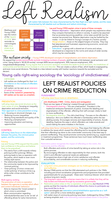
Left Realism Left realism falls between the views characterised by the New Right and right realists, and the views
characterised by left idealists such as Marxists and radical criminology.
Lea and Young (1993) explain crime in terms of three concepts:
Matthews and • Relative deprivation – deprivation which people may experience when
Young (1992) Criminal
Victim they compare themselves to others in society. It used to be assumed
see the notion justice that as societies becoming wealthier, crime rates would fall, but the
of crime
of the ‘square system reverse has proved true. Relative deprivation may be fuelled by the
of crime’ as a media – it can be linked to Young’s concept of a ‘bulimic society’.
reminder to • Marginalisation – those on the edges/margins of society. They may
criminologists feel abandoned and frustrated, experiencing economic, social and
General Criminal
that crime political deprivation.
arises at an public offender
• Subculture – a group with a shared set of norms and values,
intersection. developed as a response to the norms and values of wider society
which may be unachievable.
The exclusive society – Young (1999) developed concepts of marginalisation and relative deprivation.
He argued that society economically exclude increasing numbers of people, and he made a link between social exclusion and
crime. Using Hutton’s ‘40:30:30 society’ concept (40% secure employment, 30% insecure employment, 30%
marginalised/idle/poverty), Young argues that as economic exclusion increases this leads to social exclusion, the breakdown of
communities and families and an increase in crime and disorder. This can create a culture of fear, which leads to scapegoating
and even more social divisions. This leads to a less tolerant society with harsher reactions towards the excluded and the
deviant.
Young calls right-wing sociology the ‘sociology of vindictiveness’.
CRITICISMS
LEFT REALIST POLICIES
• Left realists are challenged for their lack
of evidence on the motives of offenders
themselves.
ON CRIME REDUCTION
• Left realism can be seen as an extension
of radical criminology.
• Some of the ‘solutions’ presented by
left realists can be seen as unrealistic. PUNISHMENT
Left-wing views focus more on rehabilitation.
PREVENTION John Braithwaite (1989) - Crime, shame and reintegration
Left-wing views see social structure as the There are two types of ’shaming’ created through punishment:
main cause of crime, focusing on inequality, • Disintegrative shaming – ‘You are a bad person’. Prevalent in the
deprivation and social exclusion. traditional retributive framework of justice. Involves the labelling and
Their approach to crime prevention is long- stigmatisation of the offender, affecting their self-concept. Likely to lead
term, focusing on structural changes, e.g: to more reoffending.
• Reducing income inequalities • Reintegrative shaming – ‘You did a bad thing;’. Focuses on the offender’s
• Raising living standards and quality of life behaviour. Aim is to reaffirm the offender’s membership within the law-
• Reducing unemployment abiding society. Encourages remorse and responsibility of actions. Avoids
• Improving education and training labelling. Explores the ways in which offenders can make amends and
opportunities avoid making the same mistakes in the future.
Left-wing views favour reintegrative shaming. They argue that helping the offender
CONTROL to address the issues which caused the offending and to recognise the damage
Left-wring views focus on the relationships that their offending has done to the victim/wider community is the best way to
between the police, the criminal justice prevent reoffending. They would promote community sentencing e.g. unpaid work
system, and the community. or treatment programmes. These sentences have much lower reoffending rates
than custodial sentences.
Policing
Lea and Young (1993) argued that the public Restorative justice recognises the impact of offending on the victim, the
lack confidence in the police and believe community and the offender.
them to be prejudiced. • Both offenders and victims of crime benefit by taking an active role in the
• This stems from a drift towards military justice process.
policing (conflict policing). Military • By encouraging offenders to take responsibility for their actions, both the
policing leads to less co-operation with victim’s and offender’s personal needs are addressed.
the police, which leads to even more • RJ programmes show a high rate of victim satisfaction and offender
military style tactics. accountability, and considerable success in reducing reoffending.
• The relationship between the police and
the community needs to be improved by EVALUATION
‘minimal policing’. • Long-term crime prevention strategies can be challenged as being unrealistic
• ’Over-policing’ of minor crimes and and ineffective.
‘under-policing’ of serious crimes e.g. • Murray (1964) points out that the USA attempted such policies in the 1960s
white-collar crimes contribute to the including pre-school socialisation programmes and programmes that provided
characterised by left idealists such as Marxists and radical criminology.
Lea and Young (1993) explain crime in terms of three concepts:
Matthews and • Relative deprivation – deprivation which people may experience when
Young (1992) Criminal
Victim they compare themselves to others in society. It used to be assumed
see the notion justice that as societies becoming wealthier, crime rates would fall, but the
of crime
of the ‘square system reverse has proved true. Relative deprivation may be fuelled by the
of crime’ as a media – it can be linked to Young’s concept of a ‘bulimic society’.
reminder to • Marginalisation – those on the edges/margins of society. They may
criminologists feel abandoned and frustrated, experiencing economic, social and
General Criminal
that crime political deprivation.
arises at an public offender
• Subculture – a group with a shared set of norms and values,
intersection. developed as a response to the norms and values of wider society
which may be unachievable.
The exclusive society – Young (1999) developed concepts of marginalisation and relative deprivation.
He argued that society economically exclude increasing numbers of people, and he made a link between social exclusion and
crime. Using Hutton’s ‘40:30:30 society’ concept (40% secure employment, 30% insecure employment, 30%
marginalised/idle/poverty), Young argues that as economic exclusion increases this leads to social exclusion, the breakdown of
communities and families and an increase in crime and disorder. This can create a culture of fear, which leads to scapegoating
and even more social divisions. This leads to a less tolerant society with harsher reactions towards the excluded and the
deviant.
Young calls right-wing sociology the ‘sociology of vindictiveness’.
CRITICISMS
LEFT REALIST POLICIES
• Left realists are challenged for their lack
of evidence on the motives of offenders
themselves.
ON CRIME REDUCTION
• Left realism can be seen as an extension
of radical criminology.
• Some of the ‘solutions’ presented by
left realists can be seen as unrealistic. PUNISHMENT
Left-wing views focus more on rehabilitation.
PREVENTION John Braithwaite (1989) - Crime, shame and reintegration
Left-wing views see social structure as the There are two types of ’shaming’ created through punishment:
main cause of crime, focusing on inequality, • Disintegrative shaming – ‘You are a bad person’. Prevalent in the
deprivation and social exclusion. traditional retributive framework of justice. Involves the labelling and
Their approach to crime prevention is long- stigmatisation of the offender, affecting their self-concept. Likely to lead
term, focusing on structural changes, e.g: to more reoffending.
• Reducing income inequalities • Reintegrative shaming – ‘You did a bad thing;’. Focuses on the offender’s
• Raising living standards and quality of life behaviour. Aim is to reaffirm the offender’s membership within the law-
• Reducing unemployment abiding society. Encourages remorse and responsibility of actions. Avoids
• Improving education and training labelling. Explores the ways in which offenders can make amends and
opportunities avoid making the same mistakes in the future.
Left-wing views favour reintegrative shaming. They argue that helping the offender
CONTROL to address the issues which caused the offending and to recognise the damage
Left-wring views focus on the relationships that their offending has done to the victim/wider community is the best way to
between the police, the criminal justice prevent reoffending. They would promote community sentencing e.g. unpaid work
system, and the community. or treatment programmes. These sentences have much lower reoffending rates
than custodial sentences.
Policing
Lea and Young (1993) argued that the public Restorative justice recognises the impact of offending on the victim, the
lack confidence in the police and believe community and the offender.
them to be prejudiced. • Both offenders and victims of crime benefit by taking an active role in the
• This stems from a drift towards military justice process.
policing (conflict policing). Military • By encouraging offenders to take responsibility for their actions, both the
policing leads to less co-operation with victim’s and offender’s personal needs are addressed.
the police, which leads to even more • RJ programmes show a high rate of victim satisfaction and offender
military style tactics. accountability, and considerable success in reducing reoffending.
• The relationship between the police and
the community needs to be improved by EVALUATION
‘minimal policing’. • Long-term crime prevention strategies can be challenged as being unrealistic
• ’Over-policing’ of minor crimes and and ineffective.
‘under-policing’ of serious crimes e.g. • Murray (1964) points out that the USA attempted such policies in the 1960s
white-collar crimes contribute to the including pre-school socialisation programmes and programmes that provided