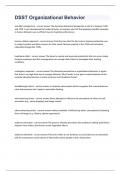
DSST Organizational Behavior questions & answers graded A+ 2023
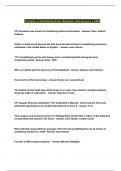
DSST Organizational Behavior scientific management - correct answer The dominant behavioral perspective in the U.S. between 1900 and 1950. It was championed by Frederick Taylor, an engineer who felt that applying scientific principles to human behavior was an efficient way to maximize performance. human relations approach - correct answer Took the view that the best way to improve production was to respect workers and show concern for their needs. Became popular in the 1920s and remained influential through the 1950s. hawthorne effect - correct answer The boost in morale and improved productivity that can occur simply because employees feel that management care enough about them to investigate their working conditions. contingency approach - correct answer The dominant perspective in organizational behavior, it argues that there's no single best way to manage behavior. What 'works' in any given context depends on the complex interplay between a variety of person and situational factors. breakthrough culture - correct answer A corporate value system which recognizes that normal business rules and pressures don't apply to innovative thinking. self-enhancing tactics - correct answer Direct attempts to influence the perceptions of others via self promotion (e.g., name dropping) and image control. other-enhancing tactics - correct answer Indirect methods of influencing others' perceptions by boosting their self-image (e.g., flattery, opinion agreement). audience extraction - correct answer The process whereby perceivers (the audience) subtlely pulls/draws behavior from others (also known as the Pygmalion effect). audience selectivity - correct answer This terms refers to our tendency as social observers to selectively look for and process certain pieces of information about people to form impressions personal constructs - correct answer A very general belief about what other people are like (e.g, untrustworthy) that has wide effect on our perceptions of others behavior. halo effect - correct answer A more specific perceptual bias that affects perceptions of others; in particular, the use of one piece of information observed about a person is used to infer other characteristics that may or may not be there. stereotypes - correct answer A perceptual bias that involves using one characteristic about a person - their group membership (e.g., race, gender, or age group) - to infer other traits they think might also be present. internal attribution - correct answer Ascribing/assigning the cause of a person's behavior at work to something about them (e.g, their effort, their innate ability, etc.). external attribution - correct answer Attributing the cause of work behavior to some reason that is external to the person (e.g., bad luck, unfair circumstances, etc.). actor-observer effect - correct answer The tendency for observers to make internal attributions and for actors to make external attributions for behavior.
Written for
- Institution
- DSST
- Course
- DSST
Document information
- Uploaded on
- September 21, 2023
- Number of pages
- 17
- Written in
- 2023/2024
- Type
- Exam (elaborations)
- Contains
- Questions & answers
Subjects
-
dsst organizational behavior

Also available in package deal