
Chapter 7 Experimental Design I, Single‐Factor Designs
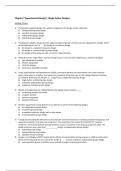
Chapter 7 Experimental Design I, Single‐Factor Designs Multiple Choice 1) If a between-subjects design uses random assignment, the design will be called a(n) a) nonequivalent groups design b) repeated-measures design c) independent groups design d) matched groups design 2) If a between-subjects design uses the subject variable of gender and has just one independent variable, which of the following is true? a) the design is a multilevel design b) the design is a repeated-measures design c) the design is a nonequivalent groups design d) the design will be analyzed with a t test for related samples 3) What does every single-factor, two level design have in common with single-factor, multilevel designs? a) one independent variable b) random assignment c) t test for analysis d) continuous dependent variable 4) In the study Mueller and Oppenheimer (2014), some participants took hand-written class notes whereas others took notes on a laptop. The researchers wanted to know the type of note-taking influenced memory for material. What was the design? a) single-factor, independent groups design b) single-factor, matched groups design c) multilevel, independent groups design d) multilevel, matched groups design 5) Mueller and Oppenheimer’s (2014) laptop note-taking study included _____. a) a matching variable (IQ scores) b) a subject variable c) random assignment d) repeated measures 6) Random assignment is least likely to be an element in which of the following designs a) an independent groups design b) a matched groups design c) a repeated-measures design with a Latin square d) a nonequivalent groups design 7) A study by evaluating the effectiveness of computer-assisted instruction in reading compared two groups, one using the computers, the other not using them. The researchers first tested the students for “reading readiness” and insured that the average readiness scores of students in the two group was the same. The design used here was a two-level ___________ design. a) independent groups design b) matched groups design c) nonequivalent groups design d) repeated measures design 8) Kroeger and colleagues (2007) examined the effects of a social skills training program in children with autism. Which of the following was true about the study? a) it was a multilevel, independent groups design b) two equivalent groups of children were created through a matching procedure
Documentinformatie
- Geüpload op
- 19 september 2023
- Aantal pagina's
- 14
- Geschreven in
- 2023/2024
- Type
- Tentamen (uitwerkingen)
- Bevat
- Vragen en antwoorden


