

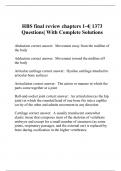
HBS final review chapters 1-4| 1373 Questions| With Complete Solutions
Abduction correct answer: Movement away from the midline of the body Adduction correct answer: Movement toward the midline off the body Articular cartilage correct answer: Hyaline cartilage attached to articular bone surfaces Articulation correct answer: The action or manner in which the parts come together at a joint Ball-and-socket joint correct answer: An articulation (as the hip joint) in which the rounded head of one bone fits into a cuplike cavity of the other and admits movement in any direction Cartilage correct answer: A usually translucent somewhat elastic tissue that composes most of the skeleton of vertebrate embryos and except for a small number of structures (as some joints, respiratory passages, and the external ear) is replaced by bone during ossification in the higher vertebrates. Circumduction correct answer: A movement at a synovial joint in which the distal end of the bone moves in a circle while the proximal end remains relatively stable Dorsiflexion correct answer: Bending the foot in the direction of the dorsum (upper surface) Extension correct answer: An unbending movement around a joint in a limb (as the knee or elbow) that increases the angle between the bones of the limb at the joint Flexion correct answer: A bending movement around a joint in a limb (as the knee or elbow) that decreases the angle between the bones of the limb at the joint Goniometer correct answer: An instrument for measuring angles (as of a joint or the skull) Hinge joint correct answer: Joint between bones (as at the elbow or knee) that permits motion in only one plane Hyaline cartilage correct answer: Translucent bluish white cartilage consisting of cells embedded in an apparently homogeneous matrix, present in joints and respiratory passages, and forming most of the fetal skeleton Joint correct answer: The point of contact between elements of an animal skeleton whether movable or rigidly fixed together with the surrounding and supporting parts (as membranes, tendons, or ligaments) Ligament correct answer: Dense regular connective tissue that attaches bone to bone Plantar flexion correct answer: Bending the foot in the direction of the plantar surface (sole) Range of Motion correct answer: The range through which a joint can be moved Rotation correct answer: Moving a bone around its own axis, with no other movement Synovial cavity correct answer: The space between the articulating bones of a synovial joint, filled with synovial fluid. Also called a joint cavity. Synovial fluid correct answer: Secretion of synovial membranes that lubricates joints and nourishes articular cartilage Synovial joint correct answer: A fully moveable joint in which the synovial (joint) cavity is present between the two articulating bones Tendon correct answer: A white fibrous cord of dense regular connective tissue that attaches muscle to bone Actin correct answer: A contractile protein that is part of the thin filaments in muscle fibers Afferent neurons correct answer: Nerve cells that carry impulses towards the central nervous system Carpal tunnel syndrome correct answer: A condition caused by compression of the median nerve in the carpal tunnel and characterized especially by weakness, pain, and disturbances of sensation in the hand and fingers Contract correct answer: To shorten and thicken Efferent neurons correct answer: Nerve cells that conduct impulses away from the central nervous system Endomysium correct answer: The delicate connective tissue surrounding the individual muscular fibers within the smallest bundles Epimysium correct answer: The external connective-tissue sheath of a muscle Fascicle correct answer: A small bundle or cluster, especially of nerve or muscle fibers Myofibril correct answer: A threadlike structure, extending longitudinally through a muscle fiber (cell) consisting mainly of think filaments (myosin) and thin filaments (actin, troponin, and tropomyosin) Myosin correct answer: The contractile protein that makes up the thick filaments of muscle fibers Nerve correct answer: A cordlike bundle of neuronal axons and/or dendrites and associated connective tissue coursing together outside the central nervous system Perimysium correct answer: The connective-tissue sheath that surrounds a muscle and forms sheaths for the bundles of muscle fibers Plexus correct answer: Network of interlacing blood vessels or nerves Rigor mortis correct answer: Temporary rigidity of muscles occurring after death Sarcomere correct answer: Any of the repeating structural units of striated muscle fibrils Sliding filament mechanism correct answer: The explanation of how thick and thin filaments slide relative to one another during striated muscle contraction to decrease sarcomere length Tropomyosin correct answer: A protein of muscle that forms a complex with troponin regulating the interaction of actin and myosin in muscular contraction Troponin correct answer: A protein of muscle that together with tropomyosin forms a regulatory protein complex controlling the interaction of actin and myosin and that when combined with calcium ions permits muscular contraction Arteriole correct answer: Any of the small terminal twigs of an artery that ends in capillaries Atherosclerosis correct answer: A cardiovascular disease in which growths called plaques develop on the inner walls of the arteries, narrowing their inner diameters. Atrium correct answer: A chamber of the heart that re
Document information
- Uploaded on
- September 18, 2023
- Number of pages
- 158
- Written in
- 2023/2024
- Type
- Exam (elaborations)
- Contains
- Questions & answers


