
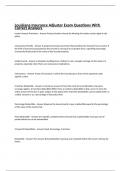
Louisiana Insurance Adjuster Exam Questions With Correct Answers
Lender Interest Provisions - Answer Protects lender interest by allowing the lender certain rights in the policy. Coinsurance Penalty - Answer A property insurance provision that penalizes the insured's loss recovery if the limit of insurance purchased by the insured is not equal to or greater than a specified percentage (commonly 80 percent) of the value of the insured property. Underinsured - Answer A situation resulting from a failure to carry enough coverage on the value of a property, especially when there are coinsurance implications. Coinsurance - Answer A type of insurance in which the insured pays a share of the payment made against a claim. Franchise Deductible - Answer A minimum amount of loss that must be incurred before insurance coverage applies. A franchise deductible differs from an ordinary deductible in that, once it is met, the entire amount of the loss is paid, subject to the policy limit. Franchise deductibles can be stated either as a dollar amount or as a percentage of the policy limit. Percentage Deductible - Answer Requires the insured party to pay a deductible equal to the percentage of the value of the insured risk. Fixed Deductible - Answer One specific, predetermined amount that a policyholder must pay out-of-pocket before he can be indemnified. 3 Typed of Deductibles - Answer Fixed, Percentage, Franchise Deductible - Answer The amount the policyholder must pay out-of-pocket before the insurer will pay for losses. Replacement Cost (RC) - Answer A method of valuation based on the cost of replacing an item at current market price, regardless of depreciation. Valued Policy - Answer A valuation method that assigns a set of values to each insured item. Value is determined prior to the issuance of policy. Avoids the confusion of assessing appreciation or depreciation. Annual Depreciation Formula - Answer Replacement Cost / the items useful life Accumulated Depreciation Formula - Answer Items annual depreciation X it's age Depreciation - Answer An items estimated loss of value due to wear, tear and age. Actual Cash Value - Answer A valuation method that takes into account an items depreciation. Actual Cash Value (ACV) Formula - Answer Replacement Cost (RC) - depreciation 3 methods of Valuation - Answer Actual Cash Value (ACV), Replacement Cost (RC), Agreed Value (Valued Policy) Valuation - Answer The process of estimating what an item is worth. Subrogation - Answer The transfer of rights that allows the insurer to recover it's losses after it has indemnified a policyholder. Lender Interest - Answer A lender's financial stake in an insured item. Insurable Interest - Answer Direct financial interest in protecting something or someone. Misrepresentation - Answer A false, distorted, or deceitful statement of fact or opinion even if made unintentionally. Estoppel - Answer Legal principle that prevents an insurer from denying coverage if the insured has reasonable come to believe that he has such coverage, based on the insurer's practices. Protects the insured. Waiver - Answer Voluntary surrender of a right, claim, or privilege. Express Waiver - Answer Voluntarily giving up rights, claims or privileges through a written statement. Implied Waiver - Answer Voluntarily giving up rights, claims or privileges implied from a person's conduct. Concealment - Answer Deliberately withholding relevant information. Warranty - Answer Promise or guarantee that certain conditions will be met. Found on the Conditions page. If the policyholder breaks a Warranty, the insurer can deny coverage. 4 Qualifications of a Legal Contract - Answer 1.) Agreement 2.) Consideration 3.) Competent Parties 4.) Legal Purpose Claims Process - Answer 1.) Filing a Claim 2.) Acknowledgement 3.) Investigation 4.) Evaluation 5.) Adjustment Third Party Claim - Answer A claim filed against an insurance policy by anyone other than the person named on that policy. First Party Claim - Answer A claim filed by the policyholder against his or her own insurance policy. Claimant - Answer Someone who has filed a claim. Claim - Answer A demand for payment in accordance with the terms of an insurance policy. Indirect Loss - Answer An economic loss that results from a direct loss. i.e. renting a hotel room until home is repaired Direct Loss - Answer Loss incurred due to direct damage to property. Proximate Cause - Answer Active, direct, and efficient cause of loss that sets in motion an unbroken chain of events which bring about damage, destruction, or injury without the intervention of a new and independent force. Original Occurrence - Answer Causes damage that then leads to more damage. Occurrence - Answer An event, incident, or condition that causes damage. Soft Fraud - Answer Exaggerating a claim to inflate the indemnity. AKA Opportunistic Fraud Hard Fraud - Answer Deliberately planning or faking a loss. Fraud - Answer The act of deliberately perverting, altering or misrepresenting the truth or willfully deceiving an insurer in order to realize financial gain. Considered a Moral Hazard. Can be "Hard" or "Soft" Physical Hazard - Answer A physical condition that increases the chance of loss. Types of Physical Hazards - Answer Environmental, Material, Operational, Occupational Moral Hazard - Answer A subjective hazard that tends to increase the probable frequency or severity of loss due to an insured peril. Results from a policyholder's conscious decision. Involves reckless behavior because of the financial security offered by insurance. Is a type of behavioral hazard.
Document information
- Uploaded on
- September 15, 2023
- Number of pages
- 22
- Written in
- 2023/2024
- Type
- Exam (elaborations)
- Contains
- Questions & answers


