

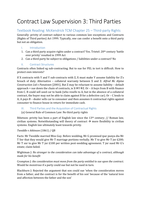
Contract Law Supervision 3: Third Parties
Textbook Reading: McKendrick TCM Chapter 25 – Third-party Rights
Generally: privity of contract subject to various common law exceptions and Contracts
(Rights of Third parties) Act 1999. Typically, one can confer a benefit onto a third party
but not an obligation.
I. Introduction
1. Can a third party acquire rights under a contract? Yes. Trietel: 20th century ‘battle
over privity’ resulted in 1999 Act
2. Can a third party be subject to obligations / liabilities under a contract? No
II. Contract Structures
Contracts often linked eg sub-contracting. But to sue for PEL in tort is difficult. How to
protect own interests?
If X contracts with Y and Y sub-contracts with Z, X must make Y assume liability for Z’s
breach of duty. Alternative – collateral warranty between X and Z: Alfred Mc Alpine
Construction Ltd v Panatown [2001]. But Z may be reluctant to assume liability – default
approach = sue down the chain of contracts, ie XYZ. Or – A buys from B with finance
from C. B could sell used car to bank (who resells to A, but in the absence of a collateral
contract, the buyer may not be able to claim against B for a defective car). Or – C lends to
A; A pays B – dealer sells car to consumer and then assumes it contractual rights against
consumer to finance house in return for immediate cash.
III. Third Parties and the Acquisition of Contractual Rights
(a) General Rule of Common Law: No third party rights
Ibbetson: privity has been a part of English law since the 13th century; // Roman law,
civilian systems. Notwithstanding will theory of contract more flexibility in civilian
systems. English law ultimately leant towards privity.
Tweddle v Atkinson (1861) / QB
Facts: Mr Tweddle married Miss Guy. Before wedding, Mr G promised ipar punya dia Mr
T Snr that they would give Mr T marriage portions verbally. Mr T to give Mr T jnr £200;
Mr T snr to give Mr T jnr £100 per written post-wedding agreement. T jnr sued Mr G’s
estate; claim failed.
Wightman J: No stranger to the consideration can take advantage of a contract, although
made for his benefit
Crompton J: the consideration must move from the party entitled to sue upon the contract.
Would be monstrous if a party could sue but not be sued in turn.
Blackburn J: Rejected the argument that son could sue ‘when the consideration moves
from a father, and the contract is for the benefit of his son’ because of the ‘natural love
and affection between the father and the son’
Textbook Reading: McKendrick TCM Chapter 25 – Third-party Rights
Generally: privity of contract subject to various common law exceptions and Contracts
(Rights of Third parties) Act 1999. Typically, one can confer a benefit onto a third party
but not an obligation.
I. Introduction
1. Can a third party acquire rights under a contract? Yes. Trietel: 20th century ‘battle
over privity’ resulted in 1999 Act
2. Can a third party be subject to obligations / liabilities under a contract? No
II. Contract Structures
Contracts often linked eg sub-contracting. But to sue for PEL in tort is difficult. How to
protect own interests?
If X contracts with Y and Y sub-contracts with Z, X must make Y assume liability for Z’s
breach of duty. Alternative – collateral warranty between X and Z: Alfred Mc Alpine
Construction Ltd v Panatown [2001]. But Z may be reluctant to assume liability – default
approach = sue down the chain of contracts, ie XYZ. Or – A buys from B with finance
from C. B could sell used car to bank (who resells to A, but in the absence of a collateral
contract, the buyer may not be able to claim against B for a defective car). Or – C lends to
A; A pays B – dealer sells car to consumer and then assumes it contractual rights against
consumer to finance house in return for immediate cash.
III. Third Parties and the Acquisition of Contractual Rights
(a) General Rule of Common Law: No third party rights
Ibbetson: privity has been a part of English law since the 13th century; // Roman law,
civilian systems. Notwithstanding will theory of contract more flexibility in civilian
systems. English law ultimately leant towards privity.
Tweddle v Atkinson (1861) / QB
Facts: Mr Tweddle married Miss Guy. Before wedding, Mr G promised ipar punya dia Mr
T Snr that they would give Mr T marriage portions verbally. Mr T to give Mr T jnr £200;
Mr T snr to give Mr T jnr £100 per written post-wedding agreement. T jnr sued Mr G’s
estate; claim failed.
Wightman J: No stranger to the consideration can take advantage of a contract, although
made for his benefit
Crompton J: the consideration must move from the party entitled to sue upon the contract.
Would be monstrous if a party could sue but not be sued in turn.
Blackburn J: Rejected the argument that son could sue ‘when the consideration moves
from a father, and the contract is for the benefit of his son’ because of the ‘natural love
and affection between the father and the son’


