

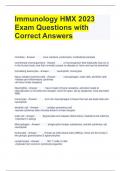
Immunology HMX 2023 Exam Questions w ith Correct Answers microbes - Answer virus, bacteria, protozoans, multicellular parasite commensal microorganisms - Answer a microorganism that habitually lives on or in the human body; one that normally causes no disease or harm and can be beneficial Circulating leukocytes - Answer neutrophils, monocytes tissue -resident sentinel cells - Answer macrophages, mast cells, dendritic cells -release pro -inflammatory cytokines -all have innate receptors Neutrophils - Answer have innate immune receptors, activation leads to internalization of microbe and receptor; short life span, die by apoptosis; most abundant WBC monocytes - Answer turn into macrophages in tissue that can eat dead cells and neutrophils dendritic cell - Answer -antigen presenting cell -secrete cytokines after microbe binds to innate receptor mast cell - Answer degranulate and release inflammatory mediators like histmine -important in allergy Macrophages - Answer phagocytize foreign substances, secrete cytokines, eat neutrophils leukocytes - Answer Known as white blood cells (WBCs), there are five kinds in two groups: granulocytes & agranulocytes Lymphocytes - Answer NK, T cells, b cells -originate from common lymphoid progenitor innate immunity characteristics - Answer react quickly, in same exact way for repeat infection, present before infection -cause inflammation -limited number of microbes it can respond to adaptive immunity characteristics - Answer -specific -systemic -travel continuously through body -has memory -late responders -response due to recognition of a specific antigen Process of innate inflammatory response - Answer 1. mirobes enter tissue and sentinel cells recognize and bind, release cytokines 2. cytokines bind to endothelium and increase expressing of adhesion molecules on lumen side 3. circulating leukocytes attach to adhesion molecules and are released into tissue 4. phagocytic cells kill 5. homeostasis restored Neutrophil -Endothelium Interaction - Answer -ICAM -1 on endo binds to LFA -1 on neutrophil=stable arrest -E-selection on endo binds to e -selectin ligand on neutrophil=lower affinity, rolling adhesion molecules on endothelium - Answer ICAM -1 and E -selection adhesion molecule ligands on leukocytes - Answer LFA -1 and e -selectin ligand pus - Answer -fluid -live and dead neutrophils -DNA from neutrophils -bacteria Pathogen -associated molecular patterns (PAMPs) - Answer molecules that are common on pathogens but not expressed in vertebrate cells Bacteria common PAMPs - Answer flagellin -Gram +: lipopolysaccharide -gram -: peptidogylcans, teichoic acids viral PAMPs - Answer ssRNA, dsRNA, dsDNA Pattern Recognition Receptors (PRRs) - Answer receptors on cell surface and in endosome that bind PAMPs and activate immune response -Toll-like receptors (TLRs) most common PAMPs and PRRs - Answer Microbes contain and release PAMPs —> activate PRRs of innate cells→ production of cytokines OR activate the antiviral state endosomal TLRs - Answer specific for nucleic acids -activate pathway to induce type 1 interferon secretion -antiviral state! Anti-viral state process - Answer 1. viral molecules bind to endosomal TLR on pDCs 2. binding signals for phosphorylation of transcription factors that go to nucleus to produce IFN genes 3. Type 1 IFNs released, trigger IFN receptors on neighboring cells to induce synthesis of protective proteins 4. antiviral state induced *protective proteins in all cells, but only cells with dsRNA from virus will die plasmacytoid dendritic cells (PDCs) - Answer sentinel cell that detects viruses and releases type 1 IFN Type 1 Interferon (IFN) - Answer cytokines that activate antiviral state Cell surface TLRs - Answer activate NF -kb pathway to induce the transcription of proinflammatory cytokine genes -specific for extracellular PAMPs Cell Surface TLR signaling - Answer 1. cell surface TLR recognizes extracellular PAMP 2. TLR signals for degradation of inhibitor on NF -kB 3. NF -kb is a transcription factor that goes to nucleus and binds to promoters 4. TNF and IL -7 genes promoted, creating cytokines like IFN, IL -1, TNFa complement activation - Answer cascade of events that leads to lysis, inflammation, and opsonization of microbes -always converge on cleavage of C3 protein C3 cleavage - Answer C3a: inflammation C3b: opsonization Opsonization - Answer coating antigen with antibody enhances phagocytosis C5 cleavage - Answer C5a: inflammation C5b: contributes to C9
Preview 3 out of 16 pages
Exam (elaborations)
Immunology HMX 2023 Exam Questions with Correct Answers
Preview 3 out of 16 pages
Immunology HMX 2023 Exam Questions with Correct Answers microbes - Answer virus, bacteria, protozoans, multicellular parasite commensal microorganisms - Answer a microorganism that habitually lives on or in the human body; one that normally causes no disease or harm and can be beneficial Circulating leukocytes - Answer neutrophils, monocytes tissue-resident sentinel cells - Answer macrophages, mast cells, dendritic cells -release pro-inflammatory cytokines -all have innate receptors Neutrophils - Answer have innate immune receptors, activation leads to internalization of microbe and receptor; short life span, die by apoptosis; most abundant WBC monocytes - Answer turn into macrophages in tissue that can eat dead cells and neutrophils dendritic cell - Answer -antigen presenting cell -secrete cytokines after microbe binds to innate receptor mast cell - Answer degranulate and release inflammatory mediators like histmine -important in allergy Macrophages - Answer phagocytize foreign substances, secrete cytokines, eat neutrophils leukocytes - Answer Known as white blood cells (WBCs), there are five kinds in two groups: granulocytes & agranulocytes Lymphocytes - Answer NK, T cells, b cells -originate from common lymphoid progenitor innate immunity characteristics - Answer react quickly, in same exact way for repeat infection, present before infection -cause inflammation -limited number of microbes it can respond to adaptive immunity characteristics - Answer -specific -systemic-travel continuously through body -has memory -late responders -response due to recognition of a specific antigen Process of innate inflammatory response - Answer 1. mirobes enter tissue and sentinel cells recognize and bind, release cytokines 2. cytokines bind to endothelium and increase expressing of adhesion molecules on lumen side 3. circulating leukocytes attach to adhesion molecules and are released into tissue 4. phagocytic cells kill 5. homeostasis restored Neutrophil-Endothelium Interaction - Answer -ICAM-1 on endo binds to LFA-1 on neutrophil=stable arrest -E-selection on endo binds to e-selectin ligand on neutrophil=lower affinity, rolling adhesion molecules on endothelium - Answer ICAM-1 and E-selection adhesion molecule ligands on leukocytes - Answer LFA-1 and e-selectin ligand pus - Answer -fluid -live and dead neutrophils -DNA from neutrophils -bacteria
Content preview
Document information
- Uploaded on
- September 12, 2023
- Number of pages
- 16
- Written in
- 2023/2024
- Type
- Exam (elaborations)
- Contains
- Questions & answers
$13.99
Wrong document? Swap it for free
Within 14 days of purchase and before downloading, you can choose a different document. You can simply spend the amount again.
Written by students who passed
Immediately available after payment
Read online or as PDF

Reputation scores are based on the amount of documents a seller has sold for a fee and the reviews they have received for those documents. There are three levels: Bronze, Silver and Gold. The better the reputation, the more your can rely on the quality of the sellers work.
Available in package deal
Package deal
Bundle For HMX Immunology Exam Questions and Answers All Correct

