
Industrial Organization exam
Chapter 1: What is strategy and the Strategic Management Process?
A firm’s strategy is defined as its theory about how to gain competitive advantages. All theories are
based on a set of assumptions and hypotheses about the way competition in this industry is likely to
evolve and how that evolution can be exploited to earn a profit. A strategy is a firm’s best bet about
how competition is going to evolve and how that evolution can be exploited for competitive
advantage.
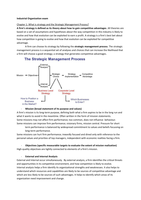
A firm can choose its strategy by following the strategic management process. The strategic
management process is a sequential set of analyses and choices that can increase the likelihood that
a firm will choose a good strategy; a strategy that generates competitive advantages.
- Mission (broad statement of its purpose and values)
A firm’s mission is its long-term purpose, defining both what a firm aspires to be in the long run and
what it wants to avoid in the meantime. Often written in the form of mission statements.
Some missions may not affect firm performance; too common, does not influence behaviour.
Some missions can improve firm performance; visionary firms, mission central. Pressure for short
term performance is balanced by widespread commitment to values and beliefs focussing on
long-term performance.
Some missions can hurt firm performance; inwardly focused and dined only with reference to the
personal values and priorities of top managers, independent with economic realities facing a firm.
- Objectives (specific measurable targets to evaluate the extent of mission realization)
High-quality objectives are tightly connected to elements of a firm’s mission.
- External and Internal Analysis
External and Internal occur simultaneously. By external analysis, a firm identifies the critical threats
and opportunities in its competitive environment, and how competition is likely to evolve.
Internal analysis helps a firm identify its organizational strengths and weaknesses. It also helps to
understand which resources and capabilities are likely to be sources of competitive advantage and
which are less likely to be sources of such advantages. It helps to identify which areas of its
organization need improvement and change.
Chapter 1: What is strategy and the Strategic Management Process?
A firm’s strategy is defined as its theory about how to gain competitive advantages. All theories are
based on a set of assumptions and hypotheses about the way competition in this industry is likely to
evolve and how that evolution can be exploited to earn a profit. A strategy is a firm’s best bet about
how competition is going to evolve and how that evolution can be exploited for competitive
advantage.
A firm can choose its strategy by following the strategic management process. The strategic
management process is a sequential set of analyses and choices that can increase the likelihood that
a firm will choose a good strategy; a strategy that generates competitive advantages.
- Mission (broad statement of its purpose and values)
A firm’s mission is its long-term purpose, defining both what a firm aspires to be in the long run and
what it wants to avoid in the meantime. Often written in the form of mission statements.
Some missions may not affect firm performance; too common, does not influence behaviour.
Some missions can improve firm performance; visionary firms, mission central. Pressure for short
term performance is balanced by widespread commitment to values and beliefs focussing on
long-term performance.
Some missions can hurt firm performance; inwardly focused and dined only with reference to the
personal values and priorities of top managers, independent with economic realities facing a firm.
- Objectives (specific measurable targets to evaluate the extent of mission realization)
High-quality objectives are tightly connected to elements of a firm’s mission.
- External and Internal Analysis
External and Internal occur simultaneously. By external analysis, a firm identifies the critical threats
and opportunities in its competitive environment, and how competition is likely to evolve.
Internal analysis helps a firm identify its organizational strengths and weaknesses. It also helps to
understand which resources and capabilities are likely to be sources of competitive advantage and
which are less likely to be sources of such advantages. It helps to identify which areas of its
organization need improvement and change.


