

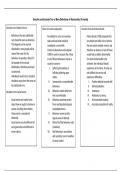
Describe and Evaluate Two or More Definitions of Abnormality (16 marks)
Deviation from Statistical Norms Failure to Function Adequately Deviation from Ideal Mental Health
Behaviours that are statistically An inability to carry out everyday Marie Jahoda (1958) proposed that
rare should be seen as abnormal. tasks and lead what would be we should start with a list of criteria
This depends on the normal considered a normal life. that we would consider normal, and
distribution; most people will be Criteria by Rosenhan and Seligman therefore an absence of any of these
around the mean for the (1989) is used to measure this. Many would help us define abnormality.
behaviour in question. About 5% or all of these behaviours may be a For ideal mental health to be
fall outside of the normal cause for concern: achieved, the individual should
distribution, therefore perceived I. Suffering themselves or experience all 6 criteria. If some are
as abnormal. inflicting suffering upon not fulfilled, the person will
Individuals need to be 2 standard others. experience difficulties:
deviations away from the mean to II. Unexpected or unpredictable I. Positive attitude towards self.
be statistically rare. behaviour. II. Self-actualisation.
Deviation from Social Norms III. Behaviour makes observers III. Autonomy.
feel uncomfortable. IV. Resistance to stress.
Social norms are implicit rules IV. Behaviour prevents person V. Environmental mastery.
about how we ought to behave in from reaching desired goals VI. Accurate perception of reality.
society. Anything that violates (maladaptiveness).
these norms is considered V. Behaviour seems to defy
abnormal. logical sense (irrational).
Social norms may be different for VI. Others find the behaviour odd
each generation and different in (vividness).
every culture. VII. Not behaving in accordance
with societies norms (violation
of moral codes).
, One limitation of deviation from social norms is that there is variability between social norms in
Point different cultures and even different situations/
The fact that there is so much variation cross culturally can be a weakness of the definition as it
Evidence/
Example
is not always clear what is abnormal and what is not in cultures. It is only by being immersed in
the culture for a period of time that the decision can be made.
This means it is difficult to judge deviation from social norms across different situations and
Link back
cultures and you could end up labelling someone abnormal by judging them by the inappropriate
Explain/
culture.
A strength of statistical infrequency is its usefulness.
Point
It is used in clinical practice as a form of diagnosis and a way to assess the severity of an
Evidence/
Example
individual’s symptoms. For example, it can help diagnose intellectual disability disorder if a score
is under 70. The Beck depression inventory is an assessment tool where a score of 30+
indicated severe depression.
Statistical infrequency criteria is useful in diagnosis and assessment processes.
Link back
Explain/
Represents a sensible threshold for when people need professional help
Point
Even though most of us have symptoms of mental disorder to some degree at some time, it helps
Evidence/
Example
those in the face of severe symptoms seek professional help or get noticed and referred for help
when they cease to function adequately.
This criterion means that treatment and services can be targeted to those who need them most.
Link back
Explain/
, Describe and Evaluate the Behaviourist Approach to Explaining Phobias (16 marks)
What is a Phobia? Classical Conditioning Operant Conditioning
A phobia is an intense, persistent, Learning by association. Takes place when our behaviour is
irrational fear for a particular Occurs when two stimuli, neutral reinforced (rewarded) or punished.
object, event or situation. stimulus (no initial fear response) and Reinforcement tends to increase the
unconditioned stimulus (triggers fear frequency of a behaviour.
response), are repeatedly paired In the case of negative reinforcement,
together, producing the same an individual avoids an unpleasant
response when the stimuli no longer situation which results in a desirable
occur together. consequence, causing the behaviour
Shows how we acquire a phobia. to be repeated.
Mowrer suggested that when we
avoid a phobic stimulus, we escape
the fear and anxiety that we should
have experienced if we remained
there. This reduction in fear
reinforces the avoidant behaviour
and so operant conditioning shows
how the phobia is maintained.
Deviation from Statistical Norms Failure to Function Adequately Deviation from Ideal Mental Health
Behaviours that are statistically An inability to carry out everyday Marie Jahoda (1958) proposed that
rare should be seen as abnormal. tasks and lead what would be we should start with a list of criteria
This depends on the normal considered a normal life. that we would consider normal, and
distribution; most people will be Criteria by Rosenhan and Seligman therefore an absence of any of these
around the mean for the (1989) is used to measure this. Many would help us define abnormality.
behaviour in question. About 5% or all of these behaviours may be a For ideal mental health to be
fall outside of the normal cause for concern: achieved, the individual should
distribution, therefore perceived I. Suffering themselves or experience all 6 criteria. If some are
as abnormal. inflicting suffering upon not fulfilled, the person will
Individuals need to be 2 standard others. experience difficulties:
deviations away from the mean to II. Unexpected or unpredictable I. Positive attitude towards self.
be statistically rare. behaviour. II. Self-actualisation.
Deviation from Social Norms III. Behaviour makes observers III. Autonomy.
feel uncomfortable. IV. Resistance to stress.
Social norms are implicit rules IV. Behaviour prevents person V. Environmental mastery.
about how we ought to behave in from reaching desired goals VI. Accurate perception of reality.
society. Anything that violates (maladaptiveness).
these norms is considered V. Behaviour seems to defy
abnormal. logical sense (irrational).
Social norms may be different for VI. Others find the behaviour odd
each generation and different in (vividness).
every culture. VII. Not behaving in accordance
with societies norms (violation
of moral codes).
, One limitation of deviation from social norms is that there is variability between social norms in
Point different cultures and even different situations/
The fact that there is so much variation cross culturally can be a weakness of the definition as it
Evidence/
Example
is not always clear what is abnormal and what is not in cultures. It is only by being immersed in
the culture for a period of time that the decision can be made.
This means it is difficult to judge deviation from social norms across different situations and
Link back
cultures and you could end up labelling someone abnormal by judging them by the inappropriate
Explain/
culture.
A strength of statistical infrequency is its usefulness.
Point
It is used in clinical practice as a form of diagnosis and a way to assess the severity of an
Evidence/
Example
individual’s symptoms. For example, it can help diagnose intellectual disability disorder if a score
is under 70. The Beck depression inventory is an assessment tool where a score of 30+
indicated severe depression.
Statistical infrequency criteria is useful in diagnosis and assessment processes.
Link back
Explain/
Represents a sensible threshold for when people need professional help
Point
Even though most of us have symptoms of mental disorder to some degree at some time, it helps
Evidence/
Example
those in the face of severe symptoms seek professional help or get noticed and referred for help
when they cease to function adequately.
This criterion means that treatment and services can be targeted to those who need them most.
Link back
Explain/
, Describe and Evaluate the Behaviourist Approach to Explaining Phobias (16 marks)
What is a Phobia? Classical Conditioning Operant Conditioning
A phobia is an intense, persistent, Learning by association. Takes place when our behaviour is
irrational fear for a particular Occurs when two stimuli, neutral reinforced (rewarded) or punished.
object, event or situation. stimulus (no initial fear response) and Reinforcement tends to increase the
unconditioned stimulus (triggers fear frequency of a behaviour.
response), are repeatedly paired In the case of negative reinforcement,
together, producing the same an individual avoids an unpleasant
response when the stimuli no longer situation which results in a desirable
occur together. consequence, causing the behaviour
Shows how we acquire a phobia. to be repeated.
Mowrer suggested that when we
avoid a phobic stimulus, we escape
the fear and anxiety that we should
have experienced if we remained
there. This reduction in fear
reinforces the avoidant behaviour
and so operant conditioning shows
how the phobia is maintained.


