
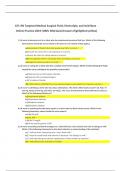
ATI: RN Targeted Medical Surgical Fluid, Electrolyte, and Acid -Base Online Practice 2019 (100% 30Q Quiz/Answers Highlighted yellow) 1.) A nurse is planning care for a client who has experienced excessive fluid loss. Which of the following interventions should the nurse include in the plan of care? (Select all that apply.) a.) Administer IV fluids to the client evenly over 24 hr is correct . b.) Provide the client with a salt substitute is incorrect. c.) Assess the client for pitting edema is incorrect. d.) Encourage the client to rise slowly when standing up is correct. e.) Weigh the client every 8 hr is correct. 2.) A nurse is caring f or a client who has a sodium level of 155 mEq/L. Which of the following IV fluids should the nurse anticipate the provider to prescribe? a.) Dextrose 5% in 0.9% sodium chloride b.) Dextrose 5% in lactated Ringer's c.) 3 % sodium chloride d.) 0.45% sodium chloride ( The nurse should anticipate a prescription for a hypotonic solution.) 3.) A nurse is admitting a client who has status asthmaticus. The client's ABG results are pH 7.32, PaO 2 74 mm Hg, PaCO 2 56 mm Hg, and HCO 3- 26 mEq/L. The nurse should interpret these laboratory values as which of the following imbalances? a.) Respiratory acidosis b.) Respiratory alkalosis c.) Metabolic acidosis d.) Metabolic alkalosis 4.) A nurse is reviewing the laboratory report of a clien t who has fluid volume excess. Which of the following laboratory values should the nurse expect? a.) Hgb 20 g/dL b.) Hct 34% c.) BUN 25 mg/dL d.) Urine specific gravity 1.050 5.) A nurse is teaching nutritional strategies to a client who has a low calcium level and an allergy to milk. Which of the following statements by the client indicates an understanding of the teaching? a.) "I will eat more cheese because I can't drink milk." b.) "I need to avoid foods with vitamin D because I am allergic to milk." c.) "I will stop taking my calcium supplements if they irritate my stomach." d.) "I will add broccoli and kale to my diet." 6.) A nurse is caring for a client who is receiving furosemide daily. During the morning assessment, the client tells the nurse that he is "feeling weak in the legs." Which of the following actions should the nurse take first? a.) Monitor the client's bowel sounds. Review the client's daily laboratory results. c.) Auscultate the client's lungs. d.) Palpate the client's peripheral pulses. 7.) A nurse is caring for a client who reports difficulty breathing and tingling in both hands. His respiratory rate is 36/min and he appears very restless. Which of the following values should the nurse anticipate to be outside the expected reference rang e if the client is experiencing respiratory alkalosis? a.) PaO 2 b.) PaCO 2 c.) Sodium d.) Bicarbonate 8.) A nurse is assessing a client who has a calcium level of 8.1 mg/dL. Which of the following findings is the priority for the nurse to assess? a.) Deep -tendon reflexes b.) Cardiac rhythm c.) Peripheral sensation d.) Bowel sounds 9.) While reviewing a client's laboratory results, a nurse notes a serum calcium level of 8.0 mg/dL. Which of the following actions should the nurse take? a.) Implement seizure precautions. b.) Administer phosphate. c.) Initiate diuretic therapy. d.) Prepare the client for hemodialysis. 10.)A nurse is providing teaching to a client who is at risk for developing respiratory acidosis following surgery. Which of th e following statements by the client indicates an understanding of the teaching? a.) "I should conserve energy by limiting my physical activity." b.) "I will wait until my pain is at least 6 out of 10 before I use the PCA." c.) "I will limit my daily fluid intake to two to three glasses." d.) "I will use the incentive spirometer every hour." 11.)A nurse is assessing a client who has a phosphorus level of 2.4 mg/dL. Which of the following findings should the nurse expect? a.) Hepatic failure b.) Abdominal pain c.) Slow peripheral pulses d.) Increase in cardiac output 12.)A nurse is caring for a client who requires continuous cardiac monitoring. The nurse identifies a prolonged PR interval and a widened QRS complex. Which of the following laborator y values supports this finding? a.) Sodium 152 mEq/L
Preview 2 out of 8 pages
Exam (elaborations)
ATI RN Targeted Medical Surgical Fluid, Electrolyte and Acid-Base Online Practice 2019
Preview 2 out of 8 pages
1.) A nurse is planning care for a client who has experienced excessive fluid loss. Which of the following interventions should the nurse include in the plan of care? (Select all that apply.) a.) Administer IV fluids to the client evenly over 24 hr is correct. b.) Provide the client with a salt substitute is incorrect. c.) Assess the client for pitting edema is incorrect. d.) Encourage the client to rise slowly when standing up is correct. e.) Weigh the client every 8 hr is correct. 2.) A nurse is caring for a client who has a sodium level of 155 mEq/L. Which of the following IV fluids should the nurse anticipate the provider to prescribe? a.) Dextrose 5% in 0.9% sodium chloride b.) Dextrose 5% in lactated Ringer's c.) 3 % sodium chloride d.) 0.45% sodium chloride (The nurse should anticipate a prescription for a hypotonic solution.) 3.) A nurse is admitting a client who has status asthmaticus. The client's ABG results are pH 7.32, PaO2 74 mm Hg, PaCO2 56 mm Hg, and HCO3- 26 mEq/L. The nurse should interpret these laboratory values as which of the following imbalances? a.) Respiratory acidosis b.) Respiratory alkalosis c.) Metabolic acidosis d.) Metabolic alkalosis 4.) A nurse is reviewing the laboratory report of a client who has fluid volume excess. Which of the following laboratory values should the nurse expect? a.) Hgb 20 g/dL b.) Hct 34% c.) BUN 25 mg/dL d.) Urine specific gravity 1.050 5.) A nurse is teaching nutritional strategies to a client who has a low calcium level and an allergy to milk. Which of the following statements by the client indicates an understanding of the teaching? a.) "I will eat more cheese because I can't drink milk." b.) "I need to avoid foods with vitamin D because I am allergic to milk." c.) "I will stop taking my calcium supplements if they irritate my stomach." d.) "I will add broccoli and kale to my diet." 6.) A nurse is caring for a client who is receiving furosemide daily. During the morning assessment, the client tells the nurse that he is "feeling weak in the legs." Which of the following actions should the nurse take first? a.) Monitor the client's bowel sounds. Review the client's daily laboratory results. c.) Auscultate the client's lungs. d.) Palpate the client's peripheral pulses. 7.) A nurse is caring for a client who reports difficulty breathing and tingling in both hands. His respiratory rate is 36/min and he appears very restless. Which of the following values should the nurse anticipate to be outside the expected reference range if the client is experiencing respiratory alkalosis? a.) PaO2 b.) PaCO2 c.) Sodium d.) Bicarbonate 8.) A nurse is assessing a client who has a calcium level of 8.1 mg/dL. Which of the following findings is the priority for the nurse to assess? a.) Deep-tendon reflexes b.) Cardiac rhythm c.) Peripheral sensation d.) Bowel sounds 9.) While reviewing a client's laboratory results, a nurse notes a serum calcium level of 8.0 mg/dL. Which of the following actions should the nurse take? a.) Implement seizure precautions. b.) Administer phosphate. c.) Initiate diuretic therapy. d.) Prepare the client for hemodialysis. 10.)A nurse is providing teaching to a client who is at risk for developing respiratory acidosis fol
Content preview
Document information
- Uploaded on
- September 10, 2023
- Number of pages
- 8
- Written in
- 2023/2024
- Type
- Exam (elaborations)
- Contains
- Questions & answers
$10.49
Wrong document? Swap it for free
Within 14 days of purchase and before downloading, you can choose a different document. You can simply spend the amount again.
Written by students who passed
Immediately available after payment
Read online or as PDF

Reputation scores are based on the amount of documents a seller has sold for a fee and the reviews they have received for those documents. There are three levels: Bronze, Silver and Gold. The better the reputation, the more your can rely on the quality of the sellers work.

