Gene expression and Cancer – AQA A Level Biology Summary Notes
Cancer arrises from uncontrolled cell division that produces a tumour
No all tumours are cancerous - malignant are, benign are non-cancerous
Tumour = mass of undifferentiated cells dividing out of control
Benign tumour = mass of undifferentiated cells dividing out of control that do not cause
cancer - if pieces break off, they will not start new tumours elsewhere in body
Malignant tumour = mass of undifferentiated cells dividing out of control that will undergo
metastasis - cells break off and form new tumours in other parts of the body
cancer = dividing cells from a tumour undergo metastasis
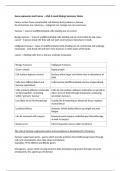
Benign Tumours Malignant Tumours
Grow v slowly Rapid growth
Cell nucleus appears normal Nucleus often larger and darker due to abundance of
DNA
Cells have differentiated and Cells become dedifferentiated and are unspecialised
become specialised
Cells produce adhesion molecules Cells do not produce adhesion molecules so spread to
so stick together, remaining other areas of body through metastasis, producing
within ‘primary’ tumour secondary tumours
Less likely to be life threatening Usually life threatening as abnormal tissue replaces
normal tissue
Localised effects Systemic (whole body) effects eg weight loss and
fatigue
Can be removed with surgery Removal usual requires radiotherapy/chemotherapy
as well as surgery
Rarely occur More frequently reoccur after treatment
The role of tumour-suppressor genes and oncogenes in development of tumours
Tumour suppressor genes - genes which encode proteins that inhibit progression through
cell cycle checkpoints, thus slow down cell division
Examples: TP53, BRCA1 and BRCA2 genes
Oncogenes - genes which encode proteins that stimulate progression through cell cycle
checkpoints, this speed up cell division
Cancer arrises from uncontrolled cell division that produces a tumour
No all tumours are cancerous - malignant are, benign are non-cancerous
Tumour = mass of undifferentiated cells dividing out of control
Benign tumour = mass of undifferentiated cells dividing out of control that do not cause
cancer - if pieces break off, they will not start new tumours elsewhere in body
Malignant tumour = mass of undifferentiated cells dividing out of control that will undergo
metastasis - cells break off and form new tumours in other parts of the body
cancer = dividing cells from a tumour undergo metastasis
Benign Tumours Malignant Tumours
Grow v slowly Rapid growth
Cell nucleus appears normal Nucleus often larger and darker due to abundance of
DNA
Cells have differentiated and Cells become dedifferentiated and are unspecialised
become specialised
Cells produce adhesion molecules Cells do not produce adhesion molecules so spread to
so stick together, remaining other areas of body through metastasis, producing
within ‘primary’ tumour secondary tumours
Less likely to be life threatening Usually life threatening as abnormal tissue replaces
normal tissue
Localised effects Systemic (whole body) effects eg weight loss and
fatigue
Can be removed with surgery Removal usual requires radiotherapy/chemotherapy
as well as surgery
Rarely occur More frequently reoccur after treatment
The role of tumour-suppressor genes and oncogenes in development of tumours
Tumour suppressor genes - genes which encode proteins that inhibit progression through
cell cycle checkpoints, thus slow down cell division
Examples: TP53, BRCA1 and BRCA2 genes
Oncogenes - genes which encode proteins that stimulate progression through cell cycle
checkpoints, this speed up cell division