3.6.4.1 Principles of homeostasis – AQA A Level Biology Summary Notes
Homeostasis
- Maintenance of a constant internal environment, within restricted limits, despite a change
environment
- Involves physiological control systems
Important to maintain stable core temperature and blood pH for optimum level enzyme activity
Explain IMPORTANCE:
- Excess heat/extremes of pH break bonds that determine enzyme’s tertiary structure
- Enzyme’s tertiary structure is changed, altering shape of active site, resulting in enzymes
become denatured
- Too low heat means less thermal energy, less kinetic energy of molecules, fewer collisions
between enzymes and substrates, less ESCs forming so less product made – slower RoR
- Too low pH (excess H+ ions)
- Too high pH (excess OH- ions)
Body temperature is regulated by – sweating, vasodilation/vasoconstriction, body hair raising and
flattening
Important to maintain a stable/relatively high blood glucose concentration as glucose is the
primary respiratory substrate used to generate ATP
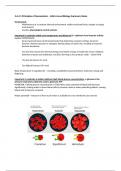
HOWEVER, if blood glucose concentration is TOO HIGH, water potential of blood will decrease
significantly, chasing water to leave blood cells by osmosis, down a water potential gradient, causing
blood cells to become crenated
Water potential = measure of how much water is available to cross membranes by osmosis