

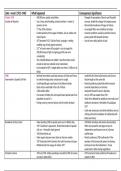
Date + event (1935-1940) What happened Consequences/significance
October 1935 - 400,000 men, quickly seized Adwa - Changed the perception of fascism and Mussolini
Invasion of Abyssinia - Use of mass aerial bombing, chemical warfare + murder of overseas, looked like a danger to European peace
prisoners of war - Demonstrated weakness of league of nations
- 5th May 1936 victorious - encouraged Hitlers own ambitions in Europe
- Limited sanctions from League of Nations, only on rubber and - economic problems caused by sanctions forced a
metal imports. growing trade shift towards Germany
- 18th December 1935, ‘Gold for Patria’ campaign = melting - start of more radical policies in Italy
wedding rings to help against sanctions.
- 2/3rd of country were still occupied + costs to supply the
250,000 troops to fight an ongoing guerrilla war were
considerable
- Only 130,000 Italians ever settled + hope that colony would
provide oil and raw materials never materialised.
- Lira devalued by 40% + budget deficit rose from 2.5 billion to 16
billion.
1936 - believed intervention would put pressure on Britain and France - marked the first time Italian fascism and German
Intervention in Spanish Civil War to make the foreign policy concessions he sought. Nazism fought on the same side
- Could hopefully gain naval bases in the Balearic Islands - financial problems pushed Italy further towards
- Quick victory would add to the cult of il Duce economic dependence on Germany
- 3,300 soldiers killed - hampered Mussolini’s aims in Abyssinia
- Cost around 14 billion lire and required exact special taxes from - army in 1939 was weaker than 1936
population to pay for it. - Italian force defeated by republican army made up of
- Foreign currency reserves halved, and lira further devalued antifascist volunteers in the Battle of Guadalajara
1937
- Costly and unnecessary, territorial ambitions came to
nothing and lead to breakdown of relationship with
Britain and France
Breakdown of Stresa Front - Italian bombing 1938 on Spanish ports sunk 11 British ships - 1938 Hitler Anschluss with Austria demonstrated
- 1937 ‘Gentlemen’s agreement’, limited intervention in Spanish Hitler more powerful, Italy began to lose its
civil war -> Mussolini simply ignored independence and became more of a German
- 1936 Rome-Berlin axis satellite state.
- Italian exports become more reliant on German markets - Munich conference 1938 confirmed to M the
- 1937 Italy joined Anti-Comintern Pact with Germany and Japan weakness of the democratic powers in allowing
- Withdrew Italy from League of nations 1937 Germany to have the Sudetenland – M was
subservient to Hitler during negotiations
Domestic tensions - 1935 and 1939, military spending accounted for 80% of massive - 1939 commercial treaty confirmed M weakness in
increase in state deficit. respect to Hitler
October 1935 - 400,000 men, quickly seized Adwa - Changed the perception of fascism and Mussolini
Invasion of Abyssinia - Use of mass aerial bombing, chemical warfare + murder of overseas, looked like a danger to European peace
prisoners of war - Demonstrated weakness of league of nations
- 5th May 1936 victorious - encouraged Hitlers own ambitions in Europe
- Limited sanctions from League of Nations, only on rubber and - economic problems caused by sanctions forced a
metal imports. growing trade shift towards Germany
- 18th December 1935, ‘Gold for Patria’ campaign = melting - start of more radical policies in Italy
wedding rings to help against sanctions.
- 2/3rd of country were still occupied + costs to supply the
250,000 troops to fight an ongoing guerrilla war were
considerable
- Only 130,000 Italians ever settled + hope that colony would
provide oil and raw materials never materialised.
- Lira devalued by 40% + budget deficit rose from 2.5 billion to 16
billion.
1936 - believed intervention would put pressure on Britain and France - marked the first time Italian fascism and German
Intervention in Spanish Civil War to make the foreign policy concessions he sought. Nazism fought on the same side
- Could hopefully gain naval bases in the Balearic Islands - financial problems pushed Italy further towards
- Quick victory would add to the cult of il Duce economic dependence on Germany
- 3,300 soldiers killed - hampered Mussolini’s aims in Abyssinia
- Cost around 14 billion lire and required exact special taxes from - army in 1939 was weaker than 1936
population to pay for it. - Italian force defeated by republican army made up of
- Foreign currency reserves halved, and lira further devalued antifascist volunteers in the Battle of Guadalajara
1937
- Costly and unnecessary, territorial ambitions came to
nothing and lead to breakdown of relationship with
Britain and France
Breakdown of Stresa Front - Italian bombing 1938 on Spanish ports sunk 11 British ships - 1938 Hitler Anschluss with Austria demonstrated
- 1937 ‘Gentlemen’s agreement’, limited intervention in Spanish Hitler more powerful, Italy began to lose its
civil war -> Mussolini simply ignored independence and became more of a German
- 1936 Rome-Berlin axis satellite state.
- Italian exports become more reliant on German markets - Munich conference 1938 confirmed to M the
- 1937 Italy joined Anti-Comintern Pact with Germany and Japan weakness of the democratic powers in allowing
- Withdrew Italy from League of nations 1937 Germany to have the Sudetenland – M was
subservient to Hitler during negotiations
Domestic tensions - 1935 and 1939, military spending accounted for 80% of massive - 1939 commercial treaty confirmed M weakness in
increase in state deficit. respect to Hitler


