

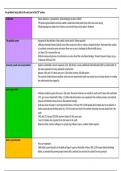
Key problems facing Italy in the early part of the 20 th century.
Unification - Italians defined as ‘campanilismo’ (pride belonging to place of birth)
- 99% spoke regional dialect and were unable to understand what people from other areas were saying
- Official language was dialect from Florence, but even the king mostly spoke in Piedmont
The political system - Hampered by the attitudes of the catholic church and the ‘Roman question’
- 1886 pope formally forbade Catholics from either running for office or voting in national elections prevented the creation
of a national conservative party and meant there was no one to challenge the liberal middle classes.
- Less than 25% of men had the vote
- Political manoeuvring known as trasformismo as many shared the same liberal ideology meant frequent changes in gov,
29 between 1870 and 1922
Economic growth and social problems - Despite considerable economic expansion, (Fiat, Alfa Romeo, Lancia established) industrialisation didn’t provide benefits to
the wider population the living standards remained low.
- Between 1901 and 1911 there were over 1,500 strikes involving 350,000 workers.
- The economic divide between wealthier north and more impoverished south was viewed as one of major barriers in creating
the unified nation they longed for.
North-south divide
- Politicians tended to ignore the issues in the south no prime minister even visited the south until 32 years after unification
- 1911, gov census showed half of Italys 2.2 million industrial workers were employed in the northern provinces of Lombardy,
Linguria and Piedmont (area known as the industrial triangle)
- South was more of Europe’s’ most impoverished areas, 1910 and 1911 25,000 people died in Naples due to an epidemic of
cholera caused by poor drinking water. By 1911 the income per head in the northern industrial area was double that in the
south.
- 1901 and 1913 around 200,000 southern Italians left Italy every year.
- 3 out of 4 Italians who migrated to the USA came to the south
- Reliant on other countries willingness to accept large influxes of poor, unskilled, Italian migrants.
Italy as a great power
- Policy of irredentism
- 1884 failed to gain Abyssinia at the Battle of Dogali + again at the Battle of Adwa 1896, 5,000 troops killed (humiliating
defeat, accentuated the growing anger towards Italy’s political class and was the catalyst for mass protests)
Unification - Italians defined as ‘campanilismo’ (pride belonging to place of birth)
- 99% spoke regional dialect and were unable to understand what people from other areas were saying
- Official language was dialect from Florence, but even the king mostly spoke in Piedmont
The political system - Hampered by the attitudes of the catholic church and the ‘Roman question’
- 1886 pope formally forbade Catholics from either running for office or voting in national elections prevented the creation
of a national conservative party and meant there was no one to challenge the liberal middle classes.
- Less than 25% of men had the vote
- Political manoeuvring known as trasformismo as many shared the same liberal ideology meant frequent changes in gov,
29 between 1870 and 1922
Economic growth and social problems - Despite considerable economic expansion, (Fiat, Alfa Romeo, Lancia established) industrialisation didn’t provide benefits to
the wider population the living standards remained low.
- Between 1901 and 1911 there were over 1,500 strikes involving 350,000 workers.
- The economic divide between wealthier north and more impoverished south was viewed as one of major barriers in creating
the unified nation they longed for.
North-south divide
- Politicians tended to ignore the issues in the south no prime minister even visited the south until 32 years after unification
- 1911, gov census showed half of Italys 2.2 million industrial workers were employed in the northern provinces of Lombardy,
Linguria and Piedmont (area known as the industrial triangle)
- South was more of Europe’s’ most impoverished areas, 1910 and 1911 25,000 people died in Naples due to an epidemic of
cholera caused by poor drinking water. By 1911 the income per head in the northern industrial area was double that in the
south.
- 1901 and 1913 around 200,000 southern Italians left Italy every year.
- 3 out of 4 Italians who migrated to the USA came to the south
- Reliant on other countries willingness to accept large influxes of poor, unskilled, Italian migrants.
Italy as a great power
- Policy of irredentism
- 1884 failed to gain Abyssinia at the Battle of Dogali + again at the Battle of Adwa 1896, 5,000 troops killed (humiliating
defeat, accentuated the growing anger towards Italy’s political class and was the catalyst for mass protests)


