

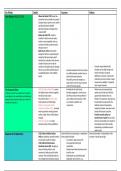
Key Policies Details Successes Failures
Early Policies 1922-25, 25-29 - Alberto de Stefani 1922 (laissez faire
economics were pursued) was a general
European boom, exports in cars, textiles
agricultural products doubled.
Agricultural groups not happy about
reduced tariffs.
- Replace by Volpi 1925, marked a
transition in fascist economic policy
towards a more regulated, state-run
economy that had a greater personal
influence from M.
- Battle for Lira 1926, M viewed the
strength of the lira as representing the
strength of the fascist regime itself –
declared the revaluation of the lira was
a battle that had to be won by the
sacrifices of the Italian nation. Although - Economic experts believed this
the lira was at 150lira to British pound, - Important example of how the economy valuation was too high and gov was
he artificially fixed it to 92.46 British was shifting towards a greater focus on forced to introduce a range of
pound. policies that would represent deflationary measures, massive price
Mussolini’s power and strength as a reductions and cuts to workers’ wages.
leader and less on the actual economic - Caused serious deflation + hampered
needs of the Italian people. Italys’ export industries
The Corporate State - 1925 The Palazzo Vidoni Pact, asserts - Provided jobs for loyal fascists - Workers were not represented by
(In theory meant to be a mixed union of workers that Italian industry will only negotiate - Excellent propaganda + used to prove workers at all but by fascist officials,
and employers who would discuss and implement with fascist trade unions that M had overcome the problems of approved by Mussolini who was
national economic planning that was conductive - Result of the failed Rocco law 1926 – class conflict and constructed a ‘third Minister of Corporations. Any plans put
to both their interests.) made lockouts and strikes illegal way’ between capitalism and forward had to be approved by the
- Ministry of corporations 1926 communism. National Council of Corporations,
- Charter of the Labour 1927 – promised headed by Mussolini, who alone could
mixed corporations would guarantee decide what became actual law.
worker’s rights. (Never really followed - Practical economic policy was
through) subservient to a façade that was more
- 1934, 22 corporations of major intent on constructing M as a leader of
economic sectors of Italy established international renown then actually
implementing a workable economic
basis for Italy.
Response to the Depression - 1932 instituto Mobiliare italiano Saved small firms from bankruptcy + employment Restricted innovation + rationalisation of the
(IMI)was established, provided credit to levels stayed fairly stable economy + kept the prices high
ensure banks would not collapse - Cut workers’ wages around 12%,
- 1932 Instituto di Ricostruzione encouraged price fixing and
Industriale scheme (IRI) - Brought up cartelisation.
shares in banking, industry, and - Mergers meant fewer businesses were
commerce to help prop up the Italian forced to close
economy. Then provided education on - Employment was provided through
new management techniques and gave large public work schemes, e.g.,
Early Policies 1922-25, 25-29 - Alberto de Stefani 1922 (laissez faire
economics were pursued) was a general
European boom, exports in cars, textiles
agricultural products doubled.
Agricultural groups not happy about
reduced tariffs.
- Replace by Volpi 1925, marked a
transition in fascist economic policy
towards a more regulated, state-run
economy that had a greater personal
influence from M.
- Battle for Lira 1926, M viewed the
strength of the lira as representing the
strength of the fascist regime itself –
declared the revaluation of the lira was
a battle that had to be won by the
sacrifices of the Italian nation. Although - Economic experts believed this
the lira was at 150lira to British pound, - Important example of how the economy valuation was too high and gov was
he artificially fixed it to 92.46 British was shifting towards a greater focus on forced to introduce a range of
pound. policies that would represent deflationary measures, massive price
Mussolini’s power and strength as a reductions and cuts to workers’ wages.
leader and less on the actual economic - Caused serious deflation + hampered
needs of the Italian people. Italys’ export industries
The Corporate State - 1925 The Palazzo Vidoni Pact, asserts - Provided jobs for loyal fascists - Workers were not represented by
(In theory meant to be a mixed union of workers that Italian industry will only negotiate - Excellent propaganda + used to prove workers at all but by fascist officials,
and employers who would discuss and implement with fascist trade unions that M had overcome the problems of approved by Mussolini who was
national economic planning that was conductive - Result of the failed Rocco law 1926 – class conflict and constructed a ‘third Minister of Corporations. Any plans put
to both their interests.) made lockouts and strikes illegal way’ between capitalism and forward had to be approved by the
- Ministry of corporations 1926 communism. National Council of Corporations,
- Charter of the Labour 1927 – promised headed by Mussolini, who alone could
mixed corporations would guarantee decide what became actual law.
worker’s rights. (Never really followed - Practical economic policy was
through) subservient to a façade that was more
- 1934, 22 corporations of major intent on constructing M as a leader of
economic sectors of Italy established international renown then actually
implementing a workable economic
basis for Italy.
Response to the Depression - 1932 instituto Mobiliare italiano Saved small firms from bankruptcy + employment Restricted innovation + rationalisation of the
(IMI)was established, provided credit to levels stayed fairly stable economy + kept the prices high
ensure banks would not collapse - Cut workers’ wages around 12%,
- 1932 Instituto di Ricostruzione encouraged price fixing and
Industriale scheme (IRI) - Brought up cartelisation.
shares in banking, industry, and - Mergers meant fewer businesses were
commerce to help prop up the Italian forced to close
economy. Then provided education on - Employment was provided through
new management techniques and gave large public work schemes, e.g.,


