
Fresenius annual competency study guide 2023
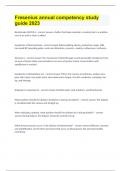
Bicarbonate (HCO3) is a buffer that helps maintain a constant pH in a solution even if an acid or base is added Symptoms of fluid overload Edema/pitting edema, productive cough, SOB, increased BP, bounding pulse, neck vein distention, cyanosis,, anxiety, restlessness, confusion Osmosis is The movement of fluid through a semi-permeable membrane from an area of lesser solute concentration to an area of greater solute concentration until equilibrium is reached Symptoms of dehydration are Thirst, dry mucous membranes, sunken eyes, poor skin turgor, low grade temp, decreased urine output, dry skin, weakness, cramping, low bp, and lethargy Dialysate is composed of Purified water, acid solutions, and bicarbonate What position should the dialyzer should be in during circulation? The dialyzer is circulated with the venous end straight up. When dialyzing a patient, what position should the dialyzer be in during dialysis? During dialysis, the dialyzer should be arterial end up What three processes occur in the dialyzer simultaneously? Diffusion, osmosis, and ultrafiltration are the three processes that occur as blood passes the semi-permeable membrane What direction does the blood flow through the dialyzer as compared to dialysate flow? Blood and dialysate flow in a countercurrent flow, as blood flows down into the dialyzer (arterial to venous)dialysate flows up (venous to arterial)Opposite flow allows better clearance How can you tell if a dialyzer is clotting? Indications of clotting dialyzer are rising TMP, rising venous pressure, dark blood in the dialyzer, and air detector alarms. Sign of venous line that is clotting is what? Increased venous pressure is a sign of clotting. Possible causes of increased venous pressure: Infiltration, malpositioned needle, tubing kinks, clamped tubing, system clotting, or a patient coughing can cause increase venous pressure. What is TMP? Transmembrane pressure is the pressure difference across the dialyzer membrane. It reflects the TOTAL PRESSURE across the membrane used to achieve the desired fluid loss. If a patient has prolonged bleeding form ONE cannulation site site, it is most likely not the heparin but what? Prolonged bleeding from ONE cannulation site usually caused from repeated cannulations in the same site When might the heparin dose be increased by the physician? The heparin dose may be increased when a patient's KECN's are decreasing during the tx, the pt is experiencing signs of clotting in the dialyzer or extracorporeal circuit, or if the pt has an infection or fever. Decreasing KECN can be an indicator of what? Decreasing KECN may indicate the dialyzer is losing surface area and clotting can be one potential cause of that loss of surface area. Heparin dose must be looked at. How long to wait to initiate tx after heparin has been given? 3-5 minutes is mandatory wait time after heparin given before tx can be initiated. Circumstances to contraindicate the use of heparin are what? Allergic/sensitive to heparin, Active bleeding, scheduled for surgery, post surgery or dental procedures are circumstances which contraindicate heparin
Document information
- Uploaded on
- September 6, 2023
- Number of pages
- 3
- Written in
- 2023/2024
- Type
- Exam (elaborations)
- Contains
- Questions & answers


