AORN Review for Final Exam .pdf
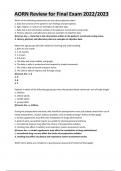
At what point in the healing process do most wound disruptions occur? a. Beginning of proliferation phase - (phase 2) 2-10 days b. End of proliferation phase - (phase 2) - 10-22 days c. Beginning of maturation phase (phase 3) - 21 days to 6 weeks d. End of maturation phase (phase 3) 6 weeks to 2 years {{Correct Ans- a. Beginning of proliferation phase - (phase 2) 2-10 days Match each type of wound with it's appropriate example 1. Clean wounds 2. Clean contaminated wounds 3. Contaminated wounds 4. Dirty wounds a. colon resection b. open or fresh traumatic wounds c. ruptured appendix d. thyroidectomy {{Correct Ans- 1. d 2. a 3. b 4. c Prolonged high dosages of steroids preoperatively delay ______. a. hemoglobin formation b. bile production c. insulin production d. collagen formation {{Correct Ans- d. collagen formation The CDC's Classification of Surgical Wounds system is intended to ______. a. categorize surgical wounds based on coexisting diseases and according to origin, diagnosis, and treatment. b. elaborate on the CDC's principles of universal precautions by establishing guidelines for treating infections should they occur c. suggest emergency criteria for dealing with infections inside the procedure room d. monitor postoperative infections and suggest steps to take to reduce these infections {{Correct Ans - d. monitor postoperative infections and suggest steps to take to reduce these infections Select the intraoperative factors that negatively affect wound healing. (SATA) a. A surgical complication b. Failure to eliminate dead space when closing the incision c. Implantation of orthopedic hardware d. Surgical incisions in an area of high mobility e. Surgical incisions in highly vascular areas f. Use of x-ray during the procedure {{Correct Ans- a. A surgical complication b. Failure to eliminate dead space when closing the incision c. Implantation of orthopedic hardware d. Surgical incisions in an area of high mobility Match the Topical Hemostatic Method with the appropriate Method of Action. 1. Passive 2. Flowables 3. Fibrin Sealants 4. Active a. enhanced clotting b. mechanically obstruct flow of blood c. provide a barrier d. increase amount of fibrinogen at site {{Correct Ans- 1. c 2. b 3. d 4. a Methods of producing hemostasis include which of the following? a. administering blood b. applying pressure c. using electrocautery d. irrigating with large amounts of sterile saline e. using an antiseptic solution containing alcohol f. using topical hemostatic agents {{Correct Ans- a. administering blood b. applying pressure c. using electrocautery f. using topical hemostatic agents The process of digestion of pathogens by neutrophils and macrophages is known as ______. a. epithelialization b. hemostasis c. edema formation d. phagocytosis e. proliferation {{Correct Ans- d. phagocytosis What contributes to potential complications of minimally invasive surgery? a. positioning b. distention glass c. irrigation fluids d. all of the above {{Correct Ans- d. all of the above Which of the following statements about light source safety is incorrect? a. Connect the light cable to the scope before turning on the light source. b. When not in use, the light source should be disconnected from the scope and placed on the drapes. c. Follow the manufacturer's instructions for use. d. Check the lightbulb status/hours before starting the case. {{Correct Ans- b. When not in use, the light source should be Which of the following statements about the CO2 insufflator is correct? a. Be sure the alarm is off so as not to interfere with anesthesia alarms. b. Intra-abdominal CO2 pressures should be 15mmHg or higher. c. Position the insufflator at the level of the patient's heart or higher. d. The insufflator tubing should have a one-way valve. {{Correct Ans- c. Position the insufflator at the level of the patient's heart or higher. Which region of the patient's abdomen is traditionally used to establish pneumoperitoneum for laparoscopic surgery? a. periumbilical b. supraumbilical c. sub umbilical d. umbilical {{Correct Ans- a. periumbilical CO2 is the gas used for abdominal insufflation because a. it is rapidly eliminated b. it increases combustion c. it is easily absorbed, causing serious adverse effects d. none of the above {{Correct Ans- a. it is rapidly eliminated Advantages of Minimally Invasive Surgery include: a. a longer recuperative period b. increased pain medication requirements c. a prolonged hospitalization d. an earlier return to normal activities {{Correct Ans- d. an earlier return to normal activities What is the meaning of capacitive coupling? a. Electrical current transfer through intact insulation b. Electrical current transfer through non-intact insulation c. Electrical current transfer through the insufflation line d. Electrical current transfer with abdominal irrigation {{Correct Ans- a. Electrical current transfer through intact insulation What is a responsibility of the scrub person ahead of a laparoscopic procedure? a. Assuming insulation cracks or breaks are discovered by sterilization techs. b. Checking and tightening any screws on endoscopic instruments. c. Cleaning bioburden off of instruments during case set-up. d. Using any endoscopic instrument set for all types of minimally invasive surgery. {{Correct Ans- b. Checking and tightening any screws on endoscopic instruments.
Document information
- Uploaded on
- September 6, 2023
- Number of pages
- 52
- Written in
- 2023/2024
- Type
- Exam (elaborations)
- Contains
- Questions & answers