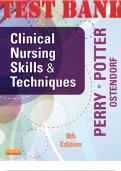
, Clinical Nursing Skills and Techniques 8th Edition Perry Test Bank
Clinical Nursing Skills and Techniques 8th Edition Perry
Test Bank
Chapter 1: Using Evidence in Nursing Practice
MULTIPLE CHOICE
1. Evidence-based practice is a problem-solving approach to making decisions about patient care
that is grounded in:
A) the latest information found in textbooks.
B) systematically conducted research studies.
C) tradition in clinical practice.
D) quality improvement and risk management data.
ANS: B
The best evidence comes from well-designed, systematically conducted research studies
described in scientific journals. Portions of a textbook often become outdated by the time it is
published. Many health care settings do not have a process to help staff adopt new evidence in
practice, and nurses in practice settings lack easy access to risk management data, relying
instead on tradition or convenience. Some sources of evidence do not originate from research.
These include quality improvement and risk management data; infection control data;
retrospective or concurrent chart reviews; and clinicians’ expertise. Although
non–research-based evidence is often very valuable, it is important that you learn to rely more
on research-based evidence.
DIF: Cognitive Level: Comprehension REF: Text reference: p. 2
OBJ: Discuss the benefits of evidence-based practice. TOP: Evidence-Based Practice
KEY: Nursing Process Step: Assessment
MSC: NCLEX: Safe and Effective Care Environment (management of care)
NUR SI NG TB.C OM
2. When evidence-based practice is used, patient care will be:
A) standardized for all.
B) unhampered by patient culture.
C) variable according to the situation.
D) safe from the hazards of critical thinking.
ANS: C
Using your clinical expertise and considering patients’ cultures, values, and preferences
ensures that you will apply available evidence in practice ethically and appropriately. Even
when you use the best evidence available, application and outcomes will differ; as a nurse,
you will develop critical thinking skills to determine whether evidence is relevant and
appropriate.
DIF: Cognitive Level: Application REF: Text reference: p. 2
OBJ: Discuss the benefits of evidence-based practice. TOP: Evidence-Based Practice
KEY: Nursing Process Step: Assessment
MSC: NCLEX: Safe and Effective Care Environment (management of care)
3. When a PICOT question is developed, the letter that corresponds with the usual standard of
care is:
A) P.
B) I.
PRIMEXAM.COM
, Clinical Nursing Skills and Techniques 8th Edition Perry Test Bank
C) C.
D) O.
ANS: C
C = Comparison of interest. What standard of care or current intervention do you usually use
now in practice?
P = Patient population of interest. Identify your patient by age, gender, ethnicity, disease, or
health problem.
I = Intervention of interest. What intervention (e.g., treatment, diagnostic test, prognostic
factor) do you think is worthwhile to use in practice?
O = Outcome. What result (e.g., change in patient’s behavior, physical finding, change in
patient’s perception) do you wish to achieve or observe as the result of an intervention?
DIF: Cognitive Level: Knowledge REF: Text reference: p. 3
OBJ: Develop a PICO question. TOP: PICO
KEY: Nursing Process Step: Implementation
MSC: NCLEX: Safe and Effective Care Environment (management of care)
4. A well-developed PICOT question helps the nurse:
A) search for evidence.
B) include all five elements of the sequence.
C) find as many articles as possible in a literature search.
D) accept standard clinical routines.
ANS: A
The more focused a question that you ask is, the easier it is to search for evidence in the
scientific literature. A well-designed PICOT question does not have to include all five
elements, nor does it have to follow the PICOT sequence. Do not be satisfied with clinical
routines. Always question anN dUusR
eScrI NG
itic thB
al T in.kC OM
ing to consider better ways to provide patient
care.
DIF: Cognitive Level: Analysis REF: Text reference: p. 4
OBJ: Describe the six steps of evidence-based practice. TOP: Evidence-Based Practice
KEY: Nursing Process Step: Implementation
MSC: NCLEX: Safe and Effective Care Environment (management of care)
5. The nurse is not sure that the procedure the patient requires is the best possible for the
situation. Utilizing which of the following resources would be the quickest way to review
research on the topic?
A) CINAHL
B) PubMed
C) MEDLINE
D) The Cochrane Library
ANS: D
The Cochrane Library Database of Systematic Reviews is a valuable source of synthesized
evidence (i.e., preappraised evidence). The Cochrane Database includes the full text of
regularly updated systematic reviews and protocols for reviews currently happening.
MEDLINE, CINAHL, and PubMed are among the most comprehensive databases and
represent the scientific knowledge base of health care.
DIF: Cognitive Level: Synthesis REF: Text reference: p. 4
OBJ: Describe the six steps of evidence-based practice. TOP: Evidence-Based Practice
PRIMEXAM.COM
, Clinical Nursing Skills and Techniques 8th Edition Perry Test Bank
KEY: Nursing Process Step: Implementation
MSC: NCLEX: Safe and Effective Care Environment (management of care)
6. The nurse is getting ready to develop a plan of care for a patient who has a specific need. The
best source for developing this plan of care would probably be:
A) The Cochrane Library.
B) MEDLINE.
C) NGC.
D) CINAHL.
ANS: C
The National Guidelines Clearinghouse (NGC) is a database supported by the Agency for
Healthcare Research and Quality (AHRQ). It contains clinical guidelines—systematically
developed statements about a plan of care for a specific set of clinical circumstances involving
a specific patient population. The NGC is a valuable source when you want to develop a plan
of care for a patient. The Cochrane Library Database of Systematic Reviews, MEDLINE, and
CINAHL are all valuable sources of synthesized evidence (i.e., preappraised evidence).
DIF: Cognitive Level: Synthesis REF: Text reference: p. 4
OBJ: Describe the six steps of evidence-based practice. TOP: Evidence-Based Practice
KEY: Nursing Process Step: Implementation
MSC: NCLEX: Safe and Effective Care Environment (management of care)
7. The nurse has done a literature search and found 25 possible articles on the topic that she is
studying. To determine which of those 25 best fit her inquiry, the nurse first should look at:
A) the abstracts.
B) literature reviews.
C) the “Methods” sections. NURSINGTB.COM
D) the narrative sections.
ANS: A
An abstract is a brief summary of an article that quickly tells you whether the article is
research based or clinically based. An abstract summarizes the purpose of the study or clinical
query, the major themes or findings, and the implications for nursing practice. The literature
review usually gives you a good idea of how past research led to the researcher’s question.
The “Methods” or “Design” section explains how a research study is organized and conducted
to answer the research question or to test the hypothesis. The narrative of a manuscript differs
according to the type of evidence-based article—clinical or research.
DIF: Cognitive Level: Application REF: Text reference: p. 7
OBJ: Discuss elements to review when critiquing the scientific literature.
TOP: Randomized Controlled Trials KEY: Nursing Process Step: Implementation
MSC: NCLEX: Safe and Effective Care Environment (management of care)
8. The nurse wants to determine the effects of cardiac rehabilitation program attendance on the
level of postmyocardial depression for individuals who have had a myocardial infarction. The
type of study that would best capture this information would be a:
A) randomized controlled trial.
B) qualitative study.
C) case control study.
D) descriptive study.
PRIMEXAM.COM
Clinical Nursing Skills and Techniques 8th Edition Perry
Test Bank
Chapter 1: Using Evidence in Nursing Practice
MULTIPLE CHOICE
1. Evidence-based practice is a problem-solving approach to making decisions about patient care
that is grounded in:
A) the latest information found in textbooks.
B) systematically conducted research studies.
C) tradition in clinical practice.
D) quality improvement and risk management data.
ANS: B
The best evidence comes from well-designed, systematically conducted research studies
described in scientific journals. Portions of a textbook often become outdated by the time it is
published. Many health care settings do not have a process to help staff adopt new evidence in
practice, and nurses in practice settings lack easy access to risk management data, relying
instead on tradition or convenience. Some sources of evidence do not originate from research.
These include quality improvement and risk management data; infection control data;
retrospective or concurrent chart reviews; and clinicians’ expertise. Although
non–research-based evidence is often very valuable, it is important that you learn to rely more
on research-based evidence.
DIF: Cognitive Level: Comprehension REF: Text reference: p. 2
OBJ: Discuss the benefits of evidence-based practice. TOP: Evidence-Based Practice
KEY: Nursing Process Step: Assessment
MSC: NCLEX: Safe and Effective Care Environment (management of care)
NUR SI NG TB.C OM
2. When evidence-based practice is used, patient care will be:
A) standardized for all.
B) unhampered by patient culture.
C) variable according to the situation.
D) safe from the hazards of critical thinking.
ANS: C
Using your clinical expertise and considering patients’ cultures, values, and preferences
ensures that you will apply available evidence in practice ethically and appropriately. Even
when you use the best evidence available, application and outcomes will differ; as a nurse,
you will develop critical thinking skills to determine whether evidence is relevant and
appropriate.
DIF: Cognitive Level: Application REF: Text reference: p. 2
OBJ: Discuss the benefits of evidence-based practice. TOP: Evidence-Based Practice
KEY: Nursing Process Step: Assessment
MSC: NCLEX: Safe and Effective Care Environment (management of care)
3. When a PICOT question is developed, the letter that corresponds with the usual standard of
care is:
A) P.
B) I.
PRIMEXAM.COM
, Clinical Nursing Skills and Techniques 8th Edition Perry Test Bank
C) C.
D) O.
ANS: C
C = Comparison of interest. What standard of care or current intervention do you usually use
now in practice?
P = Patient population of interest. Identify your patient by age, gender, ethnicity, disease, or
health problem.
I = Intervention of interest. What intervention (e.g., treatment, diagnostic test, prognostic
factor) do you think is worthwhile to use in practice?
O = Outcome. What result (e.g., change in patient’s behavior, physical finding, change in
patient’s perception) do you wish to achieve or observe as the result of an intervention?
DIF: Cognitive Level: Knowledge REF: Text reference: p. 3
OBJ: Develop a PICO question. TOP: PICO
KEY: Nursing Process Step: Implementation
MSC: NCLEX: Safe and Effective Care Environment (management of care)
4. A well-developed PICOT question helps the nurse:
A) search for evidence.
B) include all five elements of the sequence.
C) find as many articles as possible in a literature search.
D) accept standard clinical routines.
ANS: A
The more focused a question that you ask is, the easier it is to search for evidence in the
scientific literature. A well-designed PICOT question does not have to include all five
elements, nor does it have to follow the PICOT sequence. Do not be satisfied with clinical
routines. Always question anN dUusR
eScrI NG
itic thB
al T in.kC OM
ing to consider better ways to provide patient
care.
DIF: Cognitive Level: Analysis REF: Text reference: p. 4
OBJ: Describe the six steps of evidence-based practice. TOP: Evidence-Based Practice
KEY: Nursing Process Step: Implementation
MSC: NCLEX: Safe and Effective Care Environment (management of care)
5. The nurse is not sure that the procedure the patient requires is the best possible for the
situation. Utilizing which of the following resources would be the quickest way to review
research on the topic?
A) CINAHL
B) PubMed
C) MEDLINE
D) The Cochrane Library
ANS: D
The Cochrane Library Database of Systematic Reviews is a valuable source of synthesized
evidence (i.e., preappraised evidence). The Cochrane Database includes the full text of
regularly updated systematic reviews and protocols for reviews currently happening.
MEDLINE, CINAHL, and PubMed are among the most comprehensive databases and
represent the scientific knowledge base of health care.
DIF: Cognitive Level: Synthesis REF: Text reference: p. 4
OBJ: Describe the six steps of evidence-based practice. TOP: Evidence-Based Practice
PRIMEXAM.COM
, Clinical Nursing Skills and Techniques 8th Edition Perry Test Bank
KEY: Nursing Process Step: Implementation
MSC: NCLEX: Safe and Effective Care Environment (management of care)
6. The nurse is getting ready to develop a plan of care for a patient who has a specific need. The
best source for developing this plan of care would probably be:
A) The Cochrane Library.
B) MEDLINE.
C) NGC.
D) CINAHL.
ANS: C
The National Guidelines Clearinghouse (NGC) is a database supported by the Agency for
Healthcare Research and Quality (AHRQ). It contains clinical guidelines—systematically
developed statements about a plan of care for a specific set of clinical circumstances involving
a specific patient population. The NGC is a valuable source when you want to develop a plan
of care for a patient. The Cochrane Library Database of Systematic Reviews, MEDLINE, and
CINAHL are all valuable sources of synthesized evidence (i.e., preappraised evidence).
DIF: Cognitive Level: Synthesis REF: Text reference: p. 4
OBJ: Describe the six steps of evidence-based practice. TOP: Evidence-Based Practice
KEY: Nursing Process Step: Implementation
MSC: NCLEX: Safe and Effective Care Environment (management of care)
7. The nurse has done a literature search and found 25 possible articles on the topic that she is
studying. To determine which of those 25 best fit her inquiry, the nurse first should look at:
A) the abstracts.
B) literature reviews.
C) the “Methods” sections. NURSINGTB.COM
D) the narrative sections.
ANS: A
An abstract is a brief summary of an article that quickly tells you whether the article is
research based or clinically based. An abstract summarizes the purpose of the study or clinical
query, the major themes or findings, and the implications for nursing practice. The literature
review usually gives you a good idea of how past research led to the researcher’s question.
The “Methods” or “Design” section explains how a research study is organized and conducted
to answer the research question or to test the hypothesis. The narrative of a manuscript differs
according to the type of evidence-based article—clinical or research.
DIF: Cognitive Level: Application REF: Text reference: p. 7
OBJ: Discuss elements to review when critiquing the scientific literature.
TOP: Randomized Controlled Trials KEY: Nursing Process Step: Implementation
MSC: NCLEX: Safe and Effective Care Environment (management of care)
8. The nurse wants to determine the effects of cardiac rehabilitation program attendance on the
level of postmyocardial depression for individuals who have had a myocardial infarction. The
type of study that would best capture this information would be a:
A) randomized controlled trial.
B) qualitative study.
C) case control study.
D) descriptive study.
PRIMEXAM.COM