
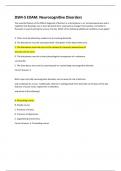
DSM-5 EXAM: Neurocognitive Disorders A+ Guaranteed
The essential feature of the DSM-5 diagnosis of delirium is a disturbance in at- tension/awareness and in cognition that develops over a short period of time, represents a change from baseline, and tends to fluctuate in severity during the course of a day. Which of the following additional conditions must apply? A. There must be laboratory evidence of an evolving dementia. B. The disturbance must be associated with a disruption of the sleep-wake cycle. C. The disturbance must not occur in the context of a severely reduced level of arousal, such as coma. D. The disturbance must be a direct physiological consequence of a substance use disorder. E. The disturbance must not be superimposed on a preexisting neurocognitive disorder. Correct Answer: C. Both major and mild neurocognitive disorders can increase the risk of delirium and complicate its course. Traditionally, delirium is distinguished from dementia on the basis of the key features of acute onset, impairment in attention, and which of the following?
Document information
- Uploaded on
- August 31, 2023
- Number of pages
- 16
- Written in
- 2023/2024
- Type
- Exam (elaborations)
- Contains
- Questions & answers


