
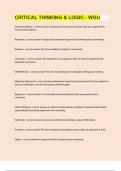
Critical Thinking & Logic - Wgu|2023/24 Update|Graded A+
Reasoned Opinion Statements that express opinions that are supported by reasons and evidence. Reasoning A logical and systematic approach to thinking about something. Evidence The facts available to support a conclusion. Conclusion The statement in an argument that we claim is implied by the argument's premises. Self-Reflection The act of examining one's thoughts, feelings and motives. Objective Statements Statements based on factual research that are subject to forms of verification, but do not require critical thought. Argument A set of statements containing at least one premise and a conclusion. Critical Thinking A method of approaching a problem or decision that entails systematically evaluating arguments and reasoning. Systematic A process performed according to a plan; Methodical. Premises The set of accepted assumptions upon which an argument is built. Fallacy An argument that is based on poor reasoning. Inference Indicator A word that signal whether a sentence is a premise or a conclusion. Non-Arguments A set of statements that do not contain supporting statements, and therefore they do not express reasoning. Assumption Statements that the conclusion of an argument depend on. Antecedent In an "if-then" statement, the phrase that is prefaced with "if". Description A set of statements intended intended to draw a picture in the mind of a listener; an example of an unsupported statement. Deductive Reasoning An approach to reasoning which attempts to draw a conclusion that cannot be false if all the premises are true. Broken Chain Fallacy An incorrectly formatted chain argument that does not link a statement to the conclusion. Inductive Reasoning An approach that uses certain information to reach a conclusion about what probably occurred, or to reach a conclusion about what is expected to occur. Correlation A pattern of two events occurring around the same time. This pattern can be coincidental, and happen by chance, or causal, when one event causes the other event to occur. Modus Ponens A pattern of deductive reasoning in which the first part of an if-then phrase is confirmed, and as a result, it follows that the consequent or "then" statement is also confirmed. Post hoc fallacy A fallacy in which the writer bases a claim that one thing is caused by another based on the occurrence of one thing after another. Consequent In an "if-then" statement, the phrase that follows from the first part of the statement. Illustration A clarifying instance or example that shows how something is used, how it works, or what it means; an example of an unsupported statement. Indexicals Words that do not have a fixed reference, but instead whose reference varies depending on the context in which they are spoken. Report A statement, or set of statements, that is merely intended to convey information; an example of an unsupported statement. Modus Tollens A pattern of deductive reasoning in which the consequent, or second part of an if-then phrase is negated, and as a result, it follows that the antecedent or "if" statement is false as well. Statement A sentence that is either true or false. Context The circumstances for a statement or idea that determine its truthfulness. Sentence A grammatical unit composed of words that form a complete thought. Valid An argument whose conclusion follows from its premises. This depends on the argument's form. Sound An argument that is both factually correct and valid. This depends on both its content and form. Equivocation This fallacy occurs when the meaning of a phrase or word changes within the context of an argument, but the conclusion of the argument relies on that word or phrase having a static meaning. Begging the Question A fallacy that occurs when an argument assumes the very point it is designed to prove. Division The fallacy that occurs when a person incorrectly infers that what is true of a whole thing is also true of all its parts.
Document information
- Uploaded on
- August 30, 2023
- Number of pages
- 14
- Written in
- 2023/2024
- Type
- Exam (elaborations)
- Contains
- Questions & answers


