
NURS 3381 OB ATI Study Guide (100%Correct) Solutions.
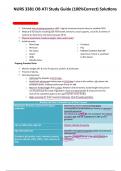
NURS 3381 OB ATI Study Guide (100%Correct) Solutions. Estimated date of delivery based on LMP. Vaginal ultrasound may be done to establish DOD Medical & nursing hx including past med health, family hx, social supports, social hx, & review of systems (to determine risk factors) & past OB hx Physical assessment: baseline weight, vitals, pelvic exam Initial lab work: o Blood type o RH factor o HIV status o Hep B o VDRL o Rubella status o Urinalysis o Pap o Indirect Coomb’s test will determine if client is sensitized to RH+ blood Ongoing Prenatal Visits: Monitor weight, BP, & urine for glucose, protein, & leukocytes Present of edema Fetal development: o FHR heard by Doppler at 10-12 wks o Heard with ultrasound stethoscope at 16-20 wks. Listen at the midline, right above the symphysis pubis, holding stethoscope firmly on abd o Measure fundal height after 12 wks. Between 18 & 30 weeks, fundal height measured in cm should equal the week of gestation. Have pt empty bladder & measure from the level of the symphysis pubis to the upper border of the fundus o Begin assessing for fetal movement between 16 & 20 weeks gestation Routine Lab Tests in Prenatal Care & Their Purpose Blood type, Rh factor, presence of irregular antibodies Determines risk for maternal-fetal blood incompatibility (erythroblastosis fetalis) or neonatal hyperbilirubinemia. For clients are are Rh(-) & not sensitized, the indirect Coombs’ test will be repeated b/t 24-28 weeks gestation CBC w/ differential, Hgb, Hct Detects infection & anemia Hgb electrophoresis Identifies hemoglobinopathies (sickle cell anemia & thalassemia) Urinalysis: pH, gravity, color, sediment, protein, glucose, albumin, RBCs, WBCs, casts, acetone, & HCG Identifies DM, gestational HTN, renal disease, & infection lOMoARcPSD| - 2 1 hr Glucose Tolerance (oral/IV admin of concentrated glucose w/ venous sample taken 1 hr later. Fasting not necessary) Identifies hyperglycemia; done at initial visit for atrisk clients, & at 24-28 wks for all pregnant women (140 requires follow up) 3 hr Glucose Tolerance (fasting overnight prior to oral or IV admin of concentrated glucose with a venous sample taken at 1, 2, & 3 hrs later) Used in clients w/ elevated 1-hr glucose tst as a screening tool for DM. A dx of GD requires 2 elevated blood-glucose readings Pap Test Screens for cervical cancer, HSV II, &/or HPV Vaginal/Cervical Culture Detects streptococcus B-hemolytic, Group B (routinely done at 35-37 wks), BV, STDS (gonorrhea, chlamydia) Rubella Titer Determines immunity to rubella. If non-immune, give shot! PPD, chest screening after 20 weeks w/ + purified protein derivative Identifies exposure to TB Hep B Screen Identifies carriers of hep B VDRL Syphilis screening mandated by law HIV Detects HIV infection: recommended for all clients who are pregnant unless client refuses testing TORCH (Toxoplasmosis, other infections, rubella, cytomegalovirus, & herpes) when indicated Screening for group of infections capable of crossing the placenta & adversely affecting fetal development Maternal serum alpha-fetoprotein (MSAFP) Between 15-22 wks Rhogam Administration: IM around 28 weeks for clients who are Rh (-) For amniocentesis, car wreck, or any instance of possibility of fetal/maternal blood mixture Health Promotion: Avoid all OTC meds, supplements, & rx meds unless OB who is supervising care has knowledge of this practice Alcohol (birth defects) & tobacco (low birth weight) contraindicated during pregnancy Substance abuse of any kind is to be avoid during pregnancy & lactation Encourage flu vaccine during the fall months lOMoARcPSD| I toxoplasmosis Other infections Rubella Cytomegalovirus Herpes 3- 3 Treat current infections Ascertain maternal exposure to hazardous materials Avoid use of hot tubs/saunas Consume at least 2-3 L of h20 daily from food & beverage sources Exercise: moderate exercise (walking/swimming) consisting of 30 minutes; no new exercise during pregnancy Third Trimester Childbirth Prep: Breathing & relaxation techniques o Deep cleansing breaths at ½ the usual respiratory rate during ctxns can promote relaxation of the abd muscles, which lessens the discomfort of uterine ctxns. discussion regarding pain management during labor & birth (natural child birth, epidural) Fetal movement/kick counts to ascertain fetal well-being. Client should be instructed to count & record fetal movements or kicks daily o It is recommended that mothers count fetal activity 2-3 x/day for 60 mins each time o Fetal movements 3/hr or movements that cease entirely for 12 hours need further eval Common Discomforts During Pregnancy: Morning sickness: eat cracker or dry toast ½ to 1 hr before rising in the morning to prevent discomfort. Avoid an empty stomach & drink fluids between meals. UTIs are common due to renal changes & vaginal flora becoming more alkaline o Wipe front to back, avoid bubble baths, wear cotton panties, avoid tight-fitting pants, & consume 8 glasses of water/day o Urinate as soon as urge occurs Constipation may occur during 2nd & 3rd trimesters. Drink plenty of fluids, eat a diet high in fiber, exercise regularly Leg cramps may occur during 3rd trimester d/c compression of lower extremity nerves & blood vessels by the enlarging uterus o Homan’s sign should be checked o If negative, patient should extend the affected leg, keeping knee straight & dorsiflexing the foot (toes toward the head) o Massaging & applying heat over affected muscle or a foot massage while the leg is extended can help relieve cramping o Notify PCP if frequent cramping occurs Varicose veins & extremity edema during 2nd & 3rd trimesters o Rest w/ legs elevated o Avoid constricting clothing o Wear support hose o Avoid sitting or standing in one position for long periods of time o Avoid sitting w/ legs crossed at knees o Sleep in left lateral position lOMoARcPSD| = - - 4 Gingivitis, nasal stuffiness, & epistaxis can occur Braxton Hicks ctxns o Should subside with change of position & walking Danger Signs of Pregnancy: Gush of fluid from vagina (rupture of amniotic fluid) prior to 37 weeks of gestation Vaginal bleeding (placental problems such as abruption or previa) Abd pain (premature labor, abruption placenta, or ectopic pregnancy) Changes in fetal activity (↓ fetal movement may indicate fetal distress) Persistent vomiting (hyperemesis gravidarum) Severe HA (PIH) Elevated temp (infection) Dysuria (UTI) Blurred vision (PIH) Edema of face & hands (PIH) Epigastric pain (PIH) Concurrent occurrence of flushed dry skin, fruity breath, rapid breathing, ↑ thirst & urination, & HA (hyperglycemia) Concurrent occurrence of clammy pale skin, weakness, tremors, irritability, & lightheadedness (hypoglycemia) Common birthing methods: prepare a pregnant woman for the l&d process & may ↓ anxiety: Dick-Read method- “childbirth w/out fear”. Uses controlled breathing & conscious & progressive relaxation of different muscle groups through the entire body. Instructs a woman to relax completely between contractions & keep all muscles except the uterus relaxed during ctxns Lamaze- promote a healthy, natural, & safe approach to pregnancy, childbirth, & early parenting by advocating & working w/ HCP, parents, & prof. childbirth instructors Leboyer- based on the idea of “birth without violence”. Environmental variables are stressed to ease the transition of the fetus from the uterus to the external environment (dim lights, soft voices, warm birthing room). Water births are based on this method. Bradley- emphasizes partner’s involvement as the birthing coach. Emphasizes increasing self - awareness & teaching the woman to deal w/ the stress of labor by tuning into her own body. Mother is encouraged to trust her body & use natural breathing, relaxation, nutrition, exercise, & education throughout pregnancy.
Document information
- Uploaded on
- August 30, 2023
- Number of pages
- 26
- Written in
- 2023/2024
- Type
- Exam (elaborations)
- Contains
- Questions & answers


