Liberty University: EDCO 735 Applied Statistics Quizzes 2-1-5 Fall 2023/24.
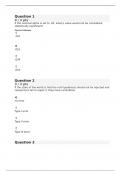
EDCO 735 Quiz 2-1 EDCO 735 Quiz 2-2 EDCO 735 Quiz 2-3. EDCO 735 Quiz 2-4 EDCO 735 Quiz 2-5 Question 1 0 / 3 pts If the nominal alpha is set to .05, what p value would not be considered statistically significant? .222 You Answered .022 .034 .033 Question 2 3 / 3 pts If the state of the world is that the null hypothesis should not be rejected and researchers fail to reject it, they have committed: Correct! no error Type I error Type II error Type III error Question 3 3 / 3 pts When researchers test a null hypothesis, they are looking for: Correct! disconfirmatory evidence supportive data a difference between individuals misrepresentation in the sample Question 4 0 / 3 pts Researchers are comparing the intelligence levels of incoming freshmen and graduating seniors. Assuming that there is a systematic difference in intelligence levels between the two groups and researchers reject the null hypothesis, they have committed no error Type I error You Answered Type II error both Type I and Type II error Question 5 3 / 3 pts Which of these is an acceptable interpretation of a non-significant outcome in research? Correct! researchers should fail to reject the null hypothesis the null hypothesis should be accepted the null hypothesis should be rejected results must be incorrect Question 6 0 / 3 pts When we reject the null hypothesis we: claim there is a difference reject the real hypothesis You Answered claim there is no difference reject the alternative hypothesis Question 7 3 / 3 pts All are possible outcomes to a study ACCEPT: Correct! reject the alternative hypothesis fail to reject the null hypothesis reject the null hypothesis fail to reject the null hypothesis when we should have failed to reject the null Question 8 3 / 3 pts What types of participants is most susceptible to experimenter expectancy effects? Correct! animals children adults teenagers Question 9 3 / 3 pts What value determines the acceptable risk of committing a Type I Error? Correct! nominal Alpha level Beta population mean sample standard deviation Question 10 3 / 3 pts If a researcher runs a two-tailed t-test (nominal alpha = .05) to see if there is a difference in anxiety scores between men (n = 156) and women (n = 142), which p value would not meet the criteria for rejecting the null hypothesis? Correct! .50 .032 .044 .0001 Question 1 0 / 3 pts Statistical power is the probability of: obtaining a test statistic large enough to reject H0 when H0 is false obtaining a test statistic large enough to reject H0 when H0 is true obtaining a test statistic to accept H0 when it is true You Answered rejecting a test statistic Question 2 3 / 3 pts A Type I error occurs if: Correct! researchers reject the null hypothesis when they should not have rejected it researchers fail to reject the null hypothesis when they should have rejected it researchers reject the null hypothesis when they should have rejected it researchers fail to reject the null hypothesis when they should not have rejected it Question 3 0 / 3 pts What can lead to a large difference between a population mean and a sample mean? sampling error random sampling You Answered an incorrect alpha level a small test statistic Question 4 3 / 3 pts Which of these is an acceptable interpretation of a non-significant outcome in research? Correct! researchers should fail to reject the null hypothesis the null hypothesis should be accepted the null hypothesis should be rejected results must be incorrect Question 5 0 / 3 pts A Type I error occurs when we: reject the null hypothesis when we should have failed to reject the null hypothesis fail to reject the null hypothesis when we should have failed to reject the null hypothesis fail to reject the null hypothesis when we should have rejected the null hypothesis You Answered reject the null hypothesis when we should have rejected the null hypothesis Question 6 0 / 3 pts Statistical power is NOT dependent upon the: population mean sample size effect size You Answered nominal alpha level Question 7 0 / 3 pts What is statistical power? the probability of rejecting the null hypothesis when it should be rejected the probability of rejecting the null hypothesis when it should not be rejected the probability of failing to reject the null hypothesis when it should be rejected You Answered the probability of failing to reject the null hypothesis when it should not be rejected Question 8 3 / 3 pts In null hypothesis testing, what do researchers typically expect to find? Correct! data that is not compatible with the null hypothesis proof that completely refutes the null hypothesis evidence that the sample is systematically different from the represented population results that prove the research hypothesis is true Question 9 3 / 3 pts What can we know from our results of a study that we have failed to reject the null hypothesis? Correct! the sample means were not statistically different from one another we have committed Type II error the theoretical population are not different from one another there was no sampling error Question 10 0 / 3 pts Which is NOT needed to make a claim that the null hypothesis is correct? statistical significance You Answered adequate sample size sufficient statistical power valid measures Question 1 3 / 3 pts Outliers are defined by: Correct! where the scores or values fall on a known (t, z, F) distribution subtracting one from the sample size the square root of variance dividing the SS by the mean Question 2 3 / 3 pts We estimate error because: Correct! it helps understand the relationship between our sample and the population it effects the standard deviation its conventional to do so our population is hypothetical Question 3 3 / 3 pts A one-tailed outlier for the t distribution must have a t score equivalent to the: Correct! highest 5% or lowest 5% of the t distribution highest 2.5% or lowest 2.5% of the t distribution only the highest 5% of the t distribution only the lowest 5% of the t distribution Question 4 0 / 3 pts N decreases the sampling distribution gets: wider more pointy You Answered more leptokurtic more representative Question 5 3 / 3 pts In order to calculate the sum of squared deviations you must do all of the following except for: Correct! calculate the square root of variance calculate the mean subtract the mean from each score multiply the difference between each score and the mean by itself Question 6 3 / 3 pts As N decreases we can expect the standard error of the mean to: Correct! increase decrease neither increase nor decrease either increase or decrease Question 7 3 / 3 pts What information do you need to find tcritical for a 95% CI? Correct! df M SEM s Question 8 3 / 3 pts As N increases, the standard error of the mean: Correct! decreases increases remains constant varies randomly Question 9 0 / 3 pts The formula for a confidence interval's lower limit is: You Answered M + [tcritical× SEM] M - [tcritical× SEM] s + [tcritical× SEM] s - [tcritical× SEM] Question 10 3 / 3 pts Which of the following is needed to calculate confidence interval's lower limit? Correct! SEM SS each score value s 2 Question 1 0 / 3 pts If the nominal alpha is set to .05, what p value would not be considered statistically significant? .222 You Answered .022 .034 .033 Question 2 3 / 3 pts If the state of the world is that the null hypothesis should not be rejected and researchers fail to reject it, they have committed: Correct! no error Type I error Type II error Type III error Question 3 3 / 3 pts When researchers test a null hypothesis, they are looking for: Correct! disconfirmatory evidence supportive data a difference between individuals misrepresentation in the sample Question 4 0 / 3 pts Researchers are comparing the intelligence levels of incoming freshmen and graduating seniors. Assuming that there is a systematic difference in intelligence levels between the two groups and researchers reject the null hypothesis, they have committed no error Type I error You Answered Type II error both Type I and Type II error Question 5 3 / 3 pts Which of these is an acceptable interpretation of a non-significant outcome in research? Correct! researchers should fail to reject the null hypothesis the null hypothesis should be accepted the null hypothesis should be rejected results must be incorrect Question 6 0 / 3 pts When we reject the null hypothesis we: claim there is a difference reject the real hypothesis You Answered claim there is no difference reject the alternative hypothesis Question 7 3 / 3 pts All are possible outcomes to a study ACCEPT: Correct! reject the alternative hypothesis fail to reject the null hypothesis reject the null hypothesis fail to reject the null hypothesis when we should have failed to reject the null Question 8 3 / 3 pts What types of participants is most susceptible to experimenter expectancy effects? Correct! animals children adults teenagers Question 9 3 / 3 pts What value determines the acceptable risk of committing a Type I Error? Correct! nominal Alpha level Beta population mean sample standard deviation Question 10 3 / 3 pts If a researcher runs a two-tailed t-test (nominal alpha = .05) to see if there is a difference in anxiety scores between men (n = 156) and women (n = 142), which p value would not meet the criteria for rejecting the null hypothesis? Correct! .50 .032 .044 .0001 Question 1 0 / 3 pts Statistical power is the probability of: obtaining a test statistic large enough to reject H0 when H0 is false obtaining a test statistic large enough to reject H0 when H0 is true obtaining a test statistic to accept H0 when it is true You Answered rejecting a test statistic Question 2 3 / 3 pts A Type I error occurs if: Correct! researchers reject the null hypothesis when they should not have rejected it researchers fail to reject the null hypothesis when they should have rejected it researchers reject the null hypothesis when they should have rejected it researchers fail to reject the null hypothesis when they should not have rejected it Question 3 0 / 3 pts What can lead to a large difference between a population mean and a sample mean? sampling error random sampling You Answered an incorrect alpha level a small test statistic Question 4 3 / 3 pts Which of these is an acceptable interpretation of a non-significant outcome in research? Correct! researchers should fail to reject the null hypothesis the null hypothesis should be accepted the null hypothesis should be rejected results must be incorrect Question 5 0 / 3 pts A Type I error occurs when we: reject the null hypothesis when we should have failed to reject the null hypothesis fail to reject the null hypothesis when we should have failed to reject the null hypothesis fail to reject the null hypothesis when we should have rejected the null hypothesis You Answered reject the null hypothesis when we should have rejected the null hypothesis Question 6 0 / 3 pts Statistical power is NOT dependent upon the: population mean sample size effect size You Answered nominal alpha level Question 7 0 / 3 pts What is statistical power? the probability of rejecting the null hypothesis when it should be rejected the probability of rejecting the null hypothesis when it should not be rejected the probability of failing to reject the null hypothesis when it should be rejected You Answered the probability of failing to reject the null hypothesis when it should not be rejected Question 8 3 / 3 pts In null hypothesis testing, what do researchers typically expect to find? Correct! data that is not compatible with the null hypothesis proof that completely refutes the null hypothesis evidence that the sample is systematically different from the represented population results that prove the research hypothesis is true Question 9 3 / 3 pts What can we know from our results of a study that we have failed to reject the null hypothesis? Correct! the sample means were not statistically different from one another we have committed Type II error the theoretical population are not different from one another there was no sampling error Question 10 0 / 3 pts Which is NOT needed to make a claim that the null hypothesis is correct? statistical significance You Answered adequate sample size sufficient statistical power valid measures Question 1 3 / 3 pts Outliers are defined by: Correct! where the scores or values fall on a known (t, z, F) distribution subtracting one from the sample size the square root of variance dividing the SS by the mean Question 2 3 / 3 pts We estimate error because: Correct! it helps understand the relationship between our sample and the population it effects the standard deviation its conventional to do so our population is hypothetical Question 3 3 / 3 pts A one-tailed outlier for the t distribution must have a t score equivalent to the: Correct! highest 5% or lowest 5% of the t distribution highest 2.5% or lowest 2.5% of the t distribution only the highest 5% of the t distribution only the lowest 5% of the t distribution Question 4 0 / 3 pts N decreases the sampling distribution gets: wider more pointy You Answered more leptokurtic more representative Question 5 3 / 3 pts In order to calculate the sum of squared deviations you must do all of the following except for: Correct! calculate the square root of variance calculate the mean subtract the mean from each score multiply the difference between each score and the mean by itself Question 6 3 / 3 pts As N decreases we can expect the standard error of the mean to: Correct! increase decrease neither increase nor decrease either increase or decrease Question 7 3 / 3 pts What information do you need to find tcritical for a 95% CI? Correct! df M SEM s Question 8 3 / 3 pts As N increases, the standard error of the mean: Correct! decreases increases remains constant varies randomly Question 9 0 / 3 pts The formula for a confidence interval's lower limit is: You Answered M + [tcritical× SEM] M - [tcritical× SEM] s + [tcritical× SEM] s - [tcritical× SEM] Question 10 3 / 3 pts Which of the following is needed to calculate confidence interval's lower limit? Correct! SEM SS each score value s 2 Question 1 3 / 3 pts The formula for a confidence interval's lower limit is: M + [tcritical× SEM] Correct! M - [tcritical× SEM] s + [tcritical× SEM] s - [tcritical× SEM] Question 2 3 / 3 pts N decreases the sampling distribution gets: Correct! wider more pointy more leptokurtic more representative Question 3 3 / 3 pts In study of a new treatment for depression, a researcher compares the new treatment on a group of patients with major depression with a second group that are treated with the standard treatment as usual. How many theoretical populations is the researcher estimating depression for? Correct! two none three one Question 4 0 / 3 pts All of the following calculations are necessary for calculating s except for: t critical mean You Answered sum of squared deviations variance Question 5 0 / 3 pts degrees of freedom is calculated by subtracting one from the sample size is calculated by dividing the SS by the sample size is the square root of variance You Answered is calculated by dividing the SS by the mean Question 6 3 / 3 pts When different sets of data of the same size are randomly chosen from a population, the resulting variation in values is called: Correct! sampling error standard deviation magnitude of error confidence interval Question 7 0 / 3 pts df are used because: samples underestimate population variance sample distributions are skewed You Answered samples underestimate SS samples provide the point estimate Question 8 0 / 3 pts Sampling error refers to: about how much we should expect our sample mean to be from the population mean about how much we should expect an individual score in our sample to be from the population mean the amount of error in our measurement You Answered how representative our sample is Question 9 3 / 3 pts The theoretical population can also be conceptualized as the: Correct! the population that a particular statistic estimates sampling frame experimental population standard deviation distribution Question 10 3 / 3 pts Outliers are defined by: Correct! where the scores or values fall on a known (t, z, F) distribution subtracting one from the sample size the square root of variance dividing the SS by the mean Question 1 3 / 3 pts df are used because: Correct! samples underestimate population variance sample distributions are skewed samples underestimate SS samples provide the point estimate Question 2 3 / 3 pts N decreases the sampling distribution gets: Correct! wider more pointy more leptokurtic more representative Question 3 3 / 3 pts In study of a new treatment for depression, a researcher compares the new treatment on a group of patients with major depression with a second group that are treated with the standard treatment as usual. How many theoretical populations is the researcher estimating depression for? Correct! two none three one Question 4 3 / 3 pts The larger the sample size: Correct! the less sampling error the more sampling error the more outliers influence our distribution the less random our sample Question 5 3 / 3 pts We use a t critical when the population is: Correct! theoretical known skewed biased Question 6 3 / 3 pts A statistic of the sample is an estimate of: Correct! the parameter in the theoretical population the statistic in the second sample the parameter in the theoretical sample the parameter in the second sample Question 7 3 / 3 pts Which of the following is NOT one of the steps for calculating a confidence interval? Correct! calculate the F ratio calculate the SEM determine df determine tcritical Question 8 3 / 3 pts Which of the following is needed to calculate confidence interval's lower limit? Correct! SEM SS each score value s 2 Question 9 3 / 3 pts Calculating the sample standard deviation always makes use of: Correct! variance random sample convenience sample nominal level of measurement Question 10 0 / 3 pts In order to calculate variance you must do all of the following except for: divide the sum of squared deviations by the sample size You Answered compute the mean subtract the mean from each score multiply the difference between each score and the mean by itself Powered by TCPDF () Question 1 0 / 3 pts Known distributions (e.g., t, z, and F) allow us: determine the percentile of our score or statistic label our means You Answered determine causal inference give and receive scores Question 2 3 / 3 pts In words, what is the formula for the SEM? Correct! the standard deviation divided by the square root of the sample size the sample mean divided by the square root of the sample size the standard deviation multiplied by the square root of the sample size the sample mean multiplied by the square root of the sample size Question 3 3 / 3 pts In order to calculate the mean you must: Correct! have at least interval level of measurement divide by degrees of freedom take the square root of the sum multiply each score by itself Question 4 3 / 3 pts s is all of the following except: Correct! is biased is a measure of dispersion tells us about how far any given score in the population can be expected to be from the mean is the square root of variance Question 5 3 / 3 pts N decreases the sampling distribution gets: Correct! wider more pointy more leptokurtic more representative Question 6 0 / 3 pts Outliers in the sample are defined by: how many standard deviations there score is from the mean You Answered a measure of dispersion how far any given score in the population can be expected to be from the mean the square root of variance Question 7 3 / 3 pts A one-tailed outlier for the t distribution must have a t score equivalent to the: Correct! highest 5% or lowest 5% of the t distribution highest 2.5% or lowest 2.5% of the t distribution only the highest 5% of the t distribution only the lowest 5% of the t distribution Question 8 3 / 3 pts The theoretical population is: Correct! the population that a particular statistic estimates equivalent to the population of the world the population where both groups are drawn only matters when a convenience sample is used Question 9 3 / 3 pts In order to calculate the mean you must: Correct! divide by the sample size have at least ratio level of measurement have a normal distribution use a representative sample Question 10 3 / 3 pts The formula for a confidence interval's upper limit is: Correct! M + [tcritical× SEM] M - [tcritical× SEM] s + [tcritical× SEM] s - [tcritical× SEM] Powered by TCPDF () Question 1 3 / 3 pts Which of the following is NOT one of the steps for calculating a confidence interval? Correct! calculate the F ratio calculate the SEM determine df determine tcritical Question 2 3 / 3 pts What is the formula for the df of a CI? Correct! n - 1 M - 1 s - 1 SEM - 1 Question 3 3 / 3 pts The formula for a confidence interval's upper limit is: Correct! M + [tcritical× SEM] M - [tcritical× SEM] s + [tcritical× SEM] s - [tcritical× SEM] Question 4 3 / 3 pts The standard error is related to all of the following except: Correct! causal inference dependent on sample size is smaller with a larger sample involves the confidence interval Question 5 3 / 3 pts Which of the following is NOT needed in the formula for calculating a confidence interval's upper limit? M Correct! SS tcritical SEM Question 6 3 / 3 pts The mean of a sample is: Correct! an estimate of the mean in the theoretical population the average of all the scores divided by the degrees of freedom the average of all scores divided by the sample size the sum of all scores divided by the degrees of freedom Question 7 3 / 3 pts Which of the following is NOT needed in the formula for calculating a confidence interval's lower limit? M Correct! SS tcritical SEM Question 8 3 / 3 pts The larger the sample size: Correct! the less sampling error the more sampling error the more outliers influence our distribution the less random our sample Question 9 3 / 3 pts A two-tailed outlier for the t distribution must have a t score equivalent to the: Correct! highest 2.5% or lowest 2.5% of the t distribution highest 5% or lowest 5% of the t distribution only the highest 5% of the t distribution only the lowest 5% of the t distribution Question 10 3 / 3 pts As N decreases we can expect the standard error of the mean to: Correct! increase decrease neither increase nor decrease either increase or decrease
Document information
- Uploaded on
- August 28, 2023
- Number of pages
- 48
- Written in
- 2023/2024
- Type
- Exam (elaborations)
- Contains
- Questions & answers