

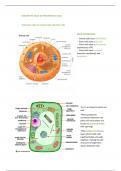
EUKARYOTIC CELLS VS PROKARYOTIC CELLS
- Eukaryotic cells are animal cells and plant cells
MAIN DIFFERENCES:
- Animal cells have CENTRIOLES
- Plant cells have a call wall
- Plant cells have a chloroplasts
(synthesizes ATP).
- Plant cells have tonoplast
(vascular membrane) and
amyloplast.
àpits are found in plant cell
wall
àthe cytoplasmic
connection between one
plant cell and another are
known as plasmodesmata
(the opening)
àthe middle lamella is a
layer which holds cells
together/holds cell walls
together, making the cell
structure stronger/less
spaces between cells
, PROKARYOTIC CELL
EUKARYOTES PROKARYOTES
Have a nucleus No nucleus
DNA within a nucleus DNA in cytoplasm
Linear chromosomes Circular chromosomes/DNA
80S ribosomes/large 70S ribosomes
NO cell wall Bacterial cell wall
Golgi/rough and smooth endoplasmic reticulum Plasmids/pili/peptidoglycan (bacteria)
BOTH EU AND PRO à ribosomes, cytoplasm, cell surface membrane
PROTEIN TRANSPORT:
1. The protein is produced on the ribosomes on the rough endoplasmic reticulum.
2. It is folded into a 3D shape (tertiary structure) and processed.
3. The protein is packed into transport vesicles by the rough endoplasmic reticulum.
4. These transport vesicles fuse with the Golgi apparatus and enter it.
5. The protein is modified by the Golgi apparatus, a carbohydrate chain is added.
6. Then, the protein is packed into secretory vesicles by the Golgi apparatus.
7. The vesicles fuse with the cell surface membrane by exocytosis.
- Eukaryotic cells are animal cells and plant cells
MAIN DIFFERENCES:
- Animal cells have CENTRIOLES
- Plant cells have a call wall
- Plant cells have a chloroplasts
(synthesizes ATP).
- Plant cells have tonoplast
(vascular membrane) and
amyloplast.
àpits are found in plant cell
wall
àthe cytoplasmic
connection between one
plant cell and another are
known as plasmodesmata
(the opening)
àthe middle lamella is a
layer which holds cells
together/holds cell walls
together, making the cell
structure stronger/less
spaces between cells
, PROKARYOTIC CELL
EUKARYOTES PROKARYOTES
Have a nucleus No nucleus
DNA within a nucleus DNA in cytoplasm
Linear chromosomes Circular chromosomes/DNA
80S ribosomes/large 70S ribosomes
NO cell wall Bacterial cell wall
Golgi/rough and smooth endoplasmic reticulum Plasmids/pili/peptidoglycan (bacteria)
BOTH EU AND PRO à ribosomes, cytoplasm, cell surface membrane
PROTEIN TRANSPORT:
1. The protein is produced on the ribosomes on the rough endoplasmic reticulum.
2. It is folded into a 3D shape (tertiary structure) and processed.
3. The protein is packed into transport vesicles by the rough endoplasmic reticulum.
4. These transport vesicles fuse with the Golgi apparatus and enter it.
5. The protein is modified by the Golgi apparatus, a carbohydrate chain is added.
6. Then, the protein is packed into secretory vesicles by the Golgi apparatus.
7. The vesicles fuse with the cell surface membrane by exocytosis.


