
UNIT 2 BIO TEST STUDY SHEET:
Cell Theory: All living things are made of one or more cells. Cells are the simplest unit that can
carry out all life processes. All cells come from other cells. Therefore, they do not come from
non-living matter.
Types of Organisms:
Prokaryotes:
- Single-celled
- No nucleus and no membrane around organelles
Eukaryotes:
- Single or multi-celled
- Have a nucleus and a membrane surrounding organelles
- Have organelles (These are cell structures that perform a specific function for the cell)
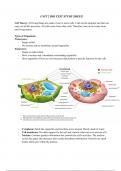
- Cytoplasm: Holds the organelles and lets them move around. Mostly made of water.
- Cell membrane: Provides support for the cell and controls what moves in and out of it.
- Nucleus: Contains genetic information that controls the cell's activities. The nucleus
carries the genes and structures that contain hereditary information. Nucleoli are small
bodies often seen within the nucleus.
, - Mitochondria: The “powerhouse” of the cell that provides energy for the cell.
- Endoplasmic Reticulum: Needed for protein synthesis and transporting proteins
throughout the cell. There is a rough endoplasmic reticulum and a smooth endoplasmic
reticulum. The most basic difference between RER and SER is the presence of
ribosomes. When ribosomes attach to the surface of an ER, it gives a characteristic rough
appearance; hence it is called Rough ER. On the other hand, a smooth ER does not have
ribosomes on its surface. It possesses ribosomes attached to its membrane.
- Golgi Bodies: Processes, collects and transports material around the cell.
- Vacuoles: Involved in storing materials, maintaining fluid pressure, and removing
substances from the cell. Plants have one big vacuole, while animal cells have many
small ones.
Plant Cells Only:
- Cell Wall: Cell walls are needed in plants for protection and structural support.
- Vacuole (1 big one): Plants have one big vacuole for maintaining fluid (water) pressure
inside the cell
- Chloroplasts: Absorbs light energy to make glucose (sugar) using photosynthesis (the
process is carbon dioxide + water → oxygen + glucose
DNA, Chromosomes, Genetics:
- Chromosome: a thread-like structure made mostly of DNA, found in the nucleus of a
cell.
- Chromatids: One of the two identical strands of DNA that make up a chromosome
- Centromere: Structure that holds chromatids together
- DNA (deoxyribonucleic acid): material found in the cell’s nucleus that contains genetic
information. DNA is made of two linked strands that wind around each other to resemble
a twisted ladder, otherwise known as the double helix.
- Gene: a segment of DNA that controls protein Genome Management Information
System.
- Why is DNA Important: Every DNA contains hundreds or thousands of genes. Genes
decide what kinds of proteins your
cells can make, and therefore how
your body might function or look.


