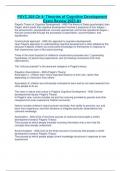
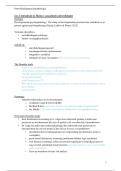
PSYC 205 Ch 4- Theories of Cognitive Development
PSYC 205 Ch 4- Theories of Cognitive Development Exam Review 2023 A+ Piaget's Theory of Cognitive Development - ANS-The theory of Swiss psychologist Jean Piaget, which posits that cognitive development involves a sequence of four stages— the sensorimotor, preoperational, concrete operational, and formal operational stages— that are constructed through the processes of assimilation, accommodation, and equilibration. Constructivist approach - ANS-(An approach to cognitive development) Jean Piaget's approach to understanding cognitive development is often labeled as this because it depicts children as constructing knowledge for themselves in response to their experiences (sort of like active learning). Three of the most important of children's constructive processes are (1) generating hypotheses, (2) performing experiments, and (3) drawing conclusions from their observations. The "child as scientist" is the dominant metaphor in Piaget's theory. Piagetion Assumptions - ANS-(Piaget's Theory) Assumption 1: children learn many important lessons on their own, rather than depending on instruction from others. Assumption 2: children are intrinsically motivated to learn and do not need rewards from other people to do so. The roles of nature and nurture in Piaget's Cognitive Development - ANS-(Central developmental issues: Piaget's Theory) In Piaget's view, nurture includes not just the nurturing provided by parents and other caregivers but every experience children encounter. Nature includes children's maturing brain and body; their ability to perceive, act, and learn from experience; and their tendency to integrate particular observations into coherent knowledge. Assimilation - ANS-(One of the three sources of continuity that propels a child's development forward: Piaget's Theory) The process by which people translate incoming information into a form that fits concepts they already understand. Accommodation - ANS-(One of the three sources of continuity that propels a child's development forward: Piaget's Theory) The process by which people adapt current knowledge structures in response to new experiences Mental Adaptation - ANS-(Continuous development: Piaget's theory) The continuous developmental process whereby a child undergoes assimilation then accommodation to gain a broader understanding of certain schema. Equilibration - ANS-(One of the three sources of continuity that propels our development forward: Piaget's Theory) The process by which children (or other people) balance assimilation and accommodation to create stable understanding. Piaget's stage theory - ANS-The most famous part of Piaget's theory concerns discontinuous aspects, which he depicted as distinct stages of cognitive development. Piaget's idea: each stage is a more mature, reorganized way of thinking. Qualitative change - ANS-(One of the four central properties of Piaget's stage theory) Piaget believed that children of different ages think in qualitatively different ways. For example, he proposed that children in the early stages of cognitive development conceive of morality in terms of the consequences of behavior, whereas children in later stages conceive of it in terms of intent. Thus, a 5-year-old would judge someone who accidentally broke a whole jar of cookies as having been naughtier than someone who deliberately stole a single cookie; an 8-year-old would reach the opposite conclusion. Broad applicability - ANS-(One of the four central properties of Piaget's stage theory) The type of thinking characteristic of each stage influences children's thinking across diverse topics and contexts. Brief transitions - ANS-(One of the four central properties of Piaget's stage theory) Before entering a new stage, children pass through a brief transitional period in which they fluctuate between the type of thinking characteristic of the new, more advanced stage and the type of thinking characteristic of the old, less advanced one. Invariant sequence - ANS-(One of the four central properties of Piaget's stage theory) Everyone progresses through the stages in the same order without skipping any of them. Sensorimotor stage - ANS-(First stage in Piaget's theory) The period (birth to 2 years) within Piaget's theory in which intelligence is expressed through sensory and motor abilities. According to Piaget, at the beginning of this stage, the infants have no mental representation (i.e., they lack object permanence) Object permanence - ANS-(Observations in Sensorimotor stage: Piaget's theory) The knowledge that an object exists even when it is not in sight. Continues...
Livre connecté
École, étude et sujet
- Établissement
- PSYC 205
- Cours
- PSYC 205
Infos sur le Document
- Publié le
- 17 août 2023
- Nombre de pages
- 12
- Écrit en
- 2023/2024
- Type
- Examen
- Contient
- Questions et réponses
Sujets
- psyc 205
- ch 4
- exam review 2023
- a grade
-
theories of cognitive development
-
psyc 205 ch 4 theories of cognitive development

Document également disponible en groupe