
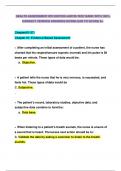
Health Assessment 8Th Edition Jarvis Test Bank With 100% Correct Verified Answers Download To Score A+
HEALTH ASSESSMENT 8TH EDITION JARVIS TEST BANK WITH 100% CORRECT VERIFIED ANSWERS DOWNLOAD TO SCORE A+ Chapter(01-27) Chapter 01: Evidence-Based Assessment After completing an initial assessment of a patient, the nurse has charted that his respirationsare eupneic (normal) and his pulse is 58 beats per minute. These types of data would be: a. Objective. A patient tells the nurse that he is very nervous, is nauseated, and feels hot. These types ofdata would be C. Subjective. . The patient's record, laboratory studies, objective data, and subjective data combine to formthe: a. Data base. When listening to a patient's breath sounds, the nurse is unsure of a sound that is heard. Thenurses next action should be to: C. Validate the data by asking a coworker to listen to the breath sounds. The nurse recognizes that the concept of prevention in describing health is essentialbecause: C. Prevention places the emphasis on the link between health and personal behavior. The nurse is performing a physical assessment on a newly admitted patient. An example of objective information obtained during the physical assessment includes the:D. 2 5 cm scar on the right lower forearm. A visiting nurse is making an initial home visit for a patient who has many chronic medicalproblems. Which type of database is most appropriate to collect in this setting? C. A complete health database because of the nurses primary responsibility for monitoring thepatients health Which situation is most appropriate during which the nurse performs a focused orproblem-centered history? D. Patient in an outpatient clinic has cold and influenza-like symptoms. A patient is at the clinic to have her blood pressure checked. She has been coming to theclinic weekly since she changed medications 2 months ago. The nurse should: a. Collect a follow-up database and then check her blood pressure. A patient is brought by ambulance to the emergency department with multiple traumas received in an automobile accident. He is alert and cooperative, but his injuries are quite severe.How would the nurse proceed with data collection? b. Simultaneously ask history questions while performing the examination and initiating life-saving measures. A 42-year-old patient of Asian descent is being seen at the clinic for an initial examination.The nurse knows that including cultural information in his health assessment is important to: D. Provide culturally sensitive and appropriate care. In the health promotion model, the focus of the health professional includes: D. Helping the consumer choose a healthier lifestyle. The nurse has implemented several planned interventions to address the nursing diagnosisof acute pain. Which would be the next appropriate action? c. Evaluate the individual's condition, and compare actual outcomes with expectedoutcomes. Which statement best describes a proficient nurse? A proficient nurse is one who: d. Understands a patient situation as a whole rather than a list of tasks and recognizes thelong-term goals for the patient. The nurse is reviewing data collected after an assessment. Of the data listed below, which would be considered related cues that would be clustered together during data analysis? Selectall that apply. Inspiratory wheezes noted in left lower lobes Nonproductive cough Patient reports dyspnea upon exertion Rate of respirations 16 breaths per minuteANS: A, C, E, F Put the following patient situations in order according to the level of priority. a. A patient newly diagnosed with type 2 diabetes mellitus does not know how to check hisown blood glucose levels with a glucometer. #3 b. A teenager who was stung by a bee during a soccer match is having trouble breathing.#1 c. An older adult with a urinary tract infection is also showing signs of confusion andagitation. #2 1. b = First-level priority problem 2. c= Second-level priority problem 3. a= Third-level priority problem The nurse is conducting a class for new graduate nurses. During the teaching session, the nurse should keep in mind that novice nurses, without a background of skills and experiencefrom which to draw, are more likely to make their decisions using: b. A set of rules. Expert nurses learn to attend to a pattern of assessment data and act without consciouslylabeling it. These responses are referred to as: a. Intuition. The nurse is reviewing information about evidence-based practice (EBP). Which statementbest reflects EBP? C. EBP emphasizes the use of best evidence with the clinician's experience. The nurse is conducting a class on priority setting for a group of new graduate nurses. Whichis an example of a first-level priority problem? D. Individual with shortness of breath and respiratory distress When considering priority setting of problems, the nurse keeps in mind that second-levelpriority problems include which of these aspects? C. Abnormal laboratory values Which critical thinking skill helps the nurse see relationships among the data?b. Clustering related cues The nurse knows that developing appropriate nursing interventions for a patient relies on theappropriateness of thediagnosis. a. Nursing The nursing process is a sequential method of problem solving that nurses use and includeswhich steps? D. Assessment, diagnosis, outcome identification, planning, implementation, and evaluation A newly admitted patient is in acute pain, has not been sleeping well lately, and is havingdifficulty breathing. How should the nurse prioritize these problems? a. Breathing, pain, and sleep Which of these would be formulated by a nurse using diagnostic reasoning? C. Diagnostic hypothesis Barriers to incorporating EBP include: a. Nurses lack of research skills in evaluating the quality of research studies. What step of the nursing process includes data collection by health history, physicalexamination, and interview? D. Assessment During a staff meeting, nurses discuss the problems with accessing research studies to incorporate evidence-based clinical decision making into their practice. Which suggestion by thenurse manager would best help these problems? D. Teach the nurses how to conduct electronic searches for research studies. When reviewing the concepts of health, the nurse recalls that the components of holistichealth include which of these? D. Holistic health views the mind, body, and spirit as interdependent. Chapter 02: Cultural Assessment The nurse is reviewing the development of culture. Which statement is correct regarding thedevelopment of ones culture? Culture is: B. Learned through language acquisition and socialization. During a class on the aspects of culture, the nurse shares that culture has four basiccharacteristics. Which statement correctly reflects one of these characteristics? a. Culture adapts to specific environmental factors and available natural resources. During a seminar on cultural aspects of nursing, the nurse recognizes that the definition stating the specific and distinct knowledge, beliefs, skills, and customs acquired by members ofa society reflects which term?
Document information
- Uploaded on
- August 16, 2023
- Number of pages
- 227
- Written in
- 2023/2024
- Type
- Exam (elaborations)
- Contains
- Questions & answers


