Written by students who passed Immediately available after payment Read online or as PDF Wrong document? Swap it for free 4.6 TrustPilot
logo-home
Exam (elaborations)

Test Bank on the Core Concepts in Pharmacology 5th Edition by Holland, Adams and Brice

Rating
-
Sold
1
Pages
545
Grade
A+
Uploaded on
13-08-2023
Written in
2023/2024

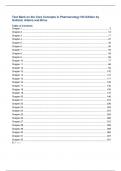
Test Bank on the Core Concepts in Pharmacology 5th Edition by Holland, Adams and Brice Table of Contents Chapter 1 ......................................................................................................................................... 3 Chapter 2 ....................................................................................................................................... 12 Chapter 3 ....................................................................................................................................... 17 Chapter 4 ....................................................................................................................................... 27 Chapter 5 ....................................................................................................................................... 43 Chapter 6 ....................................................................................................................................... 50 Chapter 7 ....................................................................................................................................... 53 Chapter 8 ....................................................................................................................................... 59 Chapter 9 ....................................................................................................................................... 69 Chapter 10 ..................................................................................................................................... 77 Chapter 11 ..................................................................................................................................... 86 Chapter 12 ..................................................................................................................................... 94 Chapter 13 ................................................................................................................................... 102 Chapter 14 ................................................................................................................................... 110 Chapter 15 ................................................................................................................................... 117 Chapter 16 ................................................................................................................................... 125 Chapter 17 ................................................................................................................................... 130 Chapter 18 ................................................................................................................................... 150 Chapter 19 ................................................................................................................................... 170 Chapter 20 ................................................................................................................................... 196 Chapter 21 ................................................................................................................................... 215 Chapter 22 ................................................................................................................................... 236 Chapter 23 ................................................................................................................................... 253 Chapter 24 ................................................................................................................................... 273 Chapter 25 ................................................................................................................................... 293 Chapter 26 ................................................................................................................................... 305 Chapter 27 ................................................................................................................................... 315 Chapter 28 ................................................................................................................................... 339 Chapter 29 ................................................................................................................................... 359 Chapter 30 ................................................................................................................................... 382 Chapter 31 ................................................................................................................................... 407 Chapter 32 ................................................................................................................................... 431 1 | P a g eChapter 33 ................................................................................................................................... 452 Chapter 34 ................................................................................................................................... 467 Chapter 35 ................................................................................................................................... 493 Chapter 36 ................................................................................................................................... 511 Chapter 37 ................................................................................................................................... 527 2 | P a g eChapter 1 Question 1 Type: MCSA A nurse educator wants to define the term pharmacology for the student. Which definition is most appropriate? 1. The study of medicine 2. The use of medicine to treat disease 3. The branch of medicine concerned with the treatment of disease and suffering 4. The use of herbs, natural extracts, vitamins, minerals, or dietary supplements to treat diseases 2, Nurses are responsible for administering medications. Nurses do not prescribe medications. Which best explains the reason why nurses study pharmacology? 1. To educate and advise patients regarding their healthcare needs 2. To clarify the reasons why a prescriber may prescribe a certain medication to the patient 3. To understand how adverse effects of medications can be avoided 4. To generate research for medications Question 2 Type: MCSA Nurses are responsible for administering medications. Nurses do not prescribe medications. Which best explains the reason why nurses study pharmacology? 1. To educate and advise patients regarding their healthcare needs 2. To clarify the reasons why a prescriber may prescribe a certain medication to the patient 3. To understand how adverse effects of medications can be avoided 4. To generate research for medications Correct Answer: 1 Question 3 Type: MCMA In addition to physicians, which healthcare providers are able to prescribe medications? (Select all that apply.) Note: Credit will be given only if all correct choices and no incorrect choices are selected. 1. Physician’s assistants 3 | P a g e2. Advanced nurse practitioners 3. Dentists 4. Medical assistants 5. Registered nurses Correct Answer: 1, 2, 3 Question 4 Type: MCSA Which branch of medicine is concerned with the treatment of disease and suffering? 1. Pharmacology 2. Therapeutics 3. Pathophysiology 4. Pharmacotherapeutics Correct Answer: 2 Question 5 Type: MCSA Which definition best describes the term pharmaceutics? 1. The science of preparing and dispensing drugs, and a very important part of pharmacotherapy 2. The use of medicine to treat disease 3. Agents naturally produced in animal cells, in microorganisms, or by the body itself 4. Herbs, natural extracts, vitamins, minerals, and dietary supplements Correct Answer: 1 Question 6 Type: MCMA Which items are considered medically therapeutic? (Select all that apply.) Note: Credit will be given only if all correct choices and no incorrect choices are selected. 1. Traditional drugs 2. Sunscreens 3. Biologics 4. Natural alternative therapies 4 | P a g e5. Antiperspirants Correct Answer: 1, 3, 4 Question 7 Type: MCSA Insulin would fall into which therapeutic drug category? 1. Biologics 2. Alternative therapies 3. Natural therapy 4. Traditional therapeutic drug Correct Answer: 1 Question 8 Type: MCSA Which statement best describes how a traditional drug is different from a biologic agent? 1. Biologics and traditional drugs are identical chemically. 2. Traditional drugs are naturally produced by the body or in animal cells, whereas biologic agents are chemically produced in a laboratory. 3. Traditional drugs are chemically produced in a laboratory, whereas biologic agents are naturally produced by the body or in animal cells. 4. Biologics include herbs, natural extracts, vitamins, minerals, and dietary supplements. Correct Answer: 3 Question 9 Type: MCSA Which medication change often occurs when a drug demonstrates a wide margin of safety and is used over long periods of time? 1. Prescription-only to over-the-counter (OTC) drug 5 | P a g e2. One classification to a lower, less restrictive one 3. Traditional drug therapy classification to biologics classification 4. Therapeutic to effective Correct Answer: 1 Question 10 Type: MCMA Which statement best describes the advantages of prescription drugs versus over-the-counter (OTC) drugs? (Select all that apply.) Note: Credit will be given only if all correct choices and no incorrect choices are selected. 1. The cost of the drug is always less than the cost of an OTC drug. 2. The practitioner can maximize therapy by ordering the proper medication for the client’s condition. 3. There are fewer side effects of prescription drugs than of OTC drugs. 4. The practitioner is able to control the dose and frequency of dosing of the drug. 5. Prescription drugs do not require a practitioner order. Correct Answer: 2, 4 Question 11 Type: MCMA The nurse is discussing the advantages of over-the-counter (OTC) medications with a client. Which statements are disadvantages of OTC drugs versus prescription drugs? (Select all that apply.) Note: Credit will be given only if all correct choices and no incorrect choices are selected. 1. OTC drugs can react with foods, herbal products, and prescriptions, or with other OTC drugs. 2. A client can obtain OTC drugs more easily than prescription drugs. 3. Self-treatment is sometimes ineffective. 4. Choosing the proper medication for a specific problem can be challenging. 5. OTC drugs are more expensive than prescription drugs. Correct Answer: 1, 3, 4 6 | P a g eQuestion 12 Type: MCSA Which science is known for preparing and dispensing drugs? 1. Pharmacology 2. Pharmaceutics 3. Traditional drug therapy 4. Therapeutics Correct Answer: 2 Question 13 Type: MCSA A client expresses concerns about a newly prescribed medication. The nurse explains that the safety and effectiveness of the medication have been proven, according to the statutes of which law? 1. Public Health Service Act 2. FDA Modernization Act 3. Food, Drug, and Cosmetic Act 4. Pure Food and Drug Act Correct Answer: 3 Question 14 Type: MCSA A client asks the nurse whether the claims made regarding a new medication are true. The nurse responds based on which act or amendment passed in 1912 that prevents the sale of drugs with false therapeutic claims intended to cheat the consumer? 1. Food, Drug, and Cosmetic Act 2. FDA Modernization Act 3. The Sherley Amendment 4. Pure Food and Drug Act Correct Answer: 3 Question 15 Type: MCSA 7 | P a g eThe nurse is discussing a medication with a patient. This approved medication is discovered to have serious problems. Which FDA response does the nurse expect? 1. Require the medication to have additional clinical trials conducted 2. Issue a warning to practitioners to watch for side effects in clients taking the drug 3. Continue to monitor the medication in postmarketing studies 4. Require that the drug be withdrawn from the market and its use discontinued Correct Answer: 4 Question 16 Type: MCSA The nurse is caring for a client with migraine headaches. The client asks why she has been prescribed a medication for seizures. Which legislation allows drug companies to share off-label drug use information with healthcare practitioners to allow such a prescription to occur? 1. Therapeutic Products Programme 2. Food and Drugs Act 3. Prescription Drug User Fee Act 4. Health Products and Food Branch Correct Answer: 3 Question 17 Type: MCSA A client asks the nurse if all herbal supplements undergo the same testing that prescription drugs undergo. Which statement is the best response by the nurse? 1. “Herbal and dietary supplements may not be marketed without prior approval from the FDA.” 2. “The Center for Food Safety and Applied Nutrition (CFSAN) regulates use of herbal supplements, which means the medication must be safe.” 3. “Herbal products and dietary supplements are regulated by the Dietary Supplement Health and Education Act of 1994. This act does not require the same research for 8 | P a g eherbal or dietary supplements.” 4. “All medications and herbal supplements undergo the same testing before being made available for purchase.” Correct Answer: 3 Question 18 Type: MCSA Which government agency has control over which prescription or OTC drugs may be used for therapy? 1. The Center for Biologics Evaluation and Research (CBER) 2. The Center for Food Safety and Applied Nutrition (CFSAN) 3. The Center for Drug Evaluation and Research (CDER) 4. The National Institutes of Health (NIH) Correct Answer: 3 Question 19 Type: MCSA Which branch of the FDA is responsible for the use of biologics, including serums, vaccines, and products found in the bloodstream? 1. The Center for Biologics Evaluation and Research (CBER) 2. The Center for Drug Evaluation and Research (CDER) 3. The Center for Food Safety and Applied Nutrition (CFSAN) 4. The FDA does not have a branch responsible for the use of biologics. Correct Answer: 1 Question 20 9 | P a g eType: MCSA A client has been selected as a participant in the approval process of a particular drug. The client’s dose and any effects from the medication are being monitored. Which phase of drug approval is this client participating in? 1. Postmarketing study 2. Clinical phase trial 3. Postclinical investigation 4. Preclinical investigation Correct Answer: 4 Question 21 Type: MCSA Which phase of clinical research involves basic science research? 1. Submission of NDA 2. Clinical phase trials 3. Postmarketing study 4. Preclinical investigation Correct Answer: 4 Question 22 Type: MCSA The nurse is providing care to a client who is taking several different medications, both prescribed and over-the-counter (OTC). The nurse is consulting with the charge nurse about possible interactions. Which statement by the nurse explains the increased potential for adverse drug–drug and drug–herbal interactions? 1. “The restrictions placed by the FDA are stricter.” 2. “People are using more herbs, so the risk for interaction is greater.” 3. “Drugs are being developed at a faster rate than their risk can be assessed.” 4. “Managed care has made a greater number of drugs available to consumers.” 10 | P a g eCorrect Answer: 3 Question 23 Type: MCSA A public health nurse is seeking information on bioterrorist agents to present education regarding security and defense in case of attack. Which resource is the most appropriate? 1. U.S. Department of Homeland Security 2. FEMA 3. U.S. Armed Forces 4. U.S. National Guard Correct Answer: 1 Question 24 Type: SEQ A nurse is discussing how drugs are approved with a healthcare provider. Place the stages of approval for therapeutic and biological drugs in the appropriate sequence. 1. NDA submission with review 2. Preclinical investigation 3. Clinical investigation 4. Postmarketing studies Correct Answer: 2, 3, 1, 4 Question 25 Type: MCMA Why do healthcare providers study pharmacology and pharmacotherapeutics? (Select all that apply.) Note: Credit will be given only if all correct choices and no incorrect choices are selected. 1. To understand how drugs improve the health of the human body 2. To educate clients 3. To gather medical data regarding results of drug therapy 11 | P a g e4. To classify medications based on how they are produced Correct Answer: 1, 2, 3 Question 25 Type: MCSA Certain drugs are produced and prescribed with a faster process of review. Why did this occur? 1. There was limited knowledge of certain diseases and people were dying. 2. 3. 4. There existed faster authorization of therapeutic drugs that met medical need. Drug development was stagnant and time consuming. The benefits outweighed the risks. Correct Answer: 2 Question 26 Type: MCMA Which are considered infectious diseases that have impacted healthcare providers in the United States? 1. Influenza 2. 3. 4. 5. Human immunodeficiency virus Food poisoning Tuberculosis Asthma Correct Answer: 1, 2, 3, 4 Chapter 2 Question 1 Type: MCSA A student nurse asks what the difference between a therapeutic class and a pharmacologic class is. What is the best response by the nurse educator? 1. Therapeutic classification is how the medication produces an effect in the body, whereas pharmacologic classification is how a medication works clinically. 2. Therapeutic classification is how addictive a medication is, whereas 12 | P a g epharmacologic classification is how the medication produces an effect in the body. 3. There are no differences between therapeutic and pharmacologic classes. 4. Pharmacologic classification is how the medication produces an effect in the body, whereas therapeutic classification is how a medication works clinically. Correct Answer: 4 Question 2 Type: MCSA The nurse is preparing to administer a drug that is labeled “used for minor skin irritations.” Based on the label, how is this drug classified? 1. By its function 2. By its usefulness 3. By its pharmacologic use 4. By its therapeutic use Correct Answer: 4 Question 3 Type: MCMA Which drug names are examples of trade names? (Select all that apply.) Note: Credit will be given only if all correct choices and no incorrect choices are selected. 1. Calcium channel blocker 2. Benadryl 3. Loop diuretic 4. Acetaminophen 5. Motrin Correct Answer: 2, 5 Question 4 Type: MCSA A nurse is discussing generic and trade drugs with a client. The client wants to know why it takes so long for trade drugs to become available in the generic form, which are generally less expensive. What is the nurse’s best response? 1. It takes 17 years for all pharmaceutical companies to develop a generic version of the drug. 2. It will take 17 years of clinical trials to approve the drug. 3. Sole ownership of a drug allows the pharmaceutical company to earn back the money spent to develop the drug. 13 | P a g e4. Animal testing must continue for 10 years, then 7 years of human clinical trials, for a drug to be approved. Correct Answer: 3 Question 5 Type: MCSA A client asks the nurse why the healthcare provider often refers to medications by the generic name instead of by the brand name. What is the best response by the nurse? 1. The pharmacy will only accept a prescription written with the generic name. 2. The physician prefers to use a more technical-sounding name for medications. 3. There is only one generic name for each medication, but there are often many brand names. 4. The client needs to ask the physician to explain why medications have so many different names. Correct Answer: 3 Question 6 Type: MCMA Why are generic names preferred over chemical or trade names when prescribing a medication? (Select all that apply.) Note: Credit will be given only if all correct choices and no incorrect choices are selected. 1. Chemical names are often complicated and difficult to remember. 2. The generic name can consistently be matched to the active ingredients. 3. There might be multiple trade names for a drug. 4. The generic name is always a shortened version of the chemical name. 5. Chemical names often change. Correct Answer: 1, 2, 3 Question 7 Type: MCSA A nurse is talking to a client about their medications. The client tells the nurse that one of the medications on the list is on a negative formulary list and asks what this means. What is the best response by the nurse? 1. This means the medication can only be dispensed using the trade name medication. 2. This means the medication can only be dispensed using the generic medication. 3. This means the medication cannot be dispensed until the order is verified with the physician a second time before dispensing the trade name medication. 4. This means the medication can be dispensed as either the generic or trade 14 | P a g ename medication. Correct Answer: 1 Question 8 Type: MCSA The nurse is teaching a client about prescribed medications. One of the medications is a controlled substance and the client asks the nurse to explain what that means. What is the best response by the nurse? 1. A controlled substance is regulated under the Controlled Substances Act, and may have many restrictions placed on ordering or refilling this medication. 2. A controlled substance requires both a written prescription and a telephone call from the prescribing practitioner. 3. A controlled substance does not require a prescription to purchase. 4. A controlled substance is always called to the pharmacy by the practitioner. Correct Answer: 1 Question 9 Type: MCSA Which drug schedule does a medication belong to if it has a moderate abuse potential and physical dependence? 1. I 2. IV 3. III 4. II Correct Answer: 3 Question 10 Type: MCMA Which of the following would be categorized as Schedule II drugs? (Select all that apply.) Note: Credit will be given only if all correct choices and no incorrect choices are selected. 1. Morphine 2. Methadone 3. Tylenol with codeine 4. Valium 5. Heroin 15 | P a g eCorrect Answer: 1, 2 Question 11 Type: MCSA What is the appropriate schedule for a drug with limited or no therapeutic use? 1. III 2. X 3. V 4. I Correct Answer: 4 Question 12 Type: MCSA Scheduled drugs are classified by their potential for abuse. Which classification has the highest potential for abuse? 1. V 2. II 3. III 4. I Correct Answer: 4 Question 13 Type: MCSA Scheduled drugs are classified by their potential for abuse. Which classification has the lowest potential for abuse? 1. I 2. V 3. II 4. III Correct Answer: 2 Question 14 Type: MCSA A pregnant woman with a life-threatening condition must take medication that can cause harm to her fetus. What is the pregnancy category that this medication most likely represents? 16 | P a g e1. A 2. B 3. C 4. D Correct Answer: 4 Question 15 Type: MCSA Which medication would have the greatest risk to a fetus if given to a pregnant client? 1. Warfarin (Coumadin) 2. Ranitidine (Zantac) 3. Tetracycline 4. Potassium chloride (KCl) Correct Answer: 1 Question 16 Type: MCSA Which medication would have the least risk to a fetus if given to a pregnant client? 1. Methotrexate 2. Alcohol 3. Ferrous fumarate (Ferranol) 4. Amoxicillin (Amoxil) Correct Answer: 3 Question 17 Type: MCSA A pregnant client asks the nurse to explain what a teratogen is. What is the best response by the nurse to educate this client? 1. A teratogen is any substance that will harm a developing fetus or embryo. 2. A teratogen is a controlled substance. 3. A teratogen is a nonnarcotic pain reliever. 4. A teratogen is a medication used to treat bacterial infections. Correct Answer: 1 Chapter 3 17 | P a g eWhat does the nurse need to determine prior to administering a medication to a client? (Select all that apply.) Note: Credit will be given only if all correct choices and no incorrect choices are selected. 1. Contraindications for this medication 2. What drug is ordered 3. The generic and trade name of the medication 4. The manufacturer of the medication 5. The drug classification Correct Answer: 1, 2, 3, 5 Question 2 Type: MCSA After administering a medication, the nurse notes that the client has itching and a runny nose. What is the nursing priority? 1. Document the findings 2. Assess vital signs 3. Notify the charge nurse 4. Monitor the client closely Correct Answer: 3 Question 3 Type: MCSA Following administration of a drug to a client, who has the greatest responsibility for monitoring the client for adverse reactions? 1. The nurse 2. The nursing assistant 3. The family of the client 4. The physical therapist Correct Answer: 1 The nurse is preparing to administer a medication. Which six rights of drug administration should the nurse assess for prior to administering the prescribed medication? (Select all that apply.) Note: Credit will be given only if all correct choices and no incorrect choices are selected. 1. Right client 2. Right route of administration 18 | P a g e3. Right dose 4. Right time of preparation 5. Right documentation Correct Answer: 1, 2, 3, 5 Question 5 Type: MCMA The nurse is preparing to administer a medication to a client. What are the checks that must occur prior to medication administration? (Select all that apply.) Note: Credit will be given only if all correct choices and no incorrect choices are selected. 1. Checking the drug after administering it to the patient 2. Checking the drug when preparing it, pouring it, taking it out of the unit dose container, or connecting the IV tubing to the bag 3. Checking the drug with the medication administration record (MAR) or medication information system when removing it from the medication drawer, refrigerator, or controlled substance locker 4. Checking the drug before administering it to the patient 5. Checking the drug prior to documenting Correct Answer: 2, 3, 5 Question 6 Type: MCMA The nurse is speaking with a client regarding current medications. The client states she does not always take the medications as prescribed. What are the potential reasons for this client’s noncompliance? (Select all that apply.) Note: Credit will be given only if all correct choices and no incorrect choices are selected. 1. Patients sometimes forget doses of medications. 2. The drug may be too expensive or may not be approved by the patient’s health insurance plan. 3. Adverse effects such as headache, dizziness, nausea, diarrhea, or impotence often cause noncompliance. 4. The client takes medications as prescribed. 5. The client may not understand the reason for the medication. Correct Answer: 1, 2, 3, 5 Question 7 Type: MCSA 19 | P a g eWhat type of medication order should be given immediately or only once? 1. A single order 2. An ASAP order 3. A prn order 4. A STAT order Correct Answer: 4 Question 8 Type: MCSA The nurse is caring for a client who has medications ordered to be given PO. The client asks the nurse what PO means. What is the best response by the nurse? 1. PO medications are given orally. 2. PO medications are given rectally. 3. PO medications are given intramuscularly. 4. PO medications are given vaginally. Correct Answer: 1 Question 9 Type: MCSA The physician ordered amlodipine (Norvasc) 5 mg tab PO bid. The drug is dispensed as 1 tablet, which is 5 mg. How should the nurse administer the medication? 1. One tablet orally four times per day 2. One tablet orally three times per day 3. One tablet orally once per day 4. One tablet orally twice per day Correct Answer: 4 Question 10 Type: MCSA The physician writes an order for a medication to be given SL tid. How should the nurse administer the prescribed medication order to the client? 1. Subcutaneous three times per day 2. Subcutaneous four times per day 3. Sublingual three times per day 20 | P a g e4. Sublingual four times per day Correct Answer: 3 Question 11 Type: MCMA The nurse is reviewing some medication administration orders for her clients. Which drug administration abbreviations are matched correctly with their definitions? (Select all that apply.) Note: Credit will be given only if all correct choices and no incorrect choices are selected. 1. hs—hour of sleep/bedtime 2. ac—after meals; after eating 3. prn—when needed/necessary 4. qid—three times per day 5. pc—before meals Correct Answer: 1, 3 Question 12 Type: MCMA Which drug administration abbreviations are matched correctly with their definitions? (Select all that apply.) Note: Credit will be given only if all correct choices and no incorrect choices are selected. 1. PO—pills only 2. gtt—drop 3. no—number 4. qh—every hour 5. qid—three times a day Correct Answer: 2, 3, 4 Question 13 Type: MCSA The nurse is reviewing orders for a newly admitted client with a student. Which statement by the student indicates that the student understands the meaning of a standing order? 21 | P a g e

Show more Read less

Content preview

Test Bank on the Core Concepts in Pharmacology 5th Edition by
Holland, Adams and Brice
Table of Contents
Chapter 1 ......................................................................................................................................... 3
Chapter 2 ....................................................................................................................................... 12
Chapter 3 ....................................................................................................................................... 17
Chapter 4 ....................................................................................................................................... 27
Chapter 5 ....................................................................................................................................... 43
Chapter 6 ....................................................................................................................................... 50
Chapter 7 ....................................................................................................................................... 53
Chapter 8 ....................................................................................................................................... 59
Chapter 9 ....................................................................................................................................... 69
Chapter 10 ..................................................................................................................................... 77
Chapter 11 ..................................................................................................................................... 86
Chapter 12 ..................................................................................................................................... 94
Chapter 13 ................................................................................................................................... 102
Chapter 14 ................................................................................................................................... 110
Chapter 15 ................................................................................................................................... 117
Chapter 16 ................................................................................................................................... 125
Chapter 17 ................................................................................................................................... 130
Chapter 18 ................................................................................................................................... 150
Chapter 19 ................................................................................................................................... 170
Chapter 20 ................................................................................................................................... 196
Chapter 21 ................................................................................................................................... 215
Chapter 22 ................................................................................................................................... 236
Chapter 23 ................................................................................................................................... 253
Chapter 24 ................................................................................................................................... 273
Chapter 25 ................................................................................................................................... 293
Chapter 26 ................................................................................................................................... 305
Chapter 27 ................................................................................................................................... 315
Chapter 28 ................................................................................................................................... 339
Chapter 29 ................................................................................................................................... 359
Chapter 30 ................................................................................................................................... 382
Chapter 31 ................................................................................................................................... 407
Chapter 32 ................................................................................................................................... 431
1|Page

,Chapter 33 ................................................................................................................................... 452
Chapter 34 ................................................................................................................................... 467
Chapter 35 ................................................................................................................................... 493
Chapter 36 ................................................................................................................................... 511
Chapter 37 ................................................................................................................................... 527


2|Page

, Chapter 1

Question 1
Type: MCSA
A nurse educator wants to define the term pharmacology for the student. Which definition is
most appropriate?
1. The study of medicine
2. The use of medicine to treat disease
3. The branch of medicine concerned with the treatment of disease and suffering
4. The use of herbs, natural extracts, vitamins, minerals, or dietary supplements to
treatdiseases


2, Nurses are responsible for administering medications. Nurses do not prescribe medications.
Which best explains the reason why nurses study pharmacology?
1. To educate and advise patients regarding their healthcare needs
2. To clarify the reasons why a prescriber may prescribe a certain medication to the patient
3. To understand how adverse effects of medications can be avoided
4. To generate research for medications
Question 2


Type: MCSA
Nurses are responsible for administering medications. Nurses do not prescribe
medications.Which best explains the reason why nurses study pharmacology?
1. To educate and advise patients regarding their healthcare needs
2. To clarify the reasons why a prescriber may prescribe a certain medication to the patient
3. To understand how adverse effects of medications can be avoided
4. To generate research for medications
Correct Answer: 1
Question 3
Type: MCMA
In addition to physicians, which healthcare providers are able to prescribe medications?
(Select all that apply.) Note: Credit will be given only if all correct choices and no incorrect
choices areselected.

1. Physician’s assistants
3|Page

, 2. Advanced nurse practitioners
3. Dentists
4. Medical assistants
5. Registered nurses


Correct Answer: 1, 2, 3

Question 4
Type: MCSA

Which branch of medicine is concerned with the treatment of disease and suffering?

1. Pharmacology
2. Therapeutics
3. Pathophysiology
4. Pharmacotherapeutics
Correct Answer: 2

Question 5
Type: MCSA

Which definition best describes the term pharmaceutics?

1. The science of preparing and dispensing drugs, and a very important part
ofpharmacotherapy
2. The use of medicine to treat disease
3. Agents naturally produced in animal cells, in microorganisms, or by the body itself
4. Herbs, natural extracts, vitamins, minerals, and dietary supplements
Correct Answer: 1

Question 6
Type: MCMA

Which items are considered medically therapeutic? (Select all that apply.) Note: Credit will be
given only if all correct choices and no incorrect choices are selected.
1. Traditional drugs
2. Sunscreens
3. Biologics
4. Natural alternative therapies
4|Page

Document information

Uploaded on
August 13, 2023
Number of pages
545
Written in
2023/2024
Type
Exam (elaborations)
Contains
Questions & answers

Subjects

$14.49
Get access to the full document:

Wrong document? Swap it for free Within 14 days of purchase and before downloading, you can choose a different document. You can simply spend the amount again.
Written by students who passed
Immediately available after payment
Read online or as PDF


Also available in package deal

Thumbnail
Package deal
PHARMACOLOGY TESTBANKS 100% QUALITY WITH ALL QUESTIONS AND ANSWERS
-
18 2024
$ 133.49 More info

Get to know the seller

Seller avatar
Reputation scores are based on the amount of documents a seller has sold for a fee and the reviews they have received for those documents. There are three levels: Bronze, Silver and Gold. The better the reputation, the more your can rely on the quality of the sellers work.
Expert001 Chamberlain School Of Nursing
View profile
Follow You need to be logged in order to follow users or courses
Sold
822
Member since
4 year
Number of followers
566
Documents
1173
Last sold
1 week ago
Expert001

High quality, well written Test Banks, Guides, Solution Manuals and Exams to enhance your learning potential and take your grades to new heights. Kindly leave a review and suggestions. We do take pride in our high-quality services and we are always ready to support all clients.

4.1

162 reviews

5
105
4
18
3
14
2
8
1
17

Recently viewed by you

Why students choose Stuvia

Created by fellow students, verified by reviews

Quality you can trust: written by students who passed their tests and reviewed by others who've used these notes.

Didn't get what you expected? Choose another document

No worries! You can instantly pick a different document that better fits what you're looking for.

Pay as you like, start learning right away

No subscription, no commitments. Pay the way you're used to via credit card and download your PDF document instantly.

Student with book image

“Bought, downloaded, and aced it. It really can be that simple.”

Alisha Student

Working on your references?

Create accurate citations in APA, MLA and Harvard with our free citation generator.

Working on your references?

Frequently asked questions