
ANCC Adult-Gero Review Test 2023
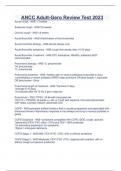
ANCC Adult-Gero Review Test 2023 Acute cough - ANS- 3 weeks Subacute cough - ANS-3-8 weeks Chronic cough - ANS-8 weeks Acute Bronchitis - ANS-inflammation of the bronchioles Acute bronchitis etiology - ANS-almost always viral Acute Bronchitis symptoms - ANS-cough that usually lasts 10-20 days Acute Bronchitis Treatment - ANS-OTC antitussive, NSAIDs, antibiotics NOT recommended Pneumonia etiology - ANS-*S. pneumoniae *M. pneumoniae *C. pneumoniae Pneumonia treatment - ANS-*healthy with no recent antibiotics=macrolide or doxy *comorbidities or recent antibiotic=DRSP=resp quinolone OR beta-lactam + macrolide OR beta-lactam +Doxy Pneumonia length of treatment - ANS-*minimum 5 days *average 5-10 days *re-evaluate after 48-72 hrs if poor response Pneumovax - ANS-*PPSV: 19-64 with increased risk *PCV13 + PPSV23: all adults /= 65, or 19-64 with asplenia, immunocompromised, CSF leaks, cochlear implant, advanced CKD COPD - ANS-persistent airflow limitation that is usually progressive and associated with enhanced chronic inflammatory response in the airways and lung to noxious particles or gases COPD Diagnosis - ANS-*symptoms compatible with COPD (DOE, cough, sputum) *spirometry=FEV1/FVC ration 70% plus FEV1 80% predicted *no alternative explanation for symptoms *Alpha-1 antitrypsin deficiency COPD Stage 1 - ANS-Mild: FEV1/FVC 70%, with or without symptoms COPD Stage 2 - ANS-Moderate: FEV1/FVC 70%, dyspnea with exertion, with or without cough and sputum production COPD Stage 3 - ANS-Severe: FEV1/FVC 70%, increased dyspnea, reduced exercise capacity, fatigue, and repeated exacerbations COPD Sage 4 - ANS-Very severe: FEV1/FVC 70%, FEV1 30% predicted or 50% plus respiratory failure COPD treatment: Stage 1 - ANS-SABA PRN COPD Treatment: Stage 2 - ANS-SABA PRN + LABA routinely COPD Treatment: Stage 3 - ANS-SABA PRN + LABA + inhaled steroids COPD Treatment: Stage 4 - ANS-SABA PRN + LABA + inhaled steroids + treatment of complications, rehab, long-term O2 therapy, consider surgical treatments Bronchodilators: SABA - ANS-`rescue med; works immediately and effects last for about 4 hours Suffix: "terol" Bronchodilators: LABA - ANS-not a rescue med; takes 10-20 minutes to work, lasts for 12 hours Inhaled anticholinergic - ANS-works by preventing bronchoconstriction Suffix: "tropium" Inhaled steroids - ANS-Reduces inflammation best in combo with LABA Suffix: "one" or "ide" COPD exacerbations - ANS-an acute event characterized by a worsening of the pt's respiratory symptoms beyond the normal day to day variations and leads to a change in medication Exacerbation management - ANS-CBC, sputum culture, bronchodilator/anticholinergic or both nebulized, systemic steroids, antibiotics (80% of time caused by infection) for increased dyspnea, sputum production, purulence COPD health promotion - ANS-*smoking cessation-- most important and cost effective (encourage at each visit) *regular exercise *pneumovax/influenza vaccine annually Asthma - ANS-a chronic respiratory disease characterized by REVERSIBLE AIRWAY OBSTRUCTION, inflammation, and airway hyper-responsiveness Asthma - ANS-majority (75%) diagnosed by age 7 Asthma: triad of symptoms - ANS-wheezing (expiratory), cough, chest tightness/SOB Asthma course - ANS-predictible pattern of respiratory symptoms when exposed to a precipitant (URI, mold, exercise) Asthma stages: intermittent - ANS-symptoms twice per week Asthma stages: mild persistent - ANS-symptoms twice per week, but once daily Asthma stages: moderate persistent - ANS-daily symptoms (but not all day) Asthma stages: severe persistent - ANS-continuous symptoms Asthma Treatment: Step 1 - ANS-SABA PRN Asthma Treatment: Step 2 - ANS-low dose ICS Asthma Treatment: Step 3 - ANS-Low dose ICS + LABA OR medium dose ICS alone Asthma Treatment: Step 4 - ANS-medium dose ICS + LABA Asthma Treatment: Step 5 - ANS-high dose ICS + LABA + consider omalizumab for pts with allergies Asthma Treatment: Step 6 - ANS-high dose ICS + LABA + PO steroid Anemia - ANS-reduction in one or more RBC measurements Anemia Etiology - ANS-blood loss (most common) *melena *hematemesis *trauma Anemia etiology - ANS-Bone marrow not making enough RBCs *lack of nutrients: iron, B12, folate *disorders: aplastic anemia, myelodysplastic syndromes *bone marrow suppression: chemo *Low levels of erythropoietin (CKD) *anemia of inflammation: malignancy, anemia of chronic disease Anemia etiology - ANS-Increased destruction of RBCs *inherited disorders: sickle cell, thalassemias *malaria *hemolytic anemia RBC Size: MCV - ANS-microcytic: 80 normocytic: 80-96 macrocytic: 96 RBC Color: MCH - ANS-hypochromic: low in color normochromic: normal color hyperchromic: too much color Microcytic Anemias - ANS-Iron deficiency anemia Thalassemia Anemia of chronic diseases Iron Deficiency Anemia - ANS-Microcytic, hypochromic Iron Deficiency Anemia: Etiology - ANS-Most common cause is blood loss Iron Deficiency Anemia: Assessment - ANS-*Most are asymptomatic *Classic presentation: weakness, HA, irritability, fatigue, exercise intolerance *Older Adult: exacerbation of co-morbids (angina, worsening dementia) Iron Deficiency Anemia: Management - ANS-*iron-rich foods: organ meats, red meat, dried peas/beans, dark green leafy vegetables, whole grains *replacement: 150-200mg/day (should increase hgb 1 point in 4 weeks) Thalassemia - ANS-Microcytic, hypochromic Thalassemia: Etiology - ANS-a group of hereditary disorders that affects the synthesis of hgb causing an overproduction of hgb Thalassemia Beta - ANS-avoid excessive consumption of iron; need genetic counseling Thalassemia Alpha - ANS-suspect in Asians, Mediterranean origin, almost never in African Americans; often undetected because so mild Anemia of Chronic Disease - ANS-normocytic, normochromic Anemia of Chronic Disease: Etiology - ANS-mild to moderate anemia associated with chronic disease such as infections, inflammatory and/or malignant disease *RBC life span is shortened to 60-90 days from the normal 100-120 days Anemia of Chronic Disease: Treatment - ANS-aimed at control of underlying disease Macrocytic Anemias - ANS-B12/folate Deficiency Anemia B12/Folate Deficiency Anemia: Etiology - ANS-Etoh/Substance abuse, elderly, celiac disease, IBD, meds (methotrexate, trimethoprim, phenytoin), myelodysplastic syndromes, pregnancy/lactation B12 is an absorption problem, rarely dietary! B12/folate often co-exist B12/folate Deficiency Anemia: Presentation - ANS-often asymptomatic, but neuro symptoms: dementia, weakness, paresthesias B12/folate Deficiency Anemia: Management - ANS-B12 IM for life, folic acid po for 1-4 months or until hematologic recovery Thrombocytopenia - ANS-decreased platelet count 150,000 rest of CBC usually normal Thrombocytopenia: Etiology - ANS-recent infection, idiopathic, drug induced (heparin) SLE, antiphospholipid syndrome, leukemia Thrombocytopenia: Management - ANS-referral to hematology, prednisone for 4-6 weeks, minimal activity to prevent injury/bruising, avoidance of ASA Interpretation of a CBC - ANS-1. look at WBC 2. Differentials = 100% 3. Polys (neutrophils) & lymphs are first responders -- within 2 hours 4. When polys & lymphs are close numerically = viral infection 5. Mono: not active x24 hours 6. Eos: increased with paracytic infections/allergic reactions 7. RBC count 8. MCV/MCH 9. RDW Bands: immature WBCs -- bone marrow thinks bad infection & sends out early Headaches: Red Flags - ANS-sudden onset in seconds or minutes: SAH "first" or "worst" HA: hemorrhage, infection focal neuro symptoms: mass, AVM fever: infection change in personality, mental status, LOC Headaches: Office visit red flags - ANS-Age 40 or 50 neck stiffness neuro deficits papilledema -- swelling of optic disc d/t increased ICP; usually bilateral Migraine without Aura - ANS-HA lasts 4-72 hours Has 2 of the following: *UNILATERAL... CONTINUES...
Document information
- Uploaded on
- August 13, 2023
- Number of pages
- 60
- Written in
- 2023/2024
- Type
- Exam (elaborations)
- Contains
- Questions & answers


