
Caiss Certification Study Guide 100% Verified 2023
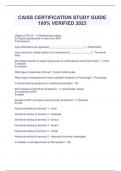
Origins of AIS (3) - 1) Standardized system 2) Classify type/severity of injury from MVC 3) Consensus Injury descriptors are organized _________________________ ? - Anatomically Injury severity is ranked relative to its importance to _______________? - The whole body AIS reflects severity of single injuries and are unaffected by what three things? - 1) time 2) sequela 3) outcome What type of scale does AIS use? - 6 point ordinal scale Which type of measurement is more variable? Anatomic or Physiologic? - Physiologic Is clinical training necessary for collecting injury data? - NO AIS is based on what three (3) factors? - 1) anatomically- based 2) consensus driven 3) global Severity is NOT contingent upon what two (2) factors? - 1) Outcome 2) time Numerical ranking of severity: 1 - minor Numerical ranking of severity: 2 - moderate Numerical ranking of severity: 3 - serious Numerical ranking of severity: 4 - severe Numerical ranking of severity: 5 - critical Numerical ranking of severity: 6 - maximum (currently untreatable) Is mortality a sole determinant of AIS severity? - NO Are all AIS data comparable from year to year? - NO (updates) Is "DEATH" part of the severity scale? - NO Is a patient who dies automatically assigned the highest AIS severity of 6? - NO (patients w/ minor injuries can die) Does a linear relationship exist between AIS severity codes? - NO (AIS 4 is more, NOT twice as severe as AIS 2) Are all injuries within the same AIS code strictly compatible? - NO (tibia fx & alveolar ridge are both AIS - 2, although one may be worse than the other, both are considered 'moderate') What AIS code is assigned to a patient with inadequate information regarding an injury? - 9 How many chapters are in the AIS dictionary? - 9 (not the same as body regions) AIS single digit severity codes are based on what type of patient? - Average What four (4) things define the "average" patient? - 1) 25-40 yrs old 2) no pre-existing conditions 3) no tx complications 4) received timely/appropriate care Approximately how many injury descriptors are included in AIS? - 2000 What part of the AIS code is considered the "Pre-Dot Code?" - 6 digits BEFORE the decimal point (left) What part of the AIS code is considered the "AIS Severity Number?" - single digit after the decimal (right) (T/F) The 6 digit pre-dot codes are unique and allow for more specificity and accurate coding? - TRUE The first digit in the pre-dot code corresponds to what? - Body Region The second digit in the pre-dot code corresponds to what? - Type of anatomic structure (skeletal, solid organ) The third/fourth digits in the pre-dot code correspond to what? - Specific anatomic structure (femur) The fifth/sixth digits in the pre-dot code correspond to what? - Level of injury within the specific body region and anatomic structure (NFS, minor, major) Parenthesis in the AIS dictionary indicate what? - synonyms or definitions for injury types Brackets in the AIS dictionary indicate what? - inclusionary/exclusionary info, OIS Grades Boxed bold type in the AIS dictionary indicates what? - directives to assist coder in appropriate use of specific description Semicolons in the AIS dictionary indicate what? - separate injury descriptors that are comparable in severity Italics in the AIS dictionary indicate what? - proper-named injuries/structures, OIS grades Does AIS assess the severity of multiple injuries? - NO (single injury severity only) The injury Severity Score (ISS) is defined as what? - Sum of the squares of highest AIS in each of 3 most severely injured ISS body regions. What are the six body regions used in the ISS? - 1) head & neck 2) face 3) chest 4) abdomen & pelvic organs 5) extremities & pelvic girdle 6) external Asphyxia is assigned to which ISS body region? - HEAD & neck Thoracic spine injuries are assigned to which ISS body region? - Chest Drowning is assigned to which ISS body region? - Chest Lumbar spine lesions would be assigned to which ISS region? - Abdomen & pelvic contents Are external injuries coded independent of their body region? - YES Hypothermia, electrical injuries, and whole body injuries are coded to which ISS region? - External The ISS score ranged from _____ to _____ ? - 1 to 75
Document information
- Uploaded on
- August 12, 2023
- Number of pages
- 20
- Written in
- 2023/2024
- Type
- Exam (elaborations)
- Contains
- Questions & answers


