Test Bank [To Accompany] Anatomy & Physiology (2011, Benjamin Cummings) Jerri K. Lindsey Elaine N. Marieb
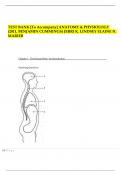
TEST BANK [To Accompany] ANATOMY & PHYSIOLOGY (2011, BENJAMIN CUMMINGS) JERRI K. LINDSEY ELAINE N. MARIEB eFigure 1.1 Using Figure 1.1, match the following cavities: 1) Thoracic cavity. Answer: C Diff: 1 Page Ref: 15-16; Fig. 1.9 2) Cranial cavity. Answer: A Diff: 1 Page Ref: 15-16; Fig. 1.9 3) Abdominal cavity. Answer: D Diff: 1 Page Ref: 15-16; Fig. 1.9 1 4) Vertebral cavity. Answer: B Diff: 1 Page Ref: 15-16; Fig. 1.9Figure 1.2 Using Figure 1.2, match the following regions: 5) Umbilical region. Answer: C Diff: 1 Page Ref: 17; Fig. 1.12 6) Right hypochondriac. Answer: B Diff: 1 Page Ref: 17; Fig. 1.12 7) Hypogastric (pubic) region. Answer: D Diff: 1 Page Ref: 17; Fig. 1.12 8) Epigastric region. Answer: A Diff: 1 Page Ref: 17; Fig. 1.12 9) Right iliac (inguinal) region. Answer: E Diff: 1 Page Ref: 17; Fig. 1.12 Match the following systems to their functions: 10) Directly causes mechanical motion. Diff: 1 Page Ref: 6; Fig. 1.3c 11) Responds to environmental changes by transmitting electrical impulses. Diff: 1 Page Ref: 6; Fig. 1.3d 12) Provides support and levers for muscles to work on. Diff: 1 Page Ref: 6; Fig. 1.3b 13) Protects underlying organs from mechanical damage and synthesizes vitamin D. Diff: 2 Page Ref: 6; Fig. 1.3a A) Muscular B) Skeletal C) Integumentary A3 | P a g eD) Nervous Answers: 10) A 11) D 12) B Match the following systems to their functions: 14) Controls the body with chemical molecules called hormones. Diff: 2 Page Ref: 6; Fig. 1.3e 15) Delivers oxygen and nutrients to the tissues. Diff: 1 Page Ref: 6; Fig. 1.3f 16) Produces antibodies that neutralize foreign substances. Diff: 1 Page Ref: 7; Fig. 1.3g 17) Removes and filters excess fluid from tissues. Diff: 1 Page Ref: 7; Fig. 1.3g A) Immune B) Endocrine C) Cardiovascular D) Lymphatic Answers: 14) B 13) C 15) C 16) A Match the following examples of feedback mechanisms: 18) Blood glucose levels Diff: 2 Page Ref: 9-10 19) Blood pressure Diff: 3 Page Ref: 9-10 20) Blood clotting Diff: 2 Page Ref: 9-10 21) Delivering a baby Diff: 2 Page Ref: 9-10 A) Negative feedback B) Positive feedback Answers: 18) A 19) A 20) B 21) B 17) DMatch the following systems and organs: 22) Arteries, veins, heart. Diff: 1 Page Ref: 6; Fig. 1.3f 23) Trachea, bronchi, alveoli. Diff: 1 Page Ref: 7; Fig. 1.3h 24) Adrenal glands, pancreas, pituitary. Diff: 1 Page Ref: 6; Fig. 1.3e 25) Esophagus, large intestine, rectum. Diff: 1 Page Ref: 7; Fig. 1.3i 26) Kidneys, bladder, ureters. Diff: 1 Page Ref: 7; Fig. 1.3j A) Digestive B) Cardiovascular C) Urinary D) Respiratory E) Endocrine Answers: 22) B 23) D 24) E Match the following cavities and organs: 27) Stomach. Diff: 1 Page Ref: 15; Fig. 1.9 28) Heart. Diff: 1 Page Ref: 15; Fig. 1.9 29) Uterus. Diff: 1 Page Ref: 15; Fig. 1.9 30) Brain. Diff: 1 Page Ref: 15; Fig. 1.9 31) Lungs. Diff: 1 Page Ref: 15; Fig. 1.9 A) Cranial A5 | P a g e 25) A 26) CB) Abdominopelvic C) Thoracic Answers: 27) B 28) C 29) B Match the following regional terms and common terms: 32) Arm. Diff: 1 Page Ref: 13; Fig. 1.7 33) Buttock. Diff: 1 Page Ref: 13; Fig. 1.7 34) Head. Diff: 1 Page Ref: 13; Fig. 1.7 35) Knee (anterior aspect). Diff: 1 Page Ref: 13; Fig. 1.7 36) Chest. Diff: 1 Page Ref: 13; Fig. 1.7 A) Brachial B) Gluteal C) Cephalic D) Patellar E) Thoracic Answers: 32) A 30) A 31) C 33) B Match the regional/directional terms and examples: 37) The bridge of the nose is to the left eye. Diff: 2 Page Ref: 12; Tbl. 1.1 38) The upper arm is to the forearm. Diff: 2 Page Ref: 12; Tbl. 1.1 39) The heart is to the stomach. Diff: 2 Page Ref: 12; Tbl. 1.1 40) The fingers are to the wrist. 34) C 35) D 36) EDiff: 2 Page Ref: 12; Tbl. 1.1 41) The stomach is to the spine. Diff: 2 Page Ref: 12; Tbl. 1.1 A) Medial B) Distal C) Proximal D) Anterior E) Superior Answers: 37) A True/False Questions 1) Positive feedback mechanisms tend to increase the original stimulus. Answer: TRUE Diff: 1 Page Ref: 9-10 2) The anatomical position means the body is standing at attention with the palms facing forward and the thumbs pointing away from the body. Answer: TRUE Diff: 1 Page Ref: 13; Fig. 1.7 3) The elbow is proximal to the shoulder. Answer: FALSE Diff: 1 Page Ref: 12; Tbl. 1.1 4) The serous membrane that lines the peritoneal cavity wall is called visceral peritoneum. Answer: FALSE Diff: 2 Page Ref: 16-17 5) A major function of serous membranes is to decrease friction. Answer: TRUE Diff: 1 Page Ref: 16-17 6) The right hypochondriac region contains the majority of the stomach. Answer: FALSE Diff: 1 Page Ref: 17; Fig. 1.12 7) Lungs carry out an excretory function. Answer: TRUE Diff: 2 Page Ref: 7 8) Embryology concerns the structural changes that occur in an individual A7 | P a g e 38) C 39) E 40) B 41) Dfrom conception through old age. Answer: FALSE Diff: 1 Page Ref: 2 9) A tissue consists of groups of similar cells that have a common function. Answer: TRUE Diff: 1 Page Ref: 4 10) It is important for any organism to maintain its boundaries, so that its internal environment remains distinct from the external environment surrounding it. Answer: TRUE Diff: 1 Page Ref: 4 11) Without some sort of negative feedback mechanism, it would be impossible to keep our body chemistry in balance. Answer: TRUE Diff: 1 Page Ref: 9 12) Regardless of the variable being regulated, all homeostatic control mechanisms have at least three interdependent components. Answer: TRUE Diff: 2 Page Ref: 9; Fig. 1.4 13) The epigastric region is located superior to the umbilical region. Answer: TRUE Diff: 1 Page Ref: 17; Fig. 1.12 Multiple-Choice Questions 1) Histology would be best defined as a study of . A) cells B) tissues C) cell chemistry D) the gross structures of the body Answer: B Diff: 1 Page Ref: 2 2) The study of the heart may incorporate many aspects of anatomy but as a whole you would say it is anatomy. A) microscopic B) gross C) developmental D) systemi c Answer: B Diff: 1 Page Ref: 2 3) An increased rate of breathing as a result of an increased buildup of carbon dioxide in the bloodstream would be best described as an example of A) maintaining boundaries B) excretion of metabolic waste .C) responsiveness D) metabolis m Answer: B Diff: 2 Page Ref: 5 4) Average body temperature is A) 98 B) 68 C) 47 D) 37 Answer: D Diff: 1 Page Ref: 8 5) If you consider your home air conditioner in terms of homeostasis, then the wall thermostat would be the . A) control center B) receptor C) effector D) variable Answer: A Diff: 2 Page Ref: 8-9 6) What is the main, general purpose of negative feedback? A) to control all body system tissues B) to maintain homeostasis C) to keep the bodyʹs sugar high D) to regulate excretion Answer: B Diff: 2 Page Ref: 8-9 7) What is the specific name for the hip region? A) manus B) inguinal C) pedal D) coxa l Answer: D Diff: 1 Page Ref: 13; Fig. 1.7 8) An oblique cut is one that is cut . A) horizontal right and left B) diagonally between the vertical and horizontal C) vertical right and left D) perpendicular to vertical and horizontal Answer: B Diff: 2 Page Ref: 13 9) The heart lies in the A9 | P a g e cavity. degrees centigrade.A) superior mediastinal B) pleural C) dorsal D) pericardi al Answer: D Diff: 1 Page Ref: 15; Fig. 1.9 10) The cavities housing the eyes are called A) frontal B) cranial C) nasal D) orbit al Answer: D Diff: 1 Page Ref: 17 11) A structure that is composed of two or more tissues would be a(n) . A) complex tissue B) organ system C) organ D) complex cell Answer: C Diff: 1 Page Ref: 4 12) cavities are spaces within joints. A) Nasal B) Synovial C) Orbital D) Oral Answer: B Diff: 2 Page Ref: 17-18 13) Which of the following would not be a functional characteristic of life? A) movement B) responsiveness to external stimuli C) maintenance of boundaries D) decay Answer: D Diff: 2 Page Ref: 4-6 14) Which term means toward or at the back of the body, behind? A) anterior B) lateral C) distal D) dors al Answer: D Diff: 1 Page Ref: 12; Tbl. 1.1 cavities.15) The single most abundant chemical substance of the body, accounting for 60% to 80% of body weight, is . A) oxygen B) protein C) water D) hydroge n Answer: C Diff: 1 Page Ref: 8 16) What is the posterior side of the patella called? A) sural B) crural C) antecubital D) poplite al Answer: D Diff: 2 Page Ref: 13; Fig. 1.7 17) Which of the following statements is true concerning feedback mechanisms? A) Positive feedback mechanisms always result in excessive damage to the host. B) Negative feedback mechanisms tend to increase the original stimulus. C) Negative feedback mechanisms work to prevent sudden severe changes within the body. D) Blood glucose levels are regulated by positive feedback mechanisms. Answer: C Diff: 2 Page Ref: 9-11 18) The anatomical position is characterized by all of the following except A) body erect B) arms at sides C) palms turned posteriorly D) thumbs pointed laterally Answer: C Diff: 1 Page Ref: 11; Fig. 1.7 19) A good example of a positive feedback mechanism would be A) body temperature regulation B) regulating glucose levels in the blood C) enhancement of labor contractions D) blood calcium level regulation Answer: C Diff: 1 Page Ref: 9-10 20) Which of the following describes a parasagittal plane? A) a transverse cut just above the knees B) two cuts dividing the body into left and right halves C) any sagittal plane except the median D) any cut dividing the body into anterior and posterior Answer: C Diff: 2 Page Ref: 13 A11 | P a g e . .21) Which of the following organs or structures would be found in the left iliac region? A) appendix B) stomach C) liver D) intestin es Answer: D Diff: 2 Page Ref: 17; Fig. 1.12 22) The parietal pleura would represent a serous membrane . A) covering individual lungs B) lining the thoracic cavity C) covering the heart D) lining the abdominal cavity Answer: B Diff: 2 Page Ref: 16 23) Which one of the following systems responds to environmental stimuli? A) muscular B) lymphatic C) immune D) nervo us Answer: D Diff: 2 Page Ref: 6; Fig. 1.3 24) Choose the anatomical topic and definition that is not correctly matched. A) Gross anatomy: study of structures visible to the eye. B) Microscopic anatomy: study of structures too small to be seen by the naked eye. C) Cytology: study of the structures in a particular region. D) Embryology: study of the changes in an individual from conception to birth. Answer: C Diff: 1 Page Ref: 2 25) Homeostasis is the condition in which the body maintains . A) the lowest possible energy usage B) a relatively stable internal environment, within limits C) a static state with no deviation from preset points D) a dynamic state within an unlimited range Answer: B Diff: 2 Page Ref: 8-9
Document information
- Uploaded on
- August 9, 2023
- Number of pages
- 494
- Written in
- 2023/2024
- Type
- Exam (elaborations)
- Contains
- Unknown