

Guidance for Final Exam
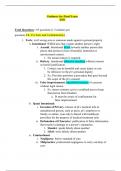
Total Questions= 65 questions (1.5 minutes per question) Ch. 23 (Torts and Confidentiality) 1. Torts: civil wrong acts or omission made against a person/property a. Intentional: Willful acts that violate another person’s right i. Assault: Intentional threat towards another person that places that person in fear of harmful, imminent or unwelcomed contact. 1. No actual contact is required ii. Battery: intentional offensive touching without consent or lawful justification. 1. Contact can be harmful and cause injury or can be offensive to the pt’s personal dignity 2. Ex: Provider performs a procedure that goes beyond the scope of the pt’s consent iii. False Imprisonment: unjustified restraint of a person without legal reason 1. Ex: nurses restrain a pt in a confined area to keep that person from freedom a. Pt must be aware of confinement for false imprisonment. b. Quasi Intentional: i. Invasion of Privacy: release of pt’s medical info to unauthorized person, such as press, pt’s employer or family or online. (can only b shared with healthcare providers for the purpose of medical treatment only ii. Defamation of Character: publication of false information that results in damage to a person’s reputation 1. Slander: speak falsely about another 2. Libel: write falsely about another c. Unintentional i. Negligence: below standard of care ii. Malpractice: professional negligence to carry out duty of care 2. Confidentiality a. HIPAA: pt right to consent to the use and disclosure of their protected health info, to inspect and copy one’s medical record and to amend mistakes or incomplete info. b. Limits who’s able to access pt records. c. Privacy and confidentiality d. Informed consent: nurse is witness that pt signed and is competent Ch. 37 x 9 Questions (See topics below) Types of Grief: a cluster of ordinary emotions arising in response of a significant loss. Intensified and complicated by the relationship to the person or object lost 1. Normal uncomplicated grief: common universal reaction 2. Anticipatory grief: before the actual loss of death ex caring for pt with dementia or ALS 3. Disenfranchised Grief: relationship to deceased person not socially sanctioned, cant be openly shared or seems less significant a. Ambiguous loss: the person is physically present but not psychologically available. Ex: dementia or brain injury 4. Complicated Grief: prolonged significant difficulty moving forward after a loss a. Chronic: normal grief response experienced over a long period of time b. Exaggerated: self destructive or maladaptive behavior, obsessions, or psych disorders. Suicide risk c. Delayed: avoidance because the loss is so significant. Ususally triggered by a second less significant loss d. Masked: behaves in a way that interferes with normal functioning Box 37-10, Care of the Body after Death 1. African American: presence of large extended family and church family. Mourning short with memorial service and public viewing of the body or wake before burial. Organ donation and autopsy allowed 2. Chinese: death negative life event. No afterlife. Dead treated same as living, may b buried with food and artifacts. Extended family stay with deceased 8 hrs. Oldest son or daughter bathes the body under direction of an older relative or temple priest a. Body should remain intact. No organ donation or autopsy 3. Hispanic or Latino: amulets, rosary, folk medicine and prayer. Grief expressed openly. Death is the will of God. Catholic. 4. Native Americans: Some don’t touch the body. Some cleanse the bosy, paint the face, dress it in clothes, attach eagle feathers to symbolize a return home. a. Mourners have a ritual to cleanse their own body b. Dead buried on the deceased homeland 5. Islamic: Deceased body ritualistically washed, wrapped cried over, prayed for and buried as soon as possible after death. Eyes and mouth closed. Faced turned towards mecca. a. Muslims of the same gender prepare the body b. Bodies are buried not cremated c. Proximity of loved ones is imp since soul stay with body until buried d. Autopsy prevents to quickness of burial 6. Buddhist: believe in afterlife inwhich humans manifest in different forms. Death is preferred at home. Minimize emotional expression to maintain peaceful, compassionate atmosphere. Male family members prepare the body. Budhists recommend not touching the body after death to facilitate a smooth transition to afterlife. The body is not left alone. Family and friends pay respects until cremation. 7. Hindu: Body in the floor with the head placed north. Same gender handles the body. The body is cremated to purify with fire. 8. Jewish: Orthodox Judaism: Jewish burial society. Family stays with the body until the burial, which is within 24 hrs but not on the Sabbath. Some but not all types avoid cremation, autopsy, and embalming Types of Loss, 1. Actual Loss: Person can no longer feel, hear, see or know a person or object a. Necessary Loss i. Maturational Loss: Normally expected changes across life span, normal life transitions Ex: toddler separation anxiety, kid leaving old classroom friends and teacher, college student leaving campus after graduating Help pt develop coping skills for unplanned, unwanted or unexpected loss ii. Situational Loss: brought about by sudden unpredictable external event Ex: car accident injury leads to physical change so pt loses job, life goals, self esteem ...................................................................................................CONTINUE.
Document information
- Uploaded on
- August 4, 2023
- Number of pages
- 12
- Written in
- 2023/2024
- Type
- Exam (elaborations)
- Contains
- Questions & answers


