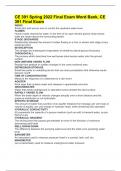
CE 391 Spring 2022 Final Exam Word Bank, CE 391 Final Exam
CE 391 Spring 2022 Final Exam Word Bank, CE 391 Final Exam WEIRS Small dam built across river to control the upstream water level FLUMES Human-made channel for water, in the form of an open decline gravity chute whose walls are raised above the surrounding terrain STAGE DISCHARGE Relationship between the amount of water flowing in a river or stream and stage at any particular point INTERCEPTION The storage and subsequent evaporation of rainfall by above-ground structures THROUGHFALL The process which describes how wet leaves shed excess water onto the ground surface NON-UNIFORM VARIED FLOW Results from gradual or sudden changes in the cross sectional area DEPRESSION STORAGE Small low points in undulating terrain that can store precipitation that otherwise would become runoff TIME OF CONCENTRATION Measure the response of a watershed to a rain event AQUIFER Rock layer that contains water and releases in appreciable amounts GROUNDWATER Water that exists underground in saturated zones beneath the land surface RAPIDLY VARIED FLOW When the water depth or velocity changes abruptly over a short distance and the pressure distribution is not hydrostatic SPECIFIC STORAGE The amount of water that a portion of an aquifer releases from storage, per unit mass or volume of aquifer, per unit change in hydraulic head, while remaining fully saturated HYDRAULIC CONDUCTIVITY (K),represents the capacity of a porous medium (such as soil) to transmit water, as per Darcy's Law HYDRAULIC GRADIENT The driving force that causes groundwater to move in the direction of maximum decreasing total head WELL-DRAW DOWN The difference between the pumping water level and the static (non-pumping) water level BAROMETER An instrument used to measure pressure head in a conduit, tank, soil, etc. MANOMETER (a.k.a piezometer) used to measure underground water pressure DISCHARGE COEFFICIENT Used to model the relationship between flow and headloss through the valve being modeled EQUIVALENT HEIGHT Way of representing changes in the gravity field in hydrological units PRESSURE GRADIENT Slope of the water table or potentiometric surface, that is, the changes in water level per unit of distance along the direction of maximum head decrease GEOMETRIC CRITICAL FLOW The variation of specific energy with a depth at a constant discharge HYDROLOGIC CYCLE WATERSHED Area of land that separates waters flowing to different rivers, basins, or seas GRADUALLY VARIED FLOW Steady non-uniform flow with the velocity of water remaining constant at a specified point AREA OF FLOW EVAPORATION The transfer of liquid water into vapor state to the atmosphere INFILTRATION Process by which water on the ground surface enters the soil VISCOMETER Instrument that measures the fluid flow and viscosity of liquids TUBE TYPE FALLING SPHERE ROTATIONAL PRESSURE TRANSDUCER Pressure transmitters that can measure water pipe pressure BOURDON GAGE Used for the measurement of relative pressure from 0.8 to 100,000 psi LYSIMETER Devices that define a specific boundary to contain soil water and permit measurement of either the soil-water balance or the volume of water percolating vertically and/or its quality EVAPORATION PAN Used to test evaporation of water, measured by comparting depth of water in pan GRAVIMETRIC METHOD A method of quantitative chemicals analysis in which the constituent sought is converted into a substance (of known composition) that can be separated from the sample and weighed INFILTROMETER Device used to measure the rate of water infiltration into soil or other porous media. HYDROMETER Device used to measure characteristics of a liquid, such as density or specific gravity CRITICAL STEP HEIGHT The depth of maximum discharge, when the specific energy is held constant HYDRAULIC STEEPNESS Causes groundwater to move in the direction of maximum decreasing total head SUBCRITICAL FLOW Occurs when the actual water depth is greater than critical depth. (Fr<1) SUPERCRITICAL FLOW A flow whose velocity is larger than the wave velocity. (Fr>1) BROAD CRESTED WEIR weir block that supports flow over a horizontal distance SHARP CRESTED WEIR rectangular or triangular plate with a sharp edge on upstream side SOIL MOISTURE quantity of water soil contains PARSHALL FLUME flow measuring flume through a contraction of both the parallel sidewalls and a drop in the floor at the flume throat FLUID SYSTEM power transfer system using force of flowing fluids to transmit power VELOCITY HEAD fluid's kinetic energy; v^2/2g ELEVATION HEAD fluid's weight caused by gravitational force; h = hp + hz PRESSURE HEAD fluid's static pressure; hp = P/specific weight TOTAL HEAD elevation head + velocity head + pressure head SPECIFIC ENERGY total mechanical energy head relative to the channel bed; minimum energy at critical depth CRITICAL VELOCITY velocity at critical depth in open channel flow KINEMATIC ENERGY types of energy POTENTIAL ENERGY types of energy PRESSURE ENERGY types of energy INTERNAL ENERGY types of energy HYDRAULIC GRADE LINE line that represents the sum of the elevation and pressure head ENERGY GRADE LINE line that represents the total energy head; distance v^2/2g above HGL VISCOUS SUBLAYER thin layer of flow near pipe wall in contact with moving stream INVISCID CORE region where viscosity of fluid is equal to zero LAMINAR BOUNDARY LAYER flow takes place in layers where each layer slides past the adjacent layers FLUID VELOCITY factors that influence open channel flow TURBULENT BOUNDARY intense agitation in adjacent layers of flow LAYER region of flowing fluid STEADY FLOW flow remains constant over time at any given point along a channel UNSTEADY FLOW flow is not constant LAW OF THE WALL the average velocity of a turbulent flow at a certain point is proportional to the logarithm of the distance from that point to the "wall", or the boundary of the fluid region. ABSOLUTE ROUGHNESS measure of the surface roughness of a material which a fluid may flow over ENTRANCE TUBES VENTURI METER flow measurement instrument based on Bernoulli's Principle STATIC PRESSURE pressure at a point in a fluid; P = ρgh EXPANSION types of minor losses BENDS AND ELBOWS types of minor losses JET CONTRACTION decrease in pipe diameter; jet types: free - discharge into gas, submerged- discharge into same fluid type KINEMATIC MAXIMUM VELOCITY usually occurs at the centerline in pipe flow FITTINGS types of minor losses SUBMERGED DISCHARGE types of minor losses CONTRACTION types of minor losses CENTERLINE VELOCITY usually maximum velocity in pipe flow CAVITATION rapid vaporization and recondensation of liquid as it briefly flows through a region of low absolute pressure CHANNEL SLOPE factors that influence open channel flow CHANNEL SHAPE factors that influence open channel flow FLUID DEPTH factors that influence open channel flow UNIFORM FLOW flow where flow depth and average velocity remain constant BED SLOPE slope at the bed of open channel flow WATER SURFACE SLOPE in open channel flow, the elevation difference of the water surface between two points ENERGY GRADIENT SLOPE height of velocity head above the hydraulic gradient ALTERNATIVE DEPTHS in open channels, two alternate depths of flow have the same energy for the same flow rate CRITICAL DEPTH depth in open channel flow where energy is at a minimum for specific Q MINIMUM ENERGY energy is at a minimum for open channel flow at critical depth MAXIMUM DISCHARGE can maximize discharge by minimizing P (wetted perimeter); occurs when depth is NEARLY FULL
Written for
- Institution
- CE 391
- Course
- CE 391
Document information
- Uploaded on
- August 3, 2023
- Number of pages
- 5
- Written in
- 2023/2024
- Type
- Exam (elaborations)
- Contains
- Questions & answers
Subjects
- ce 391 fi
-
ce 391 spring 2022 final exam word bank