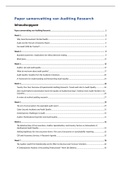
Paper samenvatting van Auditing Research
Inhoudsopgave
Paper samenvatting van Auditing Research.................................................................................................... 1
Week 1:......................................................................................................................................................... 2
Why Good Accountants Do Bad Audits................................................................................................................2
Audit and the Pursuit of Dynamic Repair.............................................................................................................4
Can Audit (Still) be Trusted?.................................................................................................................................5
Week 2:......................................................................................................................................................... 9
Bounded awareness: Implications for ethical decision making...........................................................................9
Blind Spots..........................................................................................................................................................13
Week 3........................................................................................................................................................ 15
Auditor size and audit quality............................................................................................................................15
What do we know about audit quality?.............................................................................................................17
Audit Quality: Insights from the Academic Literature.......................................................................................20
A Framework for Understanding and Researching Audit Quality......................................................................24
Week 4........................................................................................................................................................ 26
Twenty-Five-Year Overview of Experimental Auditing Research: Trends and Links to Audit Quality...............26
Does Audit Market Concentration Harm the Quality of Audited Earnings? Evidence from Audit Markets in 42
Countries............................................................................................................................................................26
A review of archival auditing research...............................................................................................................27
Week 5........................................................................................................................................................ 29
The art of conversation: the expanded audit report..........................................................................................29
Cyber-Security Incidents and Audit Quality........................................................................................................31
Contemporary Challenges in Audit....................................................................................................................31
Auditor Multinational Expertise and Audit Quality............................................................................................31
Week 6........................................................................................................................................................ 31
The Relative Role of Firm Incentives, Auditor Specialization, and Country Factors as Antecedents of
Nonfinancial Audit Quality.................................................................................................................................31
Seeking legitimacy for new assurance forms: The case of assurance on sustainability reporting....................32
CSR and Assurance Services: A Research Agenda..............................................................................................35
Week 7........................................................................................................................................................ 36
The Auditor-Audit Firm Relationship and Its Effect on Burnout and Turnover Intention...................................36
A Contemporary Analysis of Accounting Professionals’ Work-Life Balance......................................................36
,Week 1:
Why Good Accountants Do Bad Audits
The Sarbanes-Oxley Act of 2002 addresses corporate accountability. The act places new legal
constraints on executives and gives expanded protections to whistle-blowers.
The government and the public assume that the underlying problems are corruption and criminality
—unethical accountants falsifying numbers to protect equally unethical clients. But that’s only a
small part of the story. Serious accounting problems have long plagued corporate audits, routinely
leading to substantial fines for accounting firms.
Unlike conscious corruption, unconscious bias cannot be deterred by threats of jail time. If we are
really going to restore trust in the U.S. system of auditing, we will need to go well beyond the
provisions of the Sarbanes-Oxley Act. We will need to embrace practices and regulations that
recognize the existence of bias and moderate its ill effects.
The Roots of Bias
Psychological research shows that our desires powerfully influence the way we interpret information.
Professional accountants might seem immune to such biases, but the corporate auditing arena is a
particularly fertile ground for self-serving biases. Three structural aspects of accounting create
substantial opportunities for bias to influence judgment:
- Ambiguity
Bias thrives wherever there is the possibility of interpreting information in different ways.
- Attachment
Under the current system, auditors are hired and fired by the companies they audit, and it is
well known that client companies fire accounting firms that deliver unfavorable audits.
- Approval
Research shows that self-serving biases become even stronger when people are endorsing
others’ biased judgments—provided those judgments align with their own biases—than
when they are making original judgments themselves.
- Familiarity
People are more willing to harm strangers than individuals they know, especially when those
individuals are paying clients with whom they have ongoing relationships.
- Discounting
The costs of a positive report when a negative report is called for—protecting the accounting
firm’s reputation or avoiding a lawsuit, for example—are likely to be distant and uncertain.
- Escalation
It’s natural for people to conceal or explain away minor indiscretions or oversights,
sometimes without even realizing that they’re doing it.
Problems with Proposed Reforms:
Because the reforms in the Sarbanes-Oxley Act and those proposed by others do not address the
fundamental problem of bias, they will not solve the crisis in accounting in the United States. Based
on research it seems implausible that stricter accounting rules could eliminate ambiguity—and thus
they are unlikely to reduce self-serving bias.
Radical Remedies
The key to improving audits, clearly, is not to threaten or cajole. It must be to eliminate incentives
that create self-serving biases. This means that new policies must reduce an auditor’s interest in
whether a client is pleased by the results of an audit.
,- We must remove the threat of being fired for delivering an unfavorable audit. Auditors must
have fixed, limited contract periods during which they cannot be terminated. All fees and
other contractual details should be specified at the beginning of the contract and must be
unchangeable.
- In addition, the client must be prohibited from re-hiring the auditing firm at the end of the
contract; instead, the major accounting firms would be required to rotate clients.
- Audit clients must also be prohibited from hiring individual accountants away from their
audit firms.
- Less tangibly, auditors must come to appreciate the profound impact of self-serving biases
on judgment. What’s needed is education that helps auditors understand the unconscious
errors they make and the reasons they make them.
, Audit and the Pursuit of Dynamic Repair
Particular interest to our paper is the discussion of craft-like responses when an object stops working
and is in need of repair. Sennett discusses three categories of repair:
- Restoration which is to make a damaged object just like new
- Remediation which is to substitute better parts or materials to improve its operation,
- And reconfiguration which can change the object’s form or function once it is reassembled.
In considering the potential contribution of the act of repair, Sennett distinguishes between static
and dynamic repair. He contrasts a static repair, which represents basic and routine restoration and
remediation of an object to its former state with a dynamic repair, which involves reconfiguration,
and can change the object’s form or function once reassembled.
Sennett regards ‘fit-for-purpose’ tools as being one-dimensional – efficient for their intended
purpose but inherently frustrating when objects stop working and things go wrong. He refers to
‘multipurpose tools’ as being sublime (‘puzzling’), and whose sheer variety.
Sennett (2012) argues that reconfiguration is the most socially engaging of the three approaches to
repair. A central premise of this paper is that most past initiatives by regulators, the accounting
profession, and firms to repair the audit have been restorative and remediating in nature –
fundamentally ‘static repairs’ in Sennett’s framing.
In promoting the case for a dynamic repair of audit, we have highlighted four principal conceptual
considerations.
1. We started by emphasizing the restrictiveness of the notion of an ‘audit is an audit’ on
conceptual innovation in audit and the way it has been utilized to reinforce the powers of
international audit standard setters to determine what is or is not accepted as legitimate
auditing and assurance practice.
2. We then called for a conceptual switch in the relationship between audit and assurance,
highlighting the potential impact on the value proposition of audit and the capacity for
practice innovation if ‘assurance’ is viewed as a subset of ‘audit’ rather than the other way
round.
3. In a similar vein, we stressed the importance of reframing assumptions regarding the
functionality of audit standard setting, calling for a regulatory space centered on facilitating
innovation in auditing practice.
4. Finally, we advocated a major transformation in the way the profession contemplates its
public interest responsibilities. The starting point for the profession should be the
contemplation of social needs and ambitions (not perse public interest).
The fundamental ‘problem’ for the accounting profession is that it has become far too used to
defining the audit in terms of what it cannot do. Confronting such presumptions represents a
questioning of the functional competence of audit but with the direct intent of enhancing its
societal contribution. In Sennett’s terms, this is what should not be forgotten. If we regard audit as a
form of social conscience, then a dynamic repair of the audit must contemplate both the type of
society we want to inhabit and the contribution that audit can make in securing it. Dynamic repair
requires us to think and talk differently about the social construction and social purposefulness of the
audit.
Inhoudsopgave
Paper samenvatting van Auditing Research.................................................................................................... 1
Week 1:......................................................................................................................................................... 2
Why Good Accountants Do Bad Audits................................................................................................................2
Audit and the Pursuit of Dynamic Repair.............................................................................................................4
Can Audit (Still) be Trusted?.................................................................................................................................5
Week 2:......................................................................................................................................................... 9
Bounded awareness: Implications for ethical decision making...........................................................................9
Blind Spots..........................................................................................................................................................13
Week 3........................................................................................................................................................ 15
Auditor size and audit quality............................................................................................................................15
What do we know about audit quality?.............................................................................................................17
Audit Quality: Insights from the Academic Literature.......................................................................................20
A Framework for Understanding and Researching Audit Quality......................................................................24
Week 4........................................................................................................................................................ 26
Twenty-Five-Year Overview of Experimental Auditing Research: Trends and Links to Audit Quality...............26
Does Audit Market Concentration Harm the Quality of Audited Earnings? Evidence from Audit Markets in 42
Countries............................................................................................................................................................26
A review of archival auditing research...............................................................................................................27
Week 5........................................................................................................................................................ 29
The art of conversation: the expanded audit report..........................................................................................29
Cyber-Security Incidents and Audit Quality........................................................................................................31
Contemporary Challenges in Audit....................................................................................................................31
Auditor Multinational Expertise and Audit Quality............................................................................................31
Week 6........................................................................................................................................................ 31
The Relative Role of Firm Incentives, Auditor Specialization, and Country Factors as Antecedents of
Nonfinancial Audit Quality.................................................................................................................................31
Seeking legitimacy for new assurance forms: The case of assurance on sustainability reporting....................32
CSR and Assurance Services: A Research Agenda..............................................................................................35
Week 7........................................................................................................................................................ 36
The Auditor-Audit Firm Relationship and Its Effect on Burnout and Turnover Intention...................................36
A Contemporary Analysis of Accounting Professionals’ Work-Life Balance......................................................36
,Week 1:
Why Good Accountants Do Bad Audits
The Sarbanes-Oxley Act of 2002 addresses corporate accountability. The act places new legal
constraints on executives and gives expanded protections to whistle-blowers.
The government and the public assume that the underlying problems are corruption and criminality
—unethical accountants falsifying numbers to protect equally unethical clients. But that’s only a
small part of the story. Serious accounting problems have long plagued corporate audits, routinely
leading to substantial fines for accounting firms.
Unlike conscious corruption, unconscious bias cannot be deterred by threats of jail time. If we are
really going to restore trust in the U.S. system of auditing, we will need to go well beyond the
provisions of the Sarbanes-Oxley Act. We will need to embrace practices and regulations that
recognize the existence of bias and moderate its ill effects.
The Roots of Bias
Psychological research shows that our desires powerfully influence the way we interpret information.
Professional accountants might seem immune to such biases, but the corporate auditing arena is a
particularly fertile ground for self-serving biases. Three structural aspects of accounting create
substantial opportunities for bias to influence judgment:
- Ambiguity
Bias thrives wherever there is the possibility of interpreting information in different ways.
- Attachment
Under the current system, auditors are hired and fired by the companies they audit, and it is
well known that client companies fire accounting firms that deliver unfavorable audits.
- Approval
Research shows that self-serving biases become even stronger when people are endorsing
others’ biased judgments—provided those judgments align with their own biases—than
when they are making original judgments themselves.
- Familiarity
People are more willing to harm strangers than individuals they know, especially when those
individuals are paying clients with whom they have ongoing relationships.
- Discounting
The costs of a positive report when a negative report is called for—protecting the accounting
firm’s reputation or avoiding a lawsuit, for example—are likely to be distant and uncertain.
- Escalation
It’s natural for people to conceal or explain away minor indiscretions or oversights,
sometimes without even realizing that they’re doing it.
Problems with Proposed Reforms:
Because the reforms in the Sarbanes-Oxley Act and those proposed by others do not address the
fundamental problem of bias, they will not solve the crisis in accounting in the United States. Based
on research it seems implausible that stricter accounting rules could eliminate ambiguity—and thus
they are unlikely to reduce self-serving bias.
Radical Remedies
The key to improving audits, clearly, is not to threaten or cajole. It must be to eliminate incentives
that create self-serving biases. This means that new policies must reduce an auditor’s interest in
whether a client is pleased by the results of an audit.
,- We must remove the threat of being fired for delivering an unfavorable audit. Auditors must
have fixed, limited contract periods during which they cannot be terminated. All fees and
other contractual details should be specified at the beginning of the contract and must be
unchangeable.
- In addition, the client must be prohibited from re-hiring the auditing firm at the end of the
contract; instead, the major accounting firms would be required to rotate clients.
- Audit clients must also be prohibited from hiring individual accountants away from their
audit firms.
- Less tangibly, auditors must come to appreciate the profound impact of self-serving biases
on judgment. What’s needed is education that helps auditors understand the unconscious
errors they make and the reasons they make them.
, Audit and the Pursuit of Dynamic Repair
Particular interest to our paper is the discussion of craft-like responses when an object stops working
and is in need of repair. Sennett discusses three categories of repair:
- Restoration which is to make a damaged object just like new
- Remediation which is to substitute better parts or materials to improve its operation,
- And reconfiguration which can change the object’s form or function once it is reassembled.
In considering the potential contribution of the act of repair, Sennett distinguishes between static
and dynamic repair. He contrasts a static repair, which represents basic and routine restoration and
remediation of an object to its former state with a dynamic repair, which involves reconfiguration,
and can change the object’s form or function once reassembled.
Sennett regards ‘fit-for-purpose’ tools as being one-dimensional – efficient for their intended
purpose but inherently frustrating when objects stop working and things go wrong. He refers to
‘multipurpose tools’ as being sublime (‘puzzling’), and whose sheer variety.
Sennett (2012) argues that reconfiguration is the most socially engaging of the three approaches to
repair. A central premise of this paper is that most past initiatives by regulators, the accounting
profession, and firms to repair the audit have been restorative and remediating in nature –
fundamentally ‘static repairs’ in Sennett’s framing.
In promoting the case for a dynamic repair of audit, we have highlighted four principal conceptual
considerations.
1. We started by emphasizing the restrictiveness of the notion of an ‘audit is an audit’ on
conceptual innovation in audit and the way it has been utilized to reinforce the powers of
international audit standard setters to determine what is or is not accepted as legitimate
auditing and assurance practice.
2. We then called for a conceptual switch in the relationship between audit and assurance,
highlighting the potential impact on the value proposition of audit and the capacity for
practice innovation if ‘assurance’ is viewed as a subset of ‘audit’ rather than the other way
round.
3. In a similar vein, we stressed the importance of reframing assumptions regarding the
functionality of audit standard setting, calling for a regulatory space centered on facilitating
innovation in auditing practice.
4. Finally, we advocated a major transformation in the way the profession contemplates its
public interest responsibilities. The starting point for the profession should be the
contemplation of social needs and ambitions (not perse public interest).
The fundamental ‘problem’ for the accounting profession is that it has become far too used to
defining the audit in terms of what it cannot do. Confronting such presumptions represents a
questioning of the functional competence of audit but with the direct intent of enhancing its
societal contribution. In Sennett’s terms, this is what should not be forgotten. If we regard audit as a
form of social conscience, then a dynamic repair of the audit must contemplate both the type of
society we want to inhabit and the contribution that audit can make in securing it. Dynamic repair
requires us to think and talk differently about the social construction and social purposefulness of the
audit.