

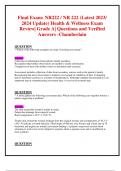
Final Exam: NR222 / NR 222 (Latest 2023/ 2024 Update) Health & Wellness Exam Review| Grade A| Questions and Verified Answers -Chamberlain
Final Exam: NR222 / NR 222 (Latest 2023/ 2024 Update) Health & Wellness Exam Review| Grade A| Questions and Verified Answers -Chamberlain QUESTION * Which of the following examples are steps of nursing assessment? Answer: Collection of information from patient's family members. Recognition that further observations are needed to clarify information. Comparison of data with another source to determine data accuracy. Assessment includes collection of data from secondary sources such as the patient's family. Recognizing that more observation is needed is an example of validation of data. Comparing data to determine accuracy is a feature of interpretation. Although complete documentation is an important step in communicating assessment data, it is not an assessment step. QUESTION * A nurse gathers the following assessment data. Which of the following cues together form(s) a pattern suggesting a problem? Answer: The skin around the wound is tender to touch. Patient has drainage from surgical wound. Body temperature is 38.3° C (101° F). Tender skin around the wound, drainage from the surgical wound, and a temperature of 38.3° C (101° F) indicate a wound infection. Fluid intake of 800 mL over 8 hours and a heart rate of 78 beats/min and regular are normal assessment findings. A patient's expressed concern about returning to work is his or her subjective response about a separate issue and is insufficient to form a pattern. QUESTION * A nurse makes the following statement during a change-of-shift report to another nurse. "I assessed Mr. Diaz, my 61-year-old patient from Chile. He fell at home and hurt his back 3 days ago. He has some difficulty turning in bed, and he says that he has pain that radiates down his leg. He rates his pain at a 6, and he moves slowly as he transfers to a chair." What can the nurse who is beginning a shift do to validate the previous nurse's assessment findings when she rounds on the patient? Answer: The nurse asks the patient to rate his pain on a scale of 0 to 10. The nurse assesses the patient's lower-limb strength. Validation of assessment data is the comparison of data with another source to determine its accuracy. The nurse compares data reported by the previous nurse with data collected directly with the patient, including assessing pain on the rating scale and assessing the patient's lower limb strength. Asking the patient what caused his fall and about past back pain and experience with pain medications would offer the nurse new information about the patient. QUESTION A nurse is checking a patient's intravenous line and, while doing so, notices how the patient bathes himself and then sits on the side of the bed independently to put on a new gown. This observation is an example of assessing: Answer: Patient's level of function. Observing a patient perform activities physical, socially, psychologically, and developmentally assesses his or her level of function. In the case of this question the nurse assesses physical functional level. Observation does not measure willingness to perform self-care but the ability to do so. Observing physical performance of self-hygiene is not a measure of level of consciousness nor does it reveal a patient's values. QUESTION The nurse asks a patient, "Describe for me a typical night's sleep. What do you do to fall asleep? Do you have difficulty falling or staying asleep? This series of questions would likely occur during which phase of a patient-centered interview? Answer: Working phase. The gathering of information is the working phase of a patient-centered interview. QUESTION The nurse enters the room of an 82-year-old patient for whom she has not cared previously. The nurse notices that the patient wears a hearing aid. The patient looks up as the nurse approaches the bedside. Which of the following approaches are likely to be effective with an older adult? Answer: Listen attentively to the patient's story. Use gestures that reinforce your questions or comments. Maintain direct eye contact. Ask questions quickly to reduce the patient's fatigue. Approaches for collecting an older-adult assessment include listening patiently, using nonverbal communication when a patient has a hearing deficit, and maintaining patientdirected eye gaze. Leaning forward, not backward, shows interest in what the patient has to say.
Document information
- Uploaded on
- August 3, 2023
- Number of pages
- 70
- Written in
- 2023/2024
- Type
- Exam (elaborations)
- Contains
- Questions & answers


