

Biology - Homeostasis Test A Graded A+
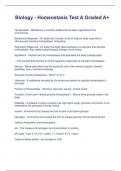
Homeostasis - Maintaining a constant stable internal state regardless of the environment Behavioral Response - An action we "choose" to do to help our body cope with a stimulus and maintain homeostasis. (Voluntary) Regulatory Response - An action the body takes because of a stimulus that disrupts homeostasis. Also called a physiological change. (Involuntary) Equlibrium - Another term for homeostasis that describes the body's steady state - The process that controls all of the regulatory responses to maintain homeostasis Neuron - Nerve cells which are the functional unit of the nervous system. Contain dendrites, axon, and nerve endings. Set point of body temperature - 98.6 F or 37 C Hormone - A substance secreted by the endocrine system to regulate homeostasis in the body. Factors of Homeostasis - Stimulus, Set point, sensor, control center Function of the Liver in blood glucose homeostasis? - Stores extra glucose made in the body Diabetes - A disease in which a person has high blood sugar (glucose) and insulin is not released by the pancreas to bring it down. Insulin - A hormone that causes the liver to take in and store glucose Glycogen - A hormone that causes the liver to release glucose into the blood stream Cellular Respiration and homeostasis - pH - The measure of hydrogen ion concentration in solution pH scale - from 0-14. 0-6 = acidic, 7 = neutral, 8-14 = basic Cause of blood acidity - An increase in CO2.
Document information
- Uploaded on
- August 2, 2023
- Number of pages
- 1
- Written in
- 2023/2024
- Type
- Exam (elaborations)
- Contains
- Questions & answers


