NUR 265 Advanced Exam 1: A+ Guide: Latest updated
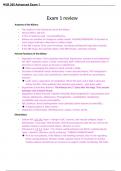
Anatomy of the Kidney: - The nephron is the functional unit of the kidney. - Normal GFR is 120-125. - If 75% of nephrons quit = renal insufficiency. - Kidneys are sensitive to changes in cardiac output. VOLUME DEPENDENT. A decrease in urine output indicates a decrease in cardiac output. - If the SBP is below 70 for over 40 minutes, the kidney will become hypo then ischemic. - If the SBP drops, the arterioles dilate. If the SBP elevate, arterioles constrict. Normal Functions of the Kidney: - Regulation of Water: Thirst regulates body fluid. Aldosterone- excretes K and reabsorbed NA. ADH- reabsorbs water, is water conserving. ANP- inhibits NA and reabsorbs water. A decrease in volume causes as increase in aldosterone. When encouraging the patient to drink, provide a GOAL. - Excretion of Metabolic Waste: Reabsorbed = water and electrolytes. NOT reabsorbed = creatinine, urea, lactic acid, and ketones. Check creatinine and BUN to assess kidney function Lactic acid is a byproduct of metabolism. When the lactic acid is high in decrease kidney function, these patients have soreness everywhere. *give them water. - Regulation of Acid-Base Balance: The kidneys are 2nd place after the lungs. They excrete hydrogen and reabsorb bicarb. - Regulation of Blood Pressure: Maintain VOLUME. Renin-Angiotensin- vasoconstricts then releases aldosterone. Aldosterone. Prostaglandins- vasodilatation. Bradykininsvasodilation and vascular permeability. - RBC Synthesis: Renal Erythropoietin Factor stimulates bone marrow to make RBCs. A dialysis patient is often anemic. - Regulation of Electrolytes: effecting neuro, cardiac, mental, and GI. Electrolytes: - Sodium NA: 135-145. Hypo = change in LOC, seizures, and vascular collapse. Hyper = dehydration. Treat hyper with diuretics, D5W because glucose pulls NA out. Correct the problem slowly to avoid cerebral edema. 48 hours or more. - Potassium K: 3.5-5.2. Hyper = MI, chemo, autotransfusion (we did it), crushing injuries. Hypo = diuretics, diarrhea, and GI suctioning. *CARDIAC DYSRHYTHMIAS* No K to renal patients, if the kidney is not working correctly, they’re not regulating levels causing build up. Monitor closely, and give slowly. Pt should be on monitor. Cardiac patients should have an increase K to support cardiac functioning. NO PUSH. NUR 265 Advanced Exam 1 - Calcium Ca: 8.5-10.2. Needed for nerve impulses, cardiac contraction, blood clotting, and bones and teeth growth. Hypo = laryngospasm (AIRWAY), and respiratory collapse. Transfusions decrease Ca. Basic Metabolic Panel is not accurate. A decrease in Ca indicates a decrease in albumin. Chovskeys- Trouvosels- - Magnesium Mg: 1.8-2.4. Hyper = decease reflexes, hypertension, and cardiac dysrhythmias. Hypo = increase in muscular and CNS activity. K needs Mg. Give Mg first so K can be transported into the cells. - Phosphorus: 2.5- 4.9. Where Ca is… Phos is NOT! Opposite s/s as Ca. Ask our Patient: current problem, what’s their normal, how much fluid do you drink daily, what meds do you take, other health issues, and family history. Nephrotic Syndrome: (pg. 1379 chart 67-3 sudden onset of sxs)
Document information
- Uploaded on
- August 1, 2023
- Number of pages
- 19
- Written in
- 2023/2024
- Type
- Exam (elaborations)
- Contains
- Questions & answers