
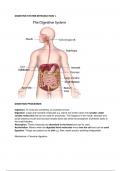
DIGESTIVE SYSTEM INTRODUCTION :)
DIGESTION PROCESSES
Ingestion: To consume something, an example is food.
Digestion: Large and insoluble molecules e.g. starch are broken down into smaller, water
soluble molecules that can be used for processes. This happens in the mouth, stomach and
small intestine (mouth and stomach breaks down fats while the breakdown of proteins starts in
the small intestine.
Absorption: These molecules are absorbed in the blood and can be used.
Assimilation: Means when the digested food molecules move into the cell and can be used
Egestion: Things are passed out as shit e.g. fiber, waste product anything indigestable
Mechanical v Chemical digestion:
,Mechanical digestion is what you do physically to break foods down and make them smaller
to be more easily used (chewing to break down the foods, stomach churns foods with gastric
juices to produce chyme which is basically gastric juices and partially digested food).
Chemical digestion is the breakdown of the large insoluble molecules into small soluble
molecules, ready to be used by the cells. Enzymes in the stomach, (but mouth in this case as
carbs are broken down in the mouth) mouth break down polysaccharides such as starch into
monosaccharides such as maltose to be usable via hydrolysis.
Hydrolysis is basically the opposite of condensation when larger molecules separate into
smaller molecules (because they BREAK DOWN) using water hence the prefix “hydro” meaning
water*
Practice questions b3p106
,


