Written by students who passed Immediately available after payment Read online or as PDF Wrong document? Swap it for free 4.6 TrustPilot
logo-home
Document preview thumbnail
Preview 4 out of 33 pages
Summary

Summary Law II: International Commercial Law: summaries book

Document preview thumbnail
Preview 4 out of 33 pages

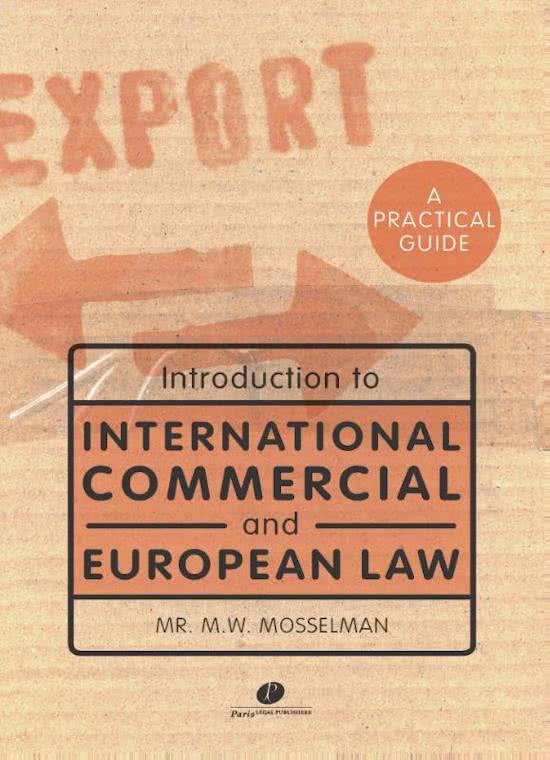
This summaries contains chapter of the studybook International and European Law, for the module Law II during the 2nd year of International Business at the Hogeschool van Amsterdam.

Content preview

Summary Commercial Law
International Business


YEAR 2

, TABLE OF CONTENTS
TABLE OF CONTENTS...................................................................................................................................... 1

CHAPTER 1 INTRODUCTION........................................................................................................2

CHAPTER 6 GENERAL CONDITIONS OF SALE.............................................................................8

Chapter 8 The international sale of goods...............................................................................9

Chapter 10 Incoterms................................................................................................................................................12
Chapter 11 Contract of carriage...........................................................................................................................14
Chapter 12 Jurisdiction and Arbitration...........................................................................................................18
Chapter 13 Applicable Law..........................................................................................................................23
Chapter 15 Payment Conditions.............................................................................................................30


1

, Chapter 1 Introduction

Individual / international contract agreements:
The success or failure of an individual contract is determined by:
 The terms of the agreement
 Economic changes
 Geopolitical changes
 Environmental changes
 Societal changes
 Technological changes

European law:
The main goal of the European law is to ensure fair competition between companies on the
European market and prevent abuse of a dominant market position.
Aswell as price – fixing agreements between companies. The European law also has an
impact on how companies in Europe operate the free movement of goods, persons, services,
and capital.

Global risks are:
 Economic risks; income disparity, chronic fiscal imbalance, major systematic financial
failure
 Geopolitical risks
 Environmental risks; Climate change, raising greenhouse gas emissions and extreme
weather events.
 Societal risks
 Technological risks.

Risks in international trade:
 Political risks
 Foreign policy risks
 Domestic policy risks.

Political risks:
 Foreign policy: war, embargo, restrictions in trade.
 Domestic policy: revolt, civil war, piracy, terrorism.
 Economic policy: introduction capital controls, nationalization.

*See table 1.3 on page 9 textbook*

Border measures are import measures such as:
 Specific duty increases
 Reference import values
 Minimum import price setting
 Burdensome licensing
 Special border fees
 Tariff quotas
 Import and export bans.


2

, Behind the border measures are part of long – term policies aiming at boosting domestic
industries, which is done by giving:
 State aid
 Tax advantages
 Local content rules
 Governmental preference to national companies.

State aid:
State aid to individual companies or sectors in the economy makes it difficult for foreign
competitors to compete with their products.

Competitive devaluation:
When a country decides to print more money, but more money devaluates the currency
compared to other currencies. This makes it cheaper for foreigners to buy products that are
from the devaluating country. Competitive devaluation can cause:
 A currency war
 High inflation in the country printing money.

Consumption subsidy:
When non – subsidized products become more expensive relative to the subsidized product.

Export subsidy:
When a country subsidizes a product that is being exported, competitors in the importing
country will experience a disadvantage: Their prices will be higher.

Export taxes or restriction:
Reasons why governments aim to control the export of goods:
 Restrictions on the sale of technology or weapons to other countries to protect national
security.
 Preservation of natural resources.
 To encourage the supply of raw to local industries.

Import ban:
Import bans are used by governments seeking to protect existing domestic industries and
reduce the country’s dependence on imports. An import ban is an advantage for domestic
producers as they can sell their products more easily and against higher prices.
However, an import ban can also be used for the protection of the health of the population and
the environment.

Investment measures:
Investment measures prohibit foreigners from investing in certain industries or owning certain
industries. Also, there are countries that nationalize companies – this mostly happens if a
company has some great losses – and this is meant to protect domestic industries.
However, nationalization is not very appealing for foreign investors because they might lose
their money when a domestic company is or will be nationalized.

Local content requirement:
A measure that constrains foreign companies in local content requirements.
For example when a country demands by law that companies only use (for a certain
percentage of the time) the native language in advertisements, instead of a foreign language

3

Connected book
 image
Publisher: april 2015 ISBN: 9789462510654 Edition: 1

Document information

Study
Summarized whole book?
No
Which chapters are summarized?
1,6, ,8, ,10, 11, 12, 13, 15
Uploaded on
July 31, 2023
File latest updated on
July 31, 2023
Number of pages
33
Written in
2018/2019
Type
Summary
$13.13

Wrong document? Swap it for free Within 14 days of purchase and before downloading, you can choose a different document. You can simply spend the amount again.
Written by students who passed
Immediately available after payment
Read online or as PDF

Seller avatar
Reputation scores are based on the amount of documents a seller has sold for a fee and the reviews they have received for those documents. There are three levels: Bronze, Silver and Gold. The better the reputation, the more your can rely on the quality of the sellers work.
swkalaykhan
4.0
(3)
Sold
16
Followers
9
Items
0
Last sold
1 year ago


Why students choose Stuvia

Created by fellow students, verified by reviews

Quality you can trust: written by students who passed their tests and reviewed by others who've used these notes.

Didn't get what you expected? Choose another document

No worries! You can instantly pick a different document that better fits what you're looking for.

Pay as you like, start learning right away

No subscription, no commitments. Pay the way you're used to via credit card and download your PDF document instantly.

Student with book image

“Bought, downloaded, and aced it. It really can be that simple.”

Alisha Student

Working on your references?

Create accurate citations in APA, MLA and Harvard with our free citation generator.

Working on your references?

Frequently asked questions