2 C Chiamaka Udoye
What is a nucleotide?
An organic molecule known as nucleotide severs as the fundamental unit of DNA
and RNA. If DNA is considered the unit of life, then a nucleotide can be
considered the component (bolding block) of DNA. These nucleotide forms
together to form to create nucleic acid which gives living thing their hereditary
traits. All living thing have a genetic material which is made up of a chain of
nucleotides.
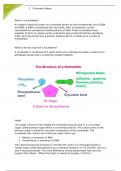
What is the structure of a nucleotide?
A nucleotide is composed of 3 parts which are a nitrogenous base,a sugar and a
phosphate group that is covalently bonded together
sugar
the sugar is found in the middle of nucleotide structure and it is a 5-carbon
sugar called pentose sugar which is a monosaccharide. The carbon atom of the
pentose sugar is jointed to the other component of the nucleotide. The
nucleotide will contain one of the two sugar which are;
Ribose, a monomer of RNA
Deoxyribose, a monomer of DNA
The chemical formula of ribose is “C5 H10 O5” and it is a monosaccharide (a
simple sugar) while deoxyribose has a chemical formular of “C5 H10 O4” and it is
also a monosaccharide. The main difference is that deoxyribose has one less
oxygen than ribose. When the sugar is expose to oxygen, it forms a
,2 C Chiamaka Udoye
phosphodiester bond with the phosphate group which creates a sugar-phosphate
chain that gives structure and rigidity to the polynucleotides such as DNA and
RNA. Sugar also forms a glycoside bond with the nitrogenous bases
Phosphate group
Phosphate group is simple one phosphorus ion boned to 4 oxygen atom which all
carry an -3 charge. The phosphate group forms a phosphodiester bond with
pentose sugar which create a sugar-phosphorus chain that gives structure and
rigidity to the polynucleotides. There are 3 types of phosphate groups which are
Monophosphate, it has 1 phosphate group
Diphosphate, it has 2 phosphate group
Triphosphate, it has 3 phosphate group
Nitrogenous base
Nitrogenous bases, also referred to as nucleobases, are compound which contain
nitrogen that acts as a base. There are component in the nucleotide that is used
to create nucleic acid. Based on how they are structured, they can be separated
into 2 groups;
Purines
Pyrimidines
Purines: purines are compound with 2 rings consisting of carbon and nitrogen
atoms. the structure of the bigger ring is hexagonal whereas the smaller ring is
pentagonal. The nucleotide contains 2 purine which are;
Adenine
guanine
Pyrimidines: pyrimidines have a sole hexagonal shaped ring that is composed of
carbon and nitrogen atom. The nucleotide contains 3 pyrimidines which are;
cytosine
thymine
uracil
.
, 2 C Chiamaka Udoye
What is DNA
DNA, also referred to as deoxyribonucleic acid, is a genetic material found in all
living thing. One molecule of DNA is made up millions of smaller units called
nucleotides. DNA comprises of instruction required for an organism to grow,
endure and reproduce. In order to carry out such function, the gene (DNA
sequence) codes a message for a protein and those coded protein is used to
perform the majority of the work in the body.
What is the structure of DNA?
DNA usually exist as a double polynucleotide strand in a twisted double helix
shape with the sugar- phosphate backbone running antiparallel to each other.
Each DNA strand is made of nucleotides that are joined together by alternating
deoxyribose sugar and phosphate group through a phosphodiester bond to form
the sugar phosphate backbone. The pentose sugar bind with the complimentary
base pair through a glycosidic bond. The 2 DNA polynucleotide strand are
bonded together in a hydrogen bond by complementary nitrogenous base pairs.
The complementary base pairs are;
purine adenine (A) paired with pyrimidine thymine (T) with 2 hydrogen
bonds between them
purine guanine (G) always paired with pyrimidine cytosine(C) with 3
hydrogen bonds between them
What is a nucleotide?
An organic molecule known as nucleotide severs as the fundamental unit of DNA
and RNA. If DNA is considered the unit of life, then a nucleotide can be
considered the component (bolding block) of DNA. These nucleotide forms
together to form to create nucleic acid which gives living thing their hereditary
traits. All living thing have a genetic material which is made up of a chain of
nucleotides.
What is the structure of a nucleotide?
A nucleotide is composed of 3 parts which are a nitrogenous base,a sugar and a
phosphate group that is covalently bonded together
sugar
the sugar is found in the middle of nucleotide structure and it is a 5-carbon
sugar called pentose sugar which is a monosaccharide. The carbon atom of the
pentose sugar is jointed to the other component of the nucleotide. The
nucleotide will contain one of the two sugar which are;
Ribose, a monomer of RNA
Deoxyribose, a monomer of DNA
The chemical formula of ribose is “C5 H10 O5” and it is a monosaccharide (a
simple sugar) while deoxyribose has a chemical formular of “C5 H10 O4” and it is
also a monosaccharide. The main difference is that deoxyribose has one less
oxygen than ribose. When the sugar is expose to oxygen, it forms a
,2 C Chiamaka Udoye
phosphodiester bond with the phosphate group which creates a sugar-phosphate
chain that gives structure and rigidity to the polynucleotides such as DNA and
RNA. Sugar also forms a glycoside bond with the nitrogenous bases
Phosphate group
Phosphate group is simple one phosphorus ion boned to 4 oxygen atom which all
carry an -3 charge. The phosphate group forms a phosphodiester bond with
pentose sugar which create a sugar-phosphorus chain that gives structure and
rigidity to the polynucleotides. There are 3 types of phosphate groups which are
Monophosphate, it has 1 phosphate group
Diphosphate, it has 2 phosphate group
Triphosphate, it has 3 phosphate group
Nitrogenous base
Nitrogenous bases, also referred to as nucleobases, are compound which contain
nitrogen that acts as a base. There are component in the nucleotide that is used
to create nucleic acid. Based on how they are structured, they can be separated
into 2 groups;
Purines
Pyrimidines
Purines: purines are compound with 2 rings consisting of carbon and nitrogen
atoms. the structure of the bigger ring is hexagonal whereas the smaller ring is
pentagonal. The nucleotide contains 2 purine which are;
Adenine
guanine
Pyrimidines: pyrimidines have a sole hexagonal shaped ring that is composed of
carbon and nitrogen atom. The nucleotide contains 3 pyrimidines which are;
cytosine
thymine
uracil
.
, 2 C Chiamaka Udoye
What is DNA
DNA, also referred to as deoxyribonucleic acid, is a genetic material found in all
living thing. One molecule of DNA is made up millions of smaller units called
nucleotides. DNA comprises of instruction required for an organism to grow,
endure and reproduce. In order to carry out such function, the gene (DNA
sequence) codes a message for a protein and those coded protein is used to
perform the majority of the work in the body.
What is the structure of DNA?
DNA usually exist as a double polynucleotide strand in a twisted double helix
shape with the sugar- phosphate backbone running antiparallel to each other.
Each DNA strand is made of nucleotides that are joined together by alternating
deoxyribose sugar and phosphate group through a phosphodiester bond to form
the sugar phosphate backbone. The pentose sugar bind with the complimentary
base pair through a glycosidic bond. The 2 DNA polynucleotide strand are
bonded together in a hydrogen bond by complementary nitrogenous base pairs.
The complementary base pairs are;
purine adenine (A) paired with pyrimidine thymine (T) with 2 hydrogen
bonds between them
purine guanine (G) always paired with pyrimidine cytosine(C) with 3
hydrogen bonds between them